

Did you know the average Australian business currently reinvests 7.2% of its total revenue back into its growth? Finding the right average marketing spend for a trade business is often the difference between staying stagnant and dominating your local area. Most tradies we talk to feel like marketing is a black hole for their hard-earned cash, leaving them uncertain if they’re overspending on ads that don’t work or underspending while competitors snatch up all the profitable jobs.
You deserve a strategy that moves beyond unreliable word-of-mouth and “spray and pray” tactics. This guide reveals the 2026 benchmarks to help you stop guessing and start investing with the confidence that your budget will actually generate high-quality leads. We’ll give you clear figures to aim for so you can scale your business without wasting a single cent on fluff that doesn’t move the needle.
We’ll break down specific percentage targets based on whether you’re maintaining your current size or chasing aggressive growth, and show you how to turn a high-converting website into a predictable lead machine. It’s time to stop treating marketing as an overhead and start treating it as the engine that drives your commercial success.
Key Takeaways
- Discover why the average marketing spend for a trade business in 2026 sits between 5% and 12% of gross revenue and where your business fits in that range.
- Learn how to balance high-intent lead generation using Google Ads with long-term brand building through SEO to keep your phone ringing year-round.
- Master a simple four-step framework to calculate an exact dollar figure for your marketing budget based on your specific revenue goals and profit margins.
- Identify the common “spray and pray” traps that drain tradie budgets and how to transition to a performance-first model that tracks every dollar of ROI.
- Understand why a high-converting website is the essential foundation for any marketing spend, ensuring you don’t waste money sending traffic to a leaky bucket.
Why Setting a Marketing Budget is the Biggest Hurdle for Australian Tradies
Many Australian trade business owners treat marketing like a gamble. They throw a few hundred dollars at a Facebook post or print some fridge magnets and hope for the best. This “spray and pray” approach is why so many feel that marketing is a black hole for cash. Without a clear strategy for developing a marketing plan, you’re essentially flying blind. You wouldn’t quote a major renovation without checking material costs, so you shouldn’t spend a cent on advertising without knowing your numbers.
Understanding the average marketing spend for a trade business starts with defining your goals. Are you happy with your current workload, or do you want to add three more vans to the fleet? A maintenance spend generally keeps your brand visible to existing customers and replaces natural churn. A growth spend is more aggressive, designed to capture new market share and outpace local competitors who are already bidding for the same high-value leads.
Relying solely on word-of-mouth is a dangerous game in 2026. While referrals are high-quality, they aren’t predictable. If your best referral source moves interstate or retires, your lead flow dies with them. Digital marketing provides the “tap” you can turn up or down based on your capacity, ensuring long-term stability rather than just lucky breaks.
The Problem with Random Acts of Marketing
Boosting a random post or dropping flyers in letterboxes might feel productive, but it rarely results in a consistent lead flow. These random acts lack a centralised strategy to track where your money actually goes. When you don’t track the source of every phone call, you can’t tell which channel is profitable. This inconsistency leads to the feast or famine cycle, where you’re either drowning in work you can’t handle or sitting by a silent phone. A structured average marketing spend for a trade business ensures that every dollar is focused on generating measurable results rather than just making noise.
Shifting Your Mindset from Cost to Investment
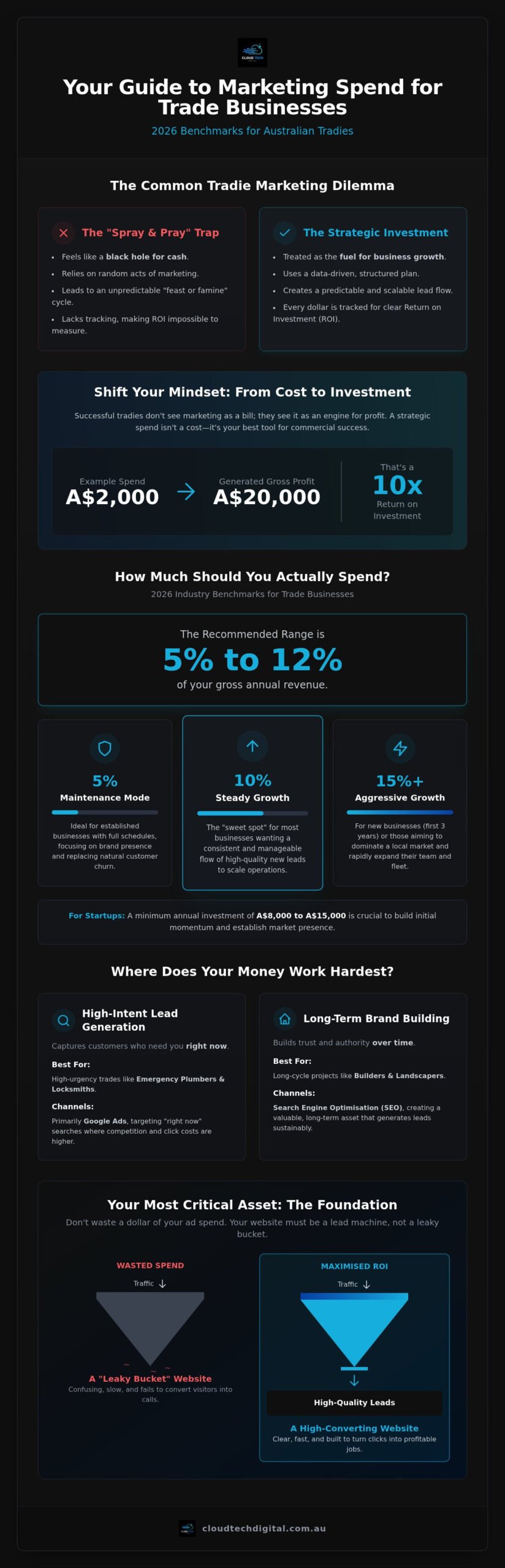
The most successful tradies in Australia don’t see marketing as a monthly bill; they see it as the fuel for their business ute. If you don’t put petrol in the tank, you aren’t going anywhere. Thinking about your budget as an investment allows you to focus on Return on Investment (ROI). If you spend A$2,000 and it generates A$20,000 in gross profit, that isn’t a cost. It’s a high-performance engine for your commercial success. Reliability and transparency in your tracking are what turn that marketing black hole into a predictable lead machine.
The 2026 Industry Benchmarks: How Much Should You Actually Spend?
Setting a budget shouldn’t be a guessing game. According to The 2026 Industry Benchmarks, most small businesses allocate a significant portion of their revenue to fuel growth. In fact, current data from the Australian Bureau of Statistics shows that the average Australian business spends approximately 7.2% of its revenue on marketing. For the trades, the average marketing spend for a trade business typically ranges from 5% to 12% of gross annual revenue. This range allows for flexibility based on your specific commercial goals.
- The 5% Rule: This is for established businesses. If your schedule is full and you just want to maintain your current brand awareness and replace natural customer churn, 5% is your baseline.
- The 10% Rule: This is the “sweet spot”. If you want steady, manageable growth, investing 10% of your revenue ensures a consistent flow of fresh leads.
- Aggressive Growth (15%+): This is for those looking to dominate or for new businesses in their first three years. Recent research suggests a minimum annual investment of A$8,000 to A$15,000 is necessary for startups to build initial momentum and market presence.
Benchmark by Trade: Plumbers vs. Builders
Your specific trade changes the math. High-urgency trades like emergency plumbing or locksmithing often require a higher percentage. These jobs rely on “right now” searches on Google, where competition is fierce and cost-per-click is higher. Conversely, builders or landscapers dealing with long-cycle projects like home renovations focus on building trust over months. Your service area and local competition level also dictate if you need to lean toward the higher end of the average marketing spend for a trade business to stay visible in a crowded market.
Fixed Costs vs. Variable Ad Spend
Transparency is non-negotiable. You must distinguish between your fixed costs, such as management fees for a lead generation agency in Australia, and your variable ad spend. Your ad spend is the money that goes directly to platforms like Google or Facebook to buy clicks. Never accept a single, opaque figure that bundles these together. You need to know exactly how much of your budget is actually “working” in the market versus what is paying for expertise and strategy. This clarity ensures every dollar is accountable for results and allows you to scale your variable spend as your lead quality improves.
Lead Gen vs. Brand Awareness: Where Does Your Money Work Hardest?
Knowing the average marketing spend for a trade business is only half the battle. The real trick is knowing where to park that cash so it actually returns a profit. We generally recommend the 70/30 split for most Australian tradies. This means 70% of your budget goes toward direct response lead generation, while the remaining 30% focuses on long-term brand building and SEO. When Calculating Your Ideal Spend, this ratio ensures you have enough immediate work to pay the bills while building a reputation that makes future sales easier. It stops you from being over-reliant on any single channel, which is critical for long-term survival.
Your website is the engine room of this entire operation. Whether a lead comes from a Google Ad, an organic search, or a Facebook post, they’ll almost always land on your site before picking up the phone. If your site is slow, outdated, or hard to use on a mobile, you’re effectively burning your marketing budget. A high-converting website makes every other dollar you spend more efficient by turning a higher percentage of visitors into actual quotes. It’s the foundation that supports both your short-term ads and your long-term organic growth.
The Power of Google Ads for Immediate Jobs
Emergency jobs require immediate visibility. Google Ads for plumbers Australia is the fastest way to get your business in front of someone whose hot water system just burst. By targeting “high-intent” keywords like “emergency pipe repair near me”, you reach people who are ready to book a tradie right now. These clicks cost more because the competition is high, but they convert at a much higher rate than generic searches. To stay in control, always set a strict daily limit. This prevents you from blowing your entire monthly budget in the first week and ensures your ads remain visible throughout the entire month.
Investing in SEO for Long-Term Lead Flow
While ads provide the “instant heat”, SEO for tradies is the slow burn that builds real wealth. Organic rankings are the most valuable real estate for an Australian trade business because you don’t pay for every click. Over time, a strong SEO strategy reduces your overall cost per lead, making your average marketing spend for a trade business far more effective. It’s about finding the balance between paying for leads today and owning the search results tomorrow. If you stop paying for ads, the leads stop. If you invest in SEO, the leads keep coming even when you aren’t actively spending on PPC.
Calculating Your Ideal Spend: A Simple 4-Step Framework
While the average marketing spend for a trade business gives you a solid ballpark, your specific numbers should be driven by your own commercial targets. You don’t need a degree in finance to work this out. By reverse-engineering your revenue goals, you can find the exact dollar figure required to keep your team busy and your profit margins healthy. This framework stops you from overspending on low-value traffic and ensures every dollar has a job to do.
- Step 1: Define your revenue goal. Decide exactly how much gross revenue you want to pull in over the next 12 months. Be specific.
- Step 2: Determine your average job value. Look at your books from the last year. Divide your total revenue by the number of jobs completed to find your average ticket price.
- Step 3: Calculate required leads. If you need A$500,000 in new work and your average job is A$5,000, you need 100 jobs. If your team closes one in every four enquiries, you need 400 leads to hit that target.
- Step 4: Multiply by industry CPL. Take that lead target and multiply it by the typical Cost Per Lead in your specific trade to find your total required spend.
Understanding Your “Cost Per Lead” (CPL)
Your Cost Per Lead is the total marketing spend divided by the number of enquiries received. In 2026, a “good” CPL for Australian tradies varies significantly. Emergency services like plumbing often see higher costs due to intense competition on Google Ads, while maintenance services might enjoy lower rates. You can lower your CPL by improving your website’s conversion rate. If your site turns 10% of visitors into callers instead of 5%, you’ve effectively halved your lead cost without spending an extra cent on ads. If you want to stop guessing and get a high-performance lead generation strategy, focusing on this metric is the fastest way to improve your ROI.
Factoring in the Lifetime Value (LTV) of a Customer
Don’t get tunnel vision on the initial cost of a lead. A A$50 lead might seem expensive at first, but it is a massive bargain if it results in a A$5,000 bathroom renovation or a repeat maintenance contract that lasts for years. This is the Lifetime Value of a customer. You should adjust your spend based on which services are your true “money makers”. Organising your budget to prioritise high-margin jobs over low-profit “tyre kickers” ensures your marketing spend actually builds wealth rather than just keeping you busy with break-even work. Focus your highest bids on the services that offer the best long-term return for your business.
Maximising Your ROI with Cloud Tech Digital’s Performance-First Approach
Once you’ve determined the average marketing spend for a trade business that fits your specific goals, the next challenge is execution. At Cloud Tech Digital, we don’t believe in “set and forget” campaigns. We eliminate waste by focusing exclusively on the channels that drive genuine phone calls and form fills. If a keyword or ad isn’t resulting in a lead, we cut it. This performance-first approach ensures that your budget isn’t eaten up by vanity metrics like “impressions” or “reach” that don’t put money in your bank account.
We prioritise marketing for tradies that delivers measurable sales increases. This involves organising a multi-channel strategy, combining SEO, PPC, and high-performance web design, that fits your specific business size. Whether you’re a solo operator or managing a national fleet, your strategy needs to be scalable and responsive to market changes. Transparent reporting is the backbone of our partnership; you’ll always know exactly what every dollar of your spend achieved and which jobs were the most profitable.
No-BS Marketing for the Australian Trade Industry
We avoid corporate jargon and fluff. Our team consists of straight-shooters who understand that you care about booked jobs and bottom-line growth. We use tailored landing pages to ensure your ad spend isn’t wasted on a generic homepage that fails to convert. By partnering with an agency that understands the Australian trade landscape, you gain a dedicated ally invested in your commercial success. We know the difference between a high-margin emergency call-out and a low-value enquiry, and we optimise your spend to capture the work that actually builds your wealth.
Ready to Stop Guessing and Start Growing?
If you’re unsure where your current budget is going, a professional audit can reveal exactly where your cash is leaking. We look at your current average marketing spend for a trade business and identify the gaps in your lead generation engine. Transitioning from unreliable word-of-mouth to a predictable lead machine is the first step toward long-term stability and growth. You can get a free strategy session with Cloud Tech Digital today to see how we can turn your marketing budget into a high-performance growth engine that works as hard as you do.
Take Command of Your Commercial Growth
Marketing isn’t a monthly bill you pay just to keep appearances; it’s the engine that drives your commercial success. By understanding that the average marketing spend for a trade business in 2026 sits between 5% and 12% of revenue, you can stop guessing and start investing with precision. Whether you’re aiming for steady maintenance or aggressive expansion, the key is reverse-engineering your revenue goals to find your ideal budget and sticking to a performance-first strategy that prioritises profit over vanity metrics.
Cloud Tech Digital specialises in high-performance lead generation for Australian tradies. We provide measurable ROI with transparent performance tracking and refuse to hide behind long-term lock-in contracts that don’t deliver. We’re here to help you move beyond the uncertainty of word-of-mouth and build a predictable lead machine that works as hard as your team does on-site. Book Your Free Lead Generation Audit Today and let’s get your phone ringing with the high-margin jobs you actually want. Your growth is within reach; you just need the right framework to grab it.
Frequently Asked Questions
Is 5% of my revenue enough for a marketing budget?
For many established businesses, 5% is the standard for maintaining your current market share and replacing natural customer churn. It keeps your brand visible but rarely provides enough fuel for aggressive expansion. If your goal is to add new vans or dominate a new suburb, you’ll need to look closer to the 10% or 12% mark to see real growth.
Should I spend more on Google Ads or Facebook Ads as a tradie?
Google Ads should usually take the lion’s share of your budget if you offer emergency services like plumbing or electrical. These users have high intent and need a tradie immediately. Facebook Ads are better suited for visual trades like landscaping or kitchen renovations, where you can inspire homeowners over a longer period before they are ready to book a quote.
What is the average cost per lead for a trade business in Australia?
Cost per lead varies wildly depending on your specific trade and location. An emergency plumbing lead in a major metro area will cost significantly more than a general maintenance enquiry in a regional town. The key is ensuring your CPL allows for a healthy profit margin after you factor in your close rate and typical job expenses.
How long does it take to see a return on my marketing spend?
You can see results from paid channels like Google Ads within 24 to 48 hours of a campaign going live. This provides the instant heat your business might need today. However, long-term strategies like SEO typically take three to six months to build momentum. A balanced average marketing spend for a trade business uses both to ensure short-term cash flow and long-term stability.
Can I do my own marketing to save money, or should I hire an agency?
You can manage your own social media or basic ads, but it often becomes a hidden cost in lost billable hours. Professional agencies have access to advanced tracking tools and industry data that prevent budget wastage. Most tradies find that the time they save and the higher lead quality an agency delivers far outweigh the management fees.
What happens if I stop spending on marketing during a busy period?
Stopping your marketing entirely creates a feast or famine cycle. Even when you are flat out, maintaining a baseline spend ensures your pipeline remains full for two or three months down the track. Instead of turning the tap off, we recommend scaling back your ad spend slightly while keeping your organic efforts consistent to avoid a quiet phone later.
How do I know if my marketing agency is actually delivering results?
Look for transparent reporting that tracks genuine phone calls and form fills, not just clicks or impressions. A good agency should be able to show you exactly how many enquiries were generated from your average marketing spend for a trade business. If they are hiding behind technical metrics without showing real-world leads, it is time to ask tougher questions.
Does my website affect how much I need to spend on advertising?
Your website is the most critical factor in your overall ad efficiency. If your site is slow or hard to navigate on a mobile, you will need to spend twice as much on ads to get the same number of leads as a competitor with a high-converting site. Investing in professional web design often pays for itself by lowering your long-term customer acquisition costs.
