


A polished project photo might earn a glance; clear proof of how you solved a real building challenge can earn a prospective client’s trust. If you’re unsure what to publish or how to fit marketing around a busy schedule, start with the questions clients already ask. Effective content marketing for builders isn’t about posting for the sake of it. It’s about showing the right clients what you do well and helping them understand your work before they get in touch.
This guide will help you build a practical content plan around the projects and clients you want. You’ll learn how to turn project experience, common client questions and useful advice into content that demonstrates your expertise, supports online visibility and gives people a clearer reason to enquire.
We’ll cover what to create, how to reuse each piece across your website and social channels, and how to assess whether it’s attracting relevant enquiries. You’ll also see how SEO, paid promotion and focused landing pages can support useful content, so your marketing has a clear purpose and you can improve it over time.
Key Takeaways
- Shape your plan around the building projects you want, the clients you want to reach and the questions they need answered.
- Use educational articles, case studies, FAQs and short-form video for different purposes, choosing formats that suit your time and available proof.
- Make content marketing for builders manageable with a simple plan that assigns an audience question, asset, channel, owner, next step and review date.
- Publish at a pace you can sustain, then review performance and refine your approach rather than chasing an arbitrary posting schedule.
- Guide prospective clients from a useful answer to relevant project proof and a next step that matches their readiness to enquire.
Content marketing for builders: what it is and why it matters
A building project is a major commitment. Before making an enquiry, prospective clients may want to understand the process, the decisions they’ll face and whether a builder has experience relevant to their plans. Helpful information gives them a clearer basis for deciding what to do next.
Content marketing is the practice of creating and sharing useful information for a specific audience. For builders, that means explaining projects, processes and decisions in ways prospective clients can understand, rather than relying only on promotional claims. Builder content marketing uses relevant information to help prospective clients understand their options and assess a building business’s experience, without promising a particular result.
A sales post can announce a service or encourage someone to get in touch. That has its place, but it isn’t the same as answering a client’s question. Nor is a stream of unconnected updates a plan. Give each piece a purpose and help readers move from an initial question to researching projects, shortlisting builders and deciding whether to enquire.
What content marketing looks like for a building business
Choose a format that suits the question and the reader’s stage of decision-making. A project explanation can describe the brief and key choices; a process guide can outline what happens from early discussions through to delivery. FAQs address practical queries, case studies show how a project unfolded, and a short video can make a construction detail easier to see.
Keep every piece accurate, relevant and easy to follow. Explain unfamiliar terms in plain language, stick to details specific to the project, and say what the example does and doesn’t demonstrate. You don’t need to publish everywhere or produce content for its own sake. Give prospective clients a useful next piece of information.
Why prospective building clients look for proof
Clients are weighing up more than the finished result. Clear information about your process can help them understand how you discuss scope, approach timing and communicate. It won’t remove every uncertainty, but it can make expectations easier to understand before a conversation begins.
Project examples make experience more tangible. Rather than simply stating that workmanship is a strength, a case study can show the project context, decisions made and completed details. Photos or video add visual evidence, while a written explanation provides details images can’t. Together, they give prospective clients useful material to consider as they research and compare options.
Content is one part of a client’s decision, alongside project requirements, conversations and other considerations. A practical content marketing for builders approach makes that research more informative, helping the right people see how your experience may relate to their plans before they enquire.
Build a content strategy around your ideal building projects
A useful content plan starts with your business priorities, not a guess about what might get attention. Decide which projects you want more of, what makes them a good fit and what you need your marketing to support. Consider project scope, the skills and capacity involved, and whether the work aligns with your business goals. This gives each topic a defined audience and purpose.
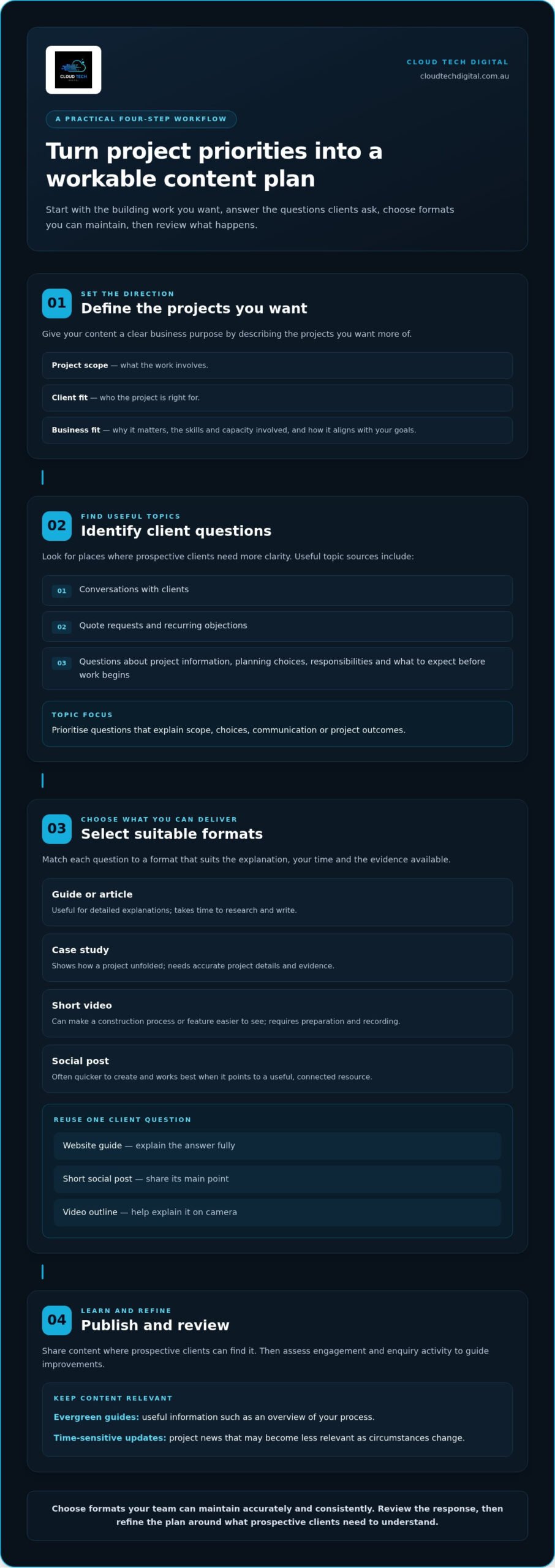
Use this workflow to turn those priorities into a workable plan:
- Define the projects you want. Describe their scope, the client fit and why they matter to your business.
- Identify client questions. Review conversations, quote requests and recurring objections to find where people need clarity.
- Select suitable formats. Match each question to a guide, case study, video or social post you can produce accurately.
- Publish and review. Share the content where prospective clients can find it, then assess engagement and enquiry activity to guide improvements.
Choose topics from client questions and project decisions
Listen for questions at different stages. Before a quote, clients may ask what information you need to understand a project. During planning, they may want to compare options or clarify responsibilities. Before work begins, they may ask what to expect from the process. Prioritise topics that explain scope, choices, communication or project outcomes. Keep evergreen guides, such as an overview of your process, separate from time-sensitive project updates that may become less relevant as circumstances change.
One recurring question can become several useful assets. A detailed website guide can explain the answer fully, a short social post can share its main point, and a concise video outline can help you explain it on camera. The Contractors Guide to Using Social Media offers construction-specific context for planning social activity as part of that mix.
Match formats to your time and capabilities
Articles suit detailed explanations and take time to research and write. Case studies need accurate project details and evidence, while short videos can show a process or feature but require preparation and recording. Social posts are often quicker to create, though they work best when they point to a useful, connected resource. Start with formats your team can maintain consistently and accurately.
Content marketing for builders works best when your website, search visibility and promotion support one another. Cloud Tech Digital can connect website content with SEO and campaign activity, helping organise content around business priorities. Explore Cloud Tech Digital’s digital marketing support as you shape your approach.
Compare builder content formats by purpose, effort and proof
The best format depends on the question a client needs answered, the evidence you can share and the time your team can commit. A detailed article may suit someone researching a process, while a case study can help a prospective client assess relevant experience. You don’t need to publish everywhere. Choose a manageable mix that answers real questions and supports the next step in a client’s research.
| Format | Best use | Effort | Client question it answers |
|---|---|---|---|
| Educational article | Explain a recurring topic and support discovery through search | Medium to high, depending on research and detail | “What should I understand before making this decision?” |
| Project case study | Show project context, decisions, process and outcome | Medium to high, with accurate details and client approval | “Have you handled a project with relevant challenges?” |
| Frequently asked questions | Answer common queries clearly on a website or service page | Low to medium, with care taken to keep answers accurate | “What happens next, and what do I need to know?” |
| Short-form video | Explain one process, answer one question or introduce a project detail | Medium, including planning, recording and editing | “Can I see or hear how this works?” |
When to use articles, case studies and project pages
Use educational articles for recurring questions that need a considered explanation. They can help prospective clients discover your business while researching a topic. Case studies provide a different kind of proof: outline the brief, decisions, process and outcome, and share identifying project details only with client approval.
Project pages can bring related examples together, making it easier for visitors to explore work that matches their interests. Give each page a clear next step, such as reading a relevant case study or making an enquiry. Together, these formats support different stages of research without asking one page to do everything.
How video and social posts extend useful content
A short video can focus on one practical point, such as explaining a stage of the process or showing a project detail. Adapt the key idea for social posts with a fresh introduction and a link to the fuller resource, rather than copying an article word for word.
Comments, views and shares can indicate interest, but they don’t prove that a post generated a qualified enquiry. Track engagement alongside website visits and enquiry activity to understand how content performs. A considered mix is more useful than a presence on every channel. That’s the practical approach to content marketing for builders: choose formats you can maintain, match them to client questions and measure whether they’re helping people take a relevant next step.
Create a builder content plan you can publish and measure
A plan only works if your team can keep it moving. Use a simple template to turn each client question into a clear publishing task:
- Audience question: What does a prospective client need to understand?
- Content asset: Will you create an article, case study, FAQ or video?
- Channel: Where will it live, and how will people find it?
- Owner: Who will research, draft, review and publish it?
- Next step: What useful action should a reader take?
- Review date: When will you check whether it’s still accurate and effective?
Set a publishing rhythm around the time and expertise you actually have. One well-researched, accurate resource that stays useful is better than a rushed stream of posts your team can’t sustain. Measure whether content supports meaningful business actions, not just how many views it receives.
Build a repeatable workflow without overloading the team
Make responsibilities clear. The person closest to the work can supply project knowledge; another team member can shape the draft, check details and manage publishing. Before anything goes live, confirm client permissions, project information and approval for any images or identifying details.
Reuse knowledge thoughtfully. A project can inform a case study, a related article and several social posts, provided each version suits its channel and audience. This reduces duplicated effort without repeating the same copy everywhere.
Review results and improve the next content cycle
Measure each piece against its intended purpose. For an educational article, review relevant search visibility and engaged visits. For a project page, look at visits to related pages and whether readers take the intended next step. Track enquiries and lead quality too: are people asking about projects that fit your business?
Use Google Search Console and Google Analytics 4 where they’re configured and available. Compare performance over time, then decide whether to update, promote or create a stronger follow-up resource. Keep your interpretation grounded: content can support discovery and evaluation, but pricing, follow-up and project suitability also influence whether an enquiry becomes work.
For more detail on organic search, read this SEO guide for tradies. Cloud Tech Digital can connect content planning with SEO, campaign activity and website improvements. Explore digital marketing support for builders.
Turn builder content into a connected path to enquiry
Useful content works harder when it gives prospective clients a clear route forward. A simple journey might start with someone finding an answer through search or a social post, then exploring a relevant project example, visiting a page about the work they’re considering and deciding whether to enquire. Make each step useful and relevant, rather than sending readers through a maze of unrelated updates.
Match the call to action to the reader’s readiness. Someone researching a process may benefit from a related guide or project page; someone comparing builders may be ready to discuss their plans. You don’t need to interrupt every section with a hard sell. Make the next step clear, relevant and easy to find.
Connect content with your website and campaigns
Give each article, case study or video a useful destination. An article can link to a related project example, while a project page can direct interested readers to an enquiry form. Check that the destination answers the question raised by the original content and makes the next step obvious. For practical advice on how your site can support enquiries, read this web design guide for tradies.
SEO can help relevant website content appear in organic search over time. Paid promotion, including search and social advertising, can put selected content in front of relevant audiences while organic visibility develops. Promote with purpose: direct people to a page that continues the same conversation, rather than boosting a post without a clear destination.
These channels can support one another. Website content gives campaigns a helpful resource to point to, and campaign activity can bring that resource to an audience that may not have found it yet. Review which content attracts relevant visits and whether people continue to useful project information or take an enquiry step.
Choose a focused next step for your business
Start by reviewing your existing website content. Choose one priority project type, note a question prospective clients commonly ask about it, then identify your strongest proof point, such as a relevant project example or a clear explanation of your process. Look for one useful improvement: update an unclear page, add a missing answer or connect an article to a relevant project example.
For the wider picture, explore this 2026 marketing guide for tradies. A connected approach to content marketing for builders brings together useful website content, SEO and paid advertising, with each channel supporting a clear business purpose. Cloud Tech Digital can connect SEO, advertising and website services as part of a practical growth strategy. Explore Cloud Tech Digital’s marketing support.
Turn useful content into a stronger next step
Good content marketing for builders starts with the projects you want and the questions prospective clients need answered. Choose formats that suit your time and evidence, then connect each piece to a relevant page and a clear next step. Keep your plan manageable and review whether it’s attracting useful visits, relevant enquiries and better-fit opportunities.
Content won’t decide every project on its own, but it can help people understand your experience before they get in touch. SEO, paid advertising, social media advertising, website design and landing pages can work together to make useful content easier to find and act on. Cloud Tech Digital is an Australian-owned and operated agency that has supported trade businesses since 2020. Client testimonials report measurable sales increases and rapid lead turnover, but results vary and no single approach suits every business.
Start small: choose one priority project, one client question and one piece of proof, then improve the page that brings them together. For support connecting your content with digital marketing, explore practical digital marketing support for your building business. A clear, consistent approach can help you build trust one useful answer at a time.
Frequently Asked Questions
What is content marketing for builders?
Content marketing for builders means creating useful information that helps prospective clients understand building decisions and assess your experience. It can include project case studies, process guides, articles, FAQs and short videos. Rather than relying only on promotional messages, answer real questions at different stages of a client’s research. Each piece should be accurate, easy to understand and connected to a relevant next step, such as exploring a project example or making an enquiry.
What content should a building business post?
Share content that answers client questions and demonstrates relevant experience. For example, explain how your process works, answer a recurring question about project planning, or publish a case study describing the brief, decisions and outcome. Short videos can show a project detail or explain one step. Choose topics that reflect the work you want and the information you can verify, rather than posting updates simply to stay active.
How often should builders publish content?
Publish at a pace your team can sustain while maintaining accuracy and quality. There’s no universal schedule that suits every building business. Start with a realistic plan based on the time available for topic research, writing, approvals and publishing. A useful article or case study that’s kept current can serve clients better than frequent posts that lack detail. Review your workflow and adjust the rhythm as capacity changes.
Does content marketing help builders get more enquiries?
Useful content can support enquiries by helping prospective clients find answers, understand your experience and take a relevant next step. For example, an educational article may attract a reader researching a project question, while a case study can help them assess your work. Content doesn’t guarantee enquiries or sales. Project suitability, pricing, follow-up and other factors also shape decisions, so track enquiry relevance alongside visits and engagement.
What is the difference between content marketing and SEO for builders?
Content marketing is the creation and sharing of useful information for prospective clients. SEO helps make relevant website content easier to discover through search and improves how pages are organised and presented. They work well together: an article can answer a client question, while SEO helps that article appear for relevant searches. Neither is a substitute for clear, accurate information and a website that gives visitors a sensible next step.
Are case studies useful for builder marketing?
Yes, case studies can make a builder’s experience more concrete by showing a project’s context, decisions, process and outcome. They help prospective clients understand how your work relates to their own plans, rather than relying on general claims. Use accurate details and obtain client approval before sharing identifying information or images. A strong case study is clear about what the example demonstrates and avoids implying every project will have the same outcome.
How do builders measure content marketing results?
Measure each piece against its purpose. For an article, review relevant search visibility and engaged visits; for a project page, check whether readers explore related work or take the intended next step. Track enquiries and assess whether they match the projects your business wants. Google Search Console and Google Analytics 4 can help if configured and available. Views and engagement are useful signals, but they don’t establish that content generated a qualified enquiry.
Should builders use an agency for content marketing?
An agency can be useful when your team needs help planning content, improving website pages or connecting content with SEO and paid promotion. Cloud Tech Digital is an Australian-owned agency that has operated since 2020, with SEO, paid advertising, social media advertising, website design and landing page services. These channels can support a connected approach to useful content. Consider what your team can manage internally and where outside marketing expertise could strengthen your plan.
