


Marketing is working when it moves the signals tied to your business goal: more relevant enquiries, stronger conversion to sales, or increased brand searches and mentions. To know if my marketing is working, set a measurable goal first, then track customer actions that show whether marketing is contributing to it. Likes and website visits can help explain performance, but they don’t prove results on their own.
If you’re unsure how to interpret your marketing numbers, that’s understandable. Customer decisions rarely show up in one metric, and a busy website can still produce few worthwhile enquiries.
This article explains which brand, customer and digital signals to watch, from direct searches and feedback to lead sources, website visits and conversions. You’ll learn how to connect those measures to sales and profitability, compare results over time, and spot where a campaign may need a practical adjustment.
Key Takeaways
- Set a measurable marketing goal first, then choose customer actions that show progress towards it.
- Track brand mentions and direct searches alongside customer feedback to understand whether awareness and trust are growing.
- Connect enquiries, sales and conversion data to the marketing activity that may have influenced them.
- Look beyond likes and traffic: assess lead quality, sales outcomes and profitability to judge business impact.
- Compare performance over time and use the results to refine campaigns, landing pages and calls to action.
1. Brand-name mentions and direct searches
Brand awareness shows whether people recognise your business before they need a service. Notice when a new customer mentions your business by name, recalls an advert or searches directly for your brand. These signals suggest your marketing has made an impression, even before an enquiry arrives. Record the source of each mention and the words customers use. For example, note whether they remember your name, a particular service or a piece of creative. If you’re asking how to know if my marketing is working, these customer signals provide useful evidence.
Recognition matters most when customers can explain why your business is different. Ask a new caller what they already know, then listen for whether they can describe your services and value clearly. If they confuse your business with another, your message may need more specific language. Compare your website headline, social posts and advertising. Each should communicate the same distinction, such as a clear specialism or practical benefit, to the intended audience. Ask whether a customer could identify that difference after seeing one advert.
Check whether your brand looks and sounds consistent across customer touchpoints. Compare your website, social media, signage, business cards, printed materials, apparel and uniforms. Look for the same logo, colours, service descriptions and tone. If a social post promises one thing but the landing page describes another, customers can hesitate. Place examples from each channel side by side and flag differences in wording, visual identity or calls to action. Consistent presentation helps people recognise the same business wherever they encounter it.
Track awareness trends month on month, rather than judging one post or one week in isolation. Record brand mentions, social engagement, website visits and searches containing your business name. Compare each measure with the previous month and note which campaign or change ran during that period. A rise in direct searches alongside more brand mentions can indicate growing recognition. Broader conversations may also show progress, even if sales-qualified leads haven’t risen yet. This gives you a clearer basis for reviewing brand activity.
Assess the numbers alongside customer attitudes. Before a campaign, note what prospects understand about your services and how they describe your business. Repeat the same check afterwards using call notes, customer feedback or a short survey. Compare responses for clearer service recognition, stronger recall or changed perceptions. Ask staff and business leaders what questions customers now ask; fewer basic explanations can mean the message is landing. If you’re still considering how to know if my marketing is working, combine these opinions with awareness trends rather than treating one measure as proof.
2. How To Tell If My Marketing Is Working?
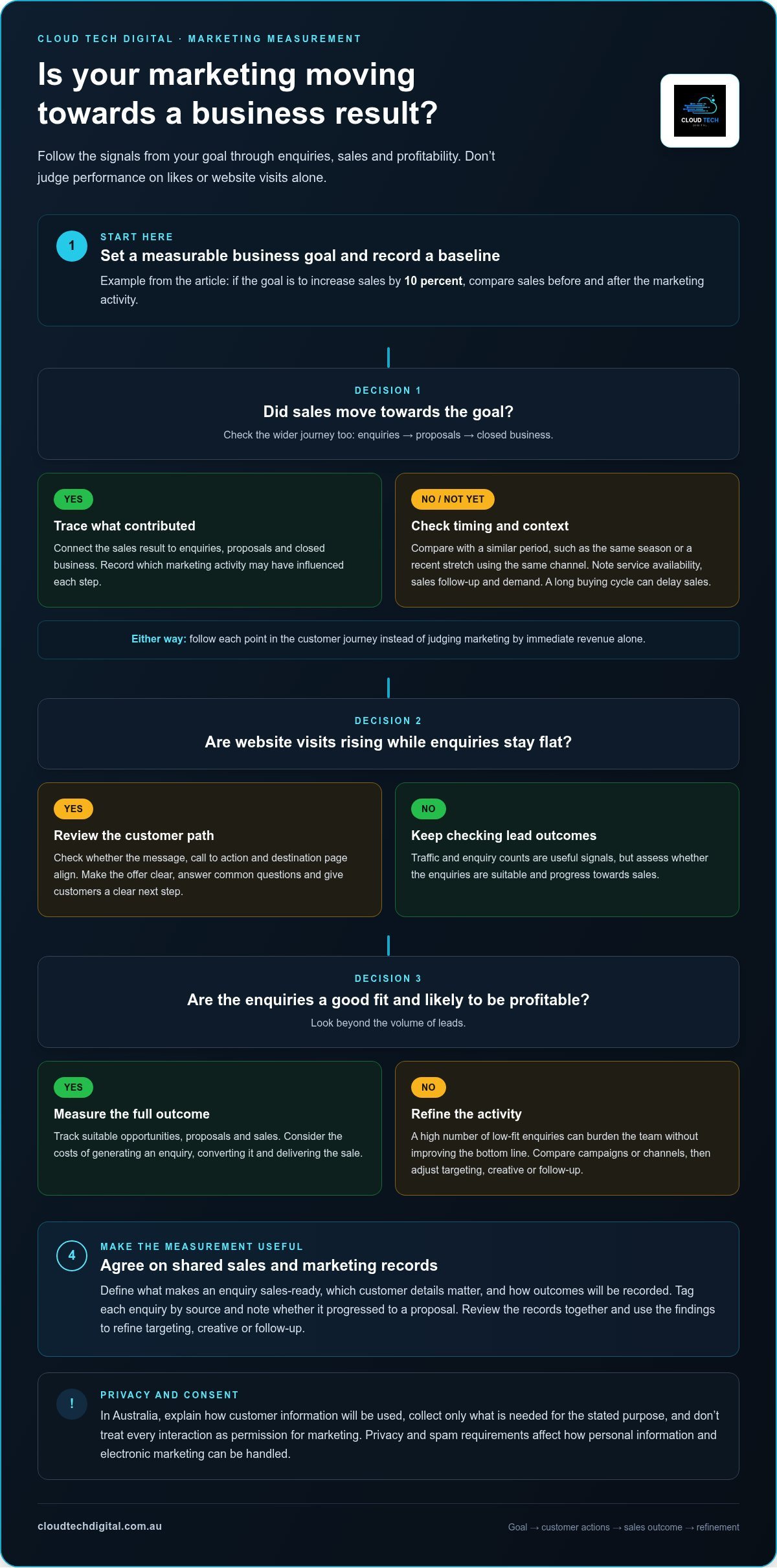
Start with a measurable business goal and a baseline. If the goal is to increase sales by 10 percent, compare sales before and after the marketing activity. Then assess whether inquiries, proposals and closed business moved in the same direction. This gives you more useful evidence than relying on a single campaign metric. It also helps answer the practical question: did the marketing strategy contribute to a commercial result?
Sales growth is a strong signal, but timing and context matter. Compare the period during and after a marketing campaign with a similar period, such as the same season or a recent stretch using the same channel. Note other influences, including changes to service availability, sales follow-up or demand. For a business with a long buying cycle, enquiries may arrive well before a sale closes. Track each point in that journey rather than judging marketing by immediate revenue alone.
Marketing supports sales by making the offer easier to understand and act on. Useful campaign content explains what a business does, shows its value, answers common questions and gives customers a clear next step. For example, if prospects repeatedly ask about the same service detail, add that answer to the relevant page or advertisement. If website visits rise but enquiries stay flat, review whether the message, call to action and destination page align.
Measure the quality and profitability of enquiries, not just their volume. Record how many enquiries become suitable opportunities, proposals and sales. Then consider the costs involved in generating an enquiry, converting it and delivering the sale. A high number of low-fit enquiries may put pressure on the team without improving the bottom line. Compare outcomes by campaign or channel to see which activity attracts customers more likely to buy profitably.
Marketing and sales need shared definitions. Agree on what makes an enquiry sales-ready, which customer details matter, and how the team will record outcomes. For instance, sales staff can tag each enquiry by source and note whether it progressed to a proposal. Review those records with the marketing team, then use the findings to adjust targeting, creative or follow-up. This closes the gap between campaign activity and customer conversations.
In Australia, marketing measurement should respect privacy and consent choices. Explain how customer information will be used, collect only what is needed for the stated purpose, and avoid treating every interaction as permission for marketing. Applicable privacy and spam requirements affect how personal information and electronic marketing can be handled.
For clearer campaign reporting, a lead generation review can help connect enquiries and sales outcomes with the marketing activity behind them.
3. Customer surveys and feedback
Marketing numbers show what customers did; feedback can reveal why. Ask a brief question after a phone call or send a post-service email survey. Keep the prompt tied to a recent experience, such as, “How did you hear about us?” or “What helped you decide to enquire?” A yes-or-no answer or rating scale gives you a clear starting point. Add a follow-up asking why, so customers can explain what influenced their response.
Make the feedback easy to compare. Use the same core questions across customer touchpoints, then review responses for repeated themes. For example, if several customers say a service page answered their questions, that message may be helping them take the next step. If respondents describe an offer differently from how your advertising presents it, the message may need clarifying. Record the date, channel and customer stage with each response, so you can connect opinions with specific marketing efforts.
Track enquiries consistently across the places customers contact you. Include phone calls, emails, website form submissions, walk-in customers and quote requests. A simple log can record the date, enquiry source, service requested and outcome. For example, label a call “Google search” only when the caller says they found you that way. If the source is unknown, record that honestly rather than guessing. These details help you compare enquiry trends with campaign activity and identify channels attracting relevant customers.
Customer sentiment adds context to those metrics. Note whether comments are positive, neutral or negative, then group them by topic, such as price clarity, service understanding or response experience. A customer might praise an advert’s clear explanation but say the landing page left a key question unanswered. That feedback points to a specific improvement. Look for repeated patterns across separate responses rather than overreacting to one comment; a single opinion is useful context, not a complete verdict.
Feedback from your team can reveal questions customers ask before they enquire. Gather observations in a staff meeting or small focus group, or use an intranet or Yammer poll. Ask which campaign messages customers mention, what they misunderstand and which objections come up repeatedly. Compare staff observations with survey answers and enquiry records. If both customers and staff report confusion about the same service detail, update the relevant marketing content and monitor whether the issue appears less often.
Use a simple review routine to turn responses into action. Sort feedback by source and theme, compare it with enquiry outcomes, then choose one practical change to test. For instance, rewrite an unclear service explanation and check whether later respondents describe the offer more accurately. Keep the original responses alongside summary metrics, so decision-makers can see the reasoning behind each adjustment. This approach helps assess whether marketing matches customer needs, not merely whether it generates activity.
4. Marketing analytics and digital advertising metrics
Use analytics to follow the path from an ad or search result to a useful action. Google Analytics can show website visits, traffic sources, new and returning visitors, and page exits. Google Search Console helps you review how people reach your site through Google Search. Together, these tools can help connect visits with conversions and reveal which channels bring relevant traffic.
To compare channel performance, use the same outcome, audience and time period for each channel. Tag campaign links with UTM parameters, then review the recorded source alongside enquiries and sales. Attribution models assign credit differently, so treat them as guides rather than complete explanations. A customer may see a social media ad, search for your business later, then enquire through your website.
Typical conversion rates and costs in Australia depend on the audience, offer, channel, landing page and buying process. Compare your results with earlier activity using the same channel, audience or season, then focus on whether qualified actions and profitable sales are improving.
Calculate return on investment by subtracting marketing spend from the revenue directly linked to the campaign, then dividing the result by spend and multiplying by 100. For example, A$2,000 in spend and A$8,000 in generated revenue produces 300% ROI. Return on ad spend, or ROAS, divides revenue by advertising spend, giving 4:1 in that example.
Use weak results to locate where people drop away. If an ad attracts visits but few enquiries, review the message, audience and landing page. If enquiries arrive but don’t become sales, examine lead fit and follow-up. Test one change at a time, such as a new headline or page layout, so you can see which adjustment affects performance.
Review campaign indicators regularly, but allow enough time for the buying cycle. For a B2B business with a six-month buying cycle, expecting results in less than six months may be unrealistic. Check early engagement and enquiry quality while tracking sales outcomes over the full cycle. Compare against relevant previous activity, not a different season or audience.
Review performance monthly to spot changes and decide whether a campaign needs adjustment. Schedule a broader marketing audit at least every six months, checking goals, channels, conversions and reporting setup. If costs per lead or acquisition rise, test alternative ads or landing pages. Regular reporting helps you direct time and spend towards what performs, while exposing tracking gaps before they distort decisions.
5. Tracking leads, website visits and conversions
Traffic only tells part of the story. To see whether a campaign is producing business results, connect each visit with the action that follows. Choose a conversion that matters, such as a completed enquiry form, a phone call or a quote request. A consultation business could set a target of five bookings in a month, then compare actual bookings with that goal.
Set up conversion reporting before the campaign starts. In your analytics platform, define the actions that count as conversions and check that each one records correctly. Test a form submission and confirm it appears in reporting. If phone calls matter, record them consistently alongside website forms and emails. A tracking gap can make a working campaign look ineffective, or make unqualified activity appear valuable.
Use UTM parameters on content marketing links to identify which asset brought a visitor. Apply a consistent naming format across campaign links, such as source, medium and campaign name. For example, a newsletter link can be distinguished from a social post in your reports. Keep a simple record of the naming conventions, so staff can interpret results consistently rather than splitting one campaign across several labels.
Follow the lead journey beyond the first conversion. Record whether each enquiry was relevant, progressed to a quote, and became a sale. This helps distinguish a page that attracts many enquiries from one that generates suitable prospects. For an online shop, completed online sales are a key measure. For a service business, connect form completions and calls with later sales outcomes.
Review the stages as a funnel: visits, enquiries, qualified leads and closed sales. If visits rise but enquiries don’t, inspect the page’s message, form and call to action. If enquiries rise but few become sales, examine lead fit and the steps after submission. Change one element at a time, such as the headline or form fields, then compare results. This makes it easier to identify what to adjust while the campaign is running.
Reporting should suit the business goal, not simply display every available metric. Put the target, recorded conversions, lead quality and sales outcomes in one clear view. Compare campaigns using consistent definitions and periods, then note changes that could affect performance. Review the tracking setup whenever a form, page or campaign changes. Reliable measurement turns website visits into useful evidence, showing where customers act and where they leave.
Cloud Tech Digital: Lead Generation Agency in Australia
Cloud Tech Digital helps Australian businesses connect digital marketing with lead generation. If website visits aren’t turning into relevant enquiries, a clearer path from ad to landing page can help address the gap. Its pay-per-click services support businesses seeking customers through paid search, while web design and landing pages give campaigns a focused destination. These offerings are most relevant when your tracking shows a drop between clicks and enquiries, or when your website isn’t guiding visitors towards a clear next step. Reviewing the campaign goal, audience and conversion journey can help identify where to focus. For support connecting marketing activity with lead generation, contact Cloud Tech Digital to discuss your goals.
Turn your marketing signals into your next move
The next step in learning how to know if my marketing is working is to turn the evidence into a clear decision. Choose what to keep running, what to change and what to test next. That decision becomes easier when campaign goals, customer actions and business outcomes are considered together, rather than treating each metric as a separate verdict.
If you want support building that connection, Cloud Tech Digital offers lead generation, pay-per-click and Facebook ad management services. These can help businesses improve how their campaigns attract and convert prospective customers. The right focus depends on where your current marketing journey needs attention, from reaching an audience to creating a clearer path to enquire.
Take the next step with a focused discussion about your marketing goals and customer signals. Contact Cloud Tech Digital to explore a practical way forward, and keep building on what your customers are already telling you.
Frequently Asked Questions
What should you measure?
Measure the action that best represents progress towards your current business goal. For a new service launch, that might be enquiries from customers seeking that service; for repeat business, it could be returning customers. Choose one primary outcome, then use supporting measures to explain movement. This keeps reporting focused and makes it easier to decide whether to continue, refine or pause an activity.
How To Tell If My Marketing Is Working?
To work out how to know if my marketing is working, compare results with your starting point and check whether the right customers are taking action. Look beyond clicks for evidence such as relevant conversations, quote requests and completed sales. Note changes to your offer, capacity or follow-up process too. Those factors can affect results, helping you interpret campaign performance with care.
Which marketing KPIs should Australian small businesses track?
Choose a small set of KPIs that reflects your sales process. A service business could track suitable enquiries, the proportion progressing to quotes, and sales won. A business focused on online sales might prioritise completed purchases and average order value. Add a channel measure, such as cost per qualified enquiry, to understand efficiency. Review definitions with staff so everyone records a “qualified” lead consistently.
How can I tell if marketing is generating qualified leads and sales?
Agree on what makes a lead suitable before assessing campaign results. For example, define whether the customer needs a service you provide, falls within your operating area and is ready to discuss the work. Then follow each enquiry through to its outcome in your records. If a campaign generates contacts but few meet those criteria or progress to a sale, refine its audience or message.
How do I set marketing goals and benchmarks for my industry?
Start with a business priority, then make the marketing goal specific, measurable, achievable, realistic and time-bound. Set a baseline using your own past performance, and use relevant industry measures as context rather than a target to copy blindly. Compare like with like: channel, audience, offer and season can all affect results. A benchmark is useful when it informs a decision, not simply because it is an industry average.
How can I measure the effectiveness of social media marketing?
Assess social media against the job each activity should do. For awareness, examine whether your content reaches and engages the intended audience; for lead generation, track visits or enquiries connected to social campaigns. Compare formats, messages and calls to action, then note which produce useful customer actions. A post with modest engagement can still contribute value if it brings relevant prospects into the sales process.
How do I track website conversions with Google Analytics 4?
Set up conversion reporting from the start, then use Google Analytics to review conversions and their sources, such as Google Search, Ads and Organic Social. Tailor the reporting to your business’s situation.
