


A quote is not a price tag; it’s the start of a professional relationship that most businesses kill by staying silent. If you are wondering how to follow up on a quote for tradies without sounding desperate, you aren’t alone. It’s incredibly frustrating to spend your evenings drafting detailed estimates only to be ghosted by a potential client or lose the job to a cowboy who undercuts you on price. You know your work is worth the premium, but when the phone stays quiet, it’s easy to feel like you’re just wasting your time on paperwork that goes nowhere.
The truth is that most clients actually want you to reach out; they are just busy and need a professional nudge to make a decision. We’ve developed the 2026 winning system to help you master the follow-up, ensuring you stop losing profitable jobs to cheaper competitors who simply shout louder. By the end of this guide, you’ll have a repeatable process that increases your conversion rates and helps you secure clients who respect your expertise. We’ll cover the exact timing for your calls, the best SMS templates to use, and how to handle the price objection with total confidence.
Key Takeaways
- Understand the legal distinction between a fixed price quote and an estimate to protect your business margins and avoid disputes under Australian law.
- Stop losing money on hidden overheads by factoring in your superannuation, tool replacement, and the “admin tax” of quoting into every job.
- Master how to follow up on a quote for tradies with a professional, repeatable system that turns ghosted messages into profitable contracts without sounding pushy.
- Create a high-converting quote document that uses a detailed scope of works and professional branding to build immediate trust with higher-quality clients.
- Leverage “speed to lead” and a high-performance website to establish authority and win the job before your competitors even have a chance to respond.
The Foundations of a Professional Trade Quote
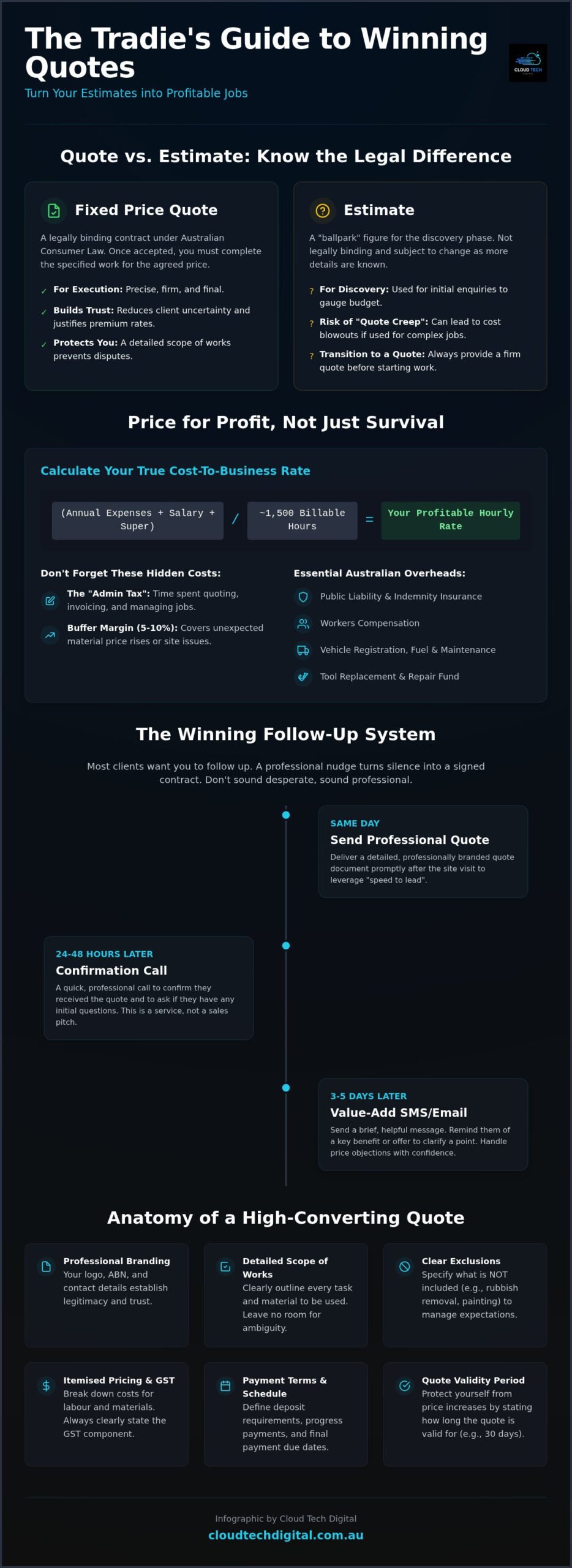
A professional quote is a high-performance sales document designed to close a deal, not just a list of costs scribbled on a notepad. In the Australian market, the difference between a “Fixed Price Quote” and an “Estimate” is more than just semantics; it’s a legal boundary. Under Australian Consumer Law, once a client accepts your fixed price quote, you’ve entered into a legally binding contract to deliver that specific scope for that exact price. This is why understanding core pricing strategies is vital for your bottom line. If you don’t know your numbers, you’re not just losing profit, you’re potentially locking yourself into a loss-making job.
The “Professionalism Gap” is wider than ever in 2026. If you’re still handing over hand-written notes or messy emails, you’re likely costing your business thousands in lost revenue. High-quality clients associate the quality of your paperwork with the quality of your trade work. When you’re learning how to follow up on a quote for tradies, you’ll find that having a digital, professional foundation makes the conversation much easier because the value is already clear on the page.
Quote vs. Estimate: Knowing the Difference
Estimates are for the discovery phase when variables are still unknown. They provide a “ballpark” range to see if the client has the budget. Quotes, however, are for execution. They are precise, firm, and final. Relying on estimates for complex jobs often leads to “quote creep,” where costs spiral and your local reputation takes a hit. To protect your margins, use estimates for initial enquiries but always transition to a firm quote before picking up your tools. Providing a price range is acceptable during the early stages, but a hard number is what builds the trust required to win the contract.
Why Your Quote is Your Best Sales Tool
A detailed quote does the heavy lifting of reducing buyer’s remorse before you even step on site. By clearly outlining every inclusion and exclusion, you remove the “fear of the unknown” that stops many homeowners from hitting the “accept” button. This level of detail justifies your premium rates and positions you as an authority rather than just another contractor. Your quote should be an extension of your brand, matching the professional authority of your web design for tradies. When your digital presence and your physical documents align, you create a seamless lead funnel that makes knowing how to follow up on a quote for tradies feel like a natural service rather than a pushy sales pitch.
Calculating Your Costs: Pricing for Profit, Not Just Survival
Every hour you spend on your laptop is an hour you aren’t on the tools. Many Australian contractors fail to account for this “admin tax,” which is the true cost of the time spent visiting sites and drafting estimates. If your margins are razor-thin, a single broken drill bit or a spike in timber prices can wipe out your week’s profit. In the 2026 Australian market, material price volatility is still a reality. You must include a “Buffer Margin” of at least 5% to 10% on every quote to handle unexpected site complications or supply chain hiccups. When you’ve accounted for every cent, you’ll feel much more confident when learning how to follow up on a quote for tradies, because you know your price is fair and sustainable.
The Maths of Labour and Overheads
Your hourly rate isn’t just what you want to take home. It’s a complex calculation of your “cost-to-business.” To find your true rate, use this formula: (Total Annual Business Expenses + Desired Annual Salary + Superannuation) / Billable Hours. Remember, you only have about 1,500 billable hours a year once you subtract public holidays, sick leave, and admin time. You also need to amortise your marketing for tradies spend across every job to ensure your growth is self-funded. Investing in customer relationship marketing helps turn these one-off quotes into long-term, profitable partnerships. Essential Australian overheads to include in your maths are:
- Public Liability and Professional Indemnity insurance.
- Workers Compensation (if you have staff or subcontractors).
- Vehicle registration, fuel, and maintenance for your ute or van.
- Tool replacement funds for when that expensive mitre saw finally dies.
GST and Tax Compliance for Australian Tradies
Confusion over GST is a leading cause of payment disputes. Be crystal clear on whether your quote is “GST Inclusive” or “Plus GST.” If your turnover is over A$75,000, you must be registered for GST and clearly display the tax component on your documents. Consistent quoting makes your Business Activity Statement (BAS) reporting much cleaner and prevents the ATO from knocking on your door. Transparent pricing isn’t just about tax compliance; it’s about building authority. If you want to see how high-performance lead generation strategies can help you find clients who don’t haggle over these costs, focus on your digital presence. Mastering how to follow up on a quote for tradies becomes a lot easier when you’re dealing with professional clients who value transparency over the lowest possible price.
The Anatomy of a High-Converting Quote Document
Your quote document is a silent salesperson that works for you when you’re off-site. If it looks amateur, your work is assumed to be amateur too. Every high-converting quote must start with a professional header that includes your ABN, a high-resolution logo, and direct contact details. This isn’t just about looking good; it’s about establishing that you are a legitimate, tax-compliant Australian business. When your paperwork is this polished, learning how to follow up on a quote for tradies becomes much easier because you are following up on a document that already commands respect and justifies your pricing.
Writing a Bulletproof Scope of Works
Specificity is your best defence against “scope creep” and unpaid extras. Generic descriptions are a recipe for disaster. Instead of writing “Fix lights,” use specific language like “Supply and install 6x Clipsal LED downlights in the kitchen area, including all necessary wiring and safety certification.” This leaves no room for “while you’re here” requests that eat into your profit margins. You should also list your exclusions clearly. If the price doesn’t include plaster patching, painting, or the removal of heavy waste, state that upfront. A major 2026 power move is attaching site photos with annotations directly to the quote. This provides undeniable proof of the job’s starting state and builds massive trust with the client.
Terms, Conditions, and the Fine Print
Your terms and conditions should be clear, not hidden in tiny text. They must define your payment terms, including the required deposit to secure a start date and the schedule for progress payments on larger projects. A “Variations” clause is non-negotiable; it ensures that if the client changes the scope mid-job, you are legally entitled to charge for the extra labour and materials. Clearly defining site access requirements and clean-up responsibilities prevents awkward disputes once the tools are packed away. This level of operational clarity is a hallmark of a business ready for SEO for tradies scaling. Having these terms in writing also gives you a professional anchor when you’re deciding how to follow up on a quote for tradies, as you can check if they have any questions regarding the specific terms or the 14-day expiry date, which protects your business from sudden 2026 material price hikes.
Managing the Quoting Process: From Site Visit to Follow-Up
Speed to lead is the most underrated factor in trade sales. The first professional quote delivered usually sets the benchmark for every other estimate the client receives. If you take three days to “get around to it,” your competitor has already secured the deposit. Use digital tools to send your quote via SMS and email instantly. This ensures your business stays top-of-mind while the client is still in the “buying” headspace. Delivering your price digitally removes the friction of physical paperwork and allows the client to accept the job with a single click.
Winning the Job at the Site Inspection
Professionalism starts before you open your mouth. A clean ute and branded gear signal that you run an organised operation. During the inspection, use active listening to understand the client’s actual pain points. This is where you identify upsell opportunities that add genuine value, such as suggesting higher-efficiency fittings that save the customer money on future power bills. For smaller maintenance jobs, the power of the on-site quote is unmatched; sending the document before you even leave the driveway often results in an immediate “yes” because the problem is fresh in the client’s mind.
The 48-Hour Follow-Up Rule
Knowing how to follow up on a quote for tradies without sounding desperate is a skill that separates high-earning businesses from those just scraping by. Never wait more than 48 hours for your first check-in. A simple, helpful message works best: “Hi [Name], just checking if you had a chance to review the quote for the [Job Type] and if you had any questions about the scope of works?” This approach feels like customer service rather than a sales pitch. It shows you are organised and ready to start, which is a rare trait in the trade industry.
If a client mentions “price shock” or says you’re too expensive, don’t drop your price immediately. Instead, reiterate the value and the specific inclusions mentioned in your scope of works. Remind them that your quote covers quality materials, proper insurance, and a guaranteed finish, which cheaper competitors often skip. Tracking your “Quote-to-Win” ratio is the only way to measure your business health. If you’re winning 100% of jobs, you’re likely too cheap; if you’re winning 0%, your follow-up process needs a total overhaul. To start filling your funnel with higher-quality leads who value your expertise over a bargain-basement price, explore our high-performance lead generation services.
Turning Your Quotes into a Growth Engine
Your quoting system is only as effective as the quality of the leads entering your funnel. If you’re constantly chasing tyre-kickers who only care about the lowest price, even a flawless follow-up process won’t save your margins. You need to position your business as a premium provider by partnering with a high-performance Lead Generation Agency in Australia. This ensures that the people you are visiting are already sold on your value before you even open your tape measure. When you have a steady stream of high-intent enquiries, mastering how to follow up on a quote for tradies becomes a strategy for selection rather than a desperate attempt at survival.
Matching Your Quote to Your Digital Presence
There is a massive “Trust Gap” that occurs when a client finds your slick, professional website but receives a messy, hand-written quote. This inconsistency kills the vibe and makes them question your professionalism. Your quote must be an extension of the “Authority Loop.” If your website promises high-end results, your quote document should prove it. Attach one or two relevant case studies or client testimonials directly to your digital quote. This provides social proof at the exact moment the client is deciding whether to spend their A$10,000 or A$50,000 with you. By targeting “A-Grade” clients who respect your time, you ensure that every hour spent on administration is an investment in a high-margin contract.
Next Steps: Automating Your Tradie Marketing
Consistent lead flow is the ultimate business insurance. It gives you the power to walk away from “bad” quotes and difficult clients without worrying about next month’s bills. When you aren’t desperate for every job, your confidence increases, and your conversion rates actually go up. If you’re ready to stop chasing and start choosing, it’s time to refine your strategy. Organise a strategy session with us today to learn how to follow up on a quote for tradies using a system that fuels your business with high-intent leads and repeatable growth.
Mastering the art of the follow-up is about more than just persistence; it’s about building a business that commands respect and high margins. You now have the tools to separate quotes from estimates, protect your profit with a precise scope of works, and use the 48-hour rule to stop opportunities from going cold. By implementing a systematic approach to how to follow up on a quote for tradies, you move from being a contractor who hopes for work to a business owner who controls their growth. Consistency is the key to turning silent prospects into signed contracts.
Your quoting process is only as powerful as the leads it processes. We provide specialist marketing for Australian tradies, delivering proven lead flow strategies and expert web design for plumbers, sparkies, and builders. This ensures you aren’t just quoting more often, but quoting for the right people who value your expertise. Ready to stop chasing tyre-kickers? Get high-quality leads for your trade business today. Stop letting profitable contracts slip through the cracks and start building the scalable trade business you deserve. Success in 2026 belongs to the tradies who treat their sales process with the same precision as their site work.
Frequently Asked Questions
How long should I wait before following up on a quote?
Wait 24 to 48 hours for smaller maintenance jobs and up to a week for larger projects. Smaller jobs often require a quicker decision; a prompt check-in shows you are organised and ready to start. For major works, give the client time to review the details but don’t let it sit longer than seven days without a professional touchpoint. This timing ensures you stay top-of-mind while the client is still in the buying headspace.
What is the best way to follow up on a quote without being annoying?
Frame your follow-up as a customer service check-in rather than a sales pitch. Use a polite SMS or email asking if they have any questions about the scope of works or the materials specified. This positions you as a helpful expert. Learning how to follow up on a quote for tradies effectively involves keeping the message short, professional, and focused on the client’s needs. Avoid calling multiple times a day; one well-timed message is usually enough.
Is a quote legally binding for Australian trade businesses?
Yes, a fixed-price quote becomes a legally binding contract once the client accepts it under Australian Consumer Law. Unlike an estimate, which is a non-binding ballpark figure, a quote commits you to the price and scope specified. It is essential to include an expiry date on your documents to protect your business from material price hikes or changes in your schedule. This legal certainty protects both you and the client once the agreement is signed.
Should I charge for the time it takes to provide a quote?
Most Australian tradies include the cost of quoting in their general overheads rather than charging a separate fee. However, for complex jobs requiring detailed design work or extensive site inspections, some businesses charge a consultation fee that is credited back if the job is won. If you choose this path, be transparent about the cost during the initial enquiry to maintain trust. This prevents surprises and ensures you are compensated for high-value technical advice.
How do I handle a client who asks for a discount after the quote?
Hold your ground by reiterating the value and quality of the materials and labour included in your scope. If the client has a lower budget, offer to reduce the scope of works rather than cutting your profit margin. Explain that your price covers insurance, high-quality finishes, and guaranteed workmanship. This ensures you only work with clients who respect your expertise and business sustainability. Dropping your price immediately signals that your original quote was inflated.
What should I do if a client never responds to my follow-up?
Send a final, polite closing message after two or three unsuccessful attempts over two weeks. State that you’ll be closing the file for now but are happy to help if they decide to proceed in the future. This professional closure keeps the door open while allowing you to focus your energy on high-quality leads who are actually ready to book. It’s better to move on than to waste time chasing someone who isn’t ready to commit.
Do I need to include GST in my trade job quotes?
If your business turnover exceeds A$75,000, you must register for GST and include it in your pricing. Your quotes should clearly state whether the total is GST inclusive or plus GST to avoid confusion. Proper tax compliance is vital for clean BAS reporting and prevents the ATO from auditing your accounts. High-performance businesses always use transparent tax breakdowns to build authority and trust with their client base while staying on the right side of the law.
How do I handle “scope creep” if the job changes after the quote is signed?
Address changes immediately by issuing a formal Variation document before the extra work begins. Mastering how to follow up on a quote for tradies includes managing these mid-job adjustments professionally. Never assume the client will pay for extras without a written agreement. A clear variations clause in your original terms and conditions ensures you are legally entitled to charge for additional labour and materials as they arise. This prevents awkward payment disputes at the end of the project.
