


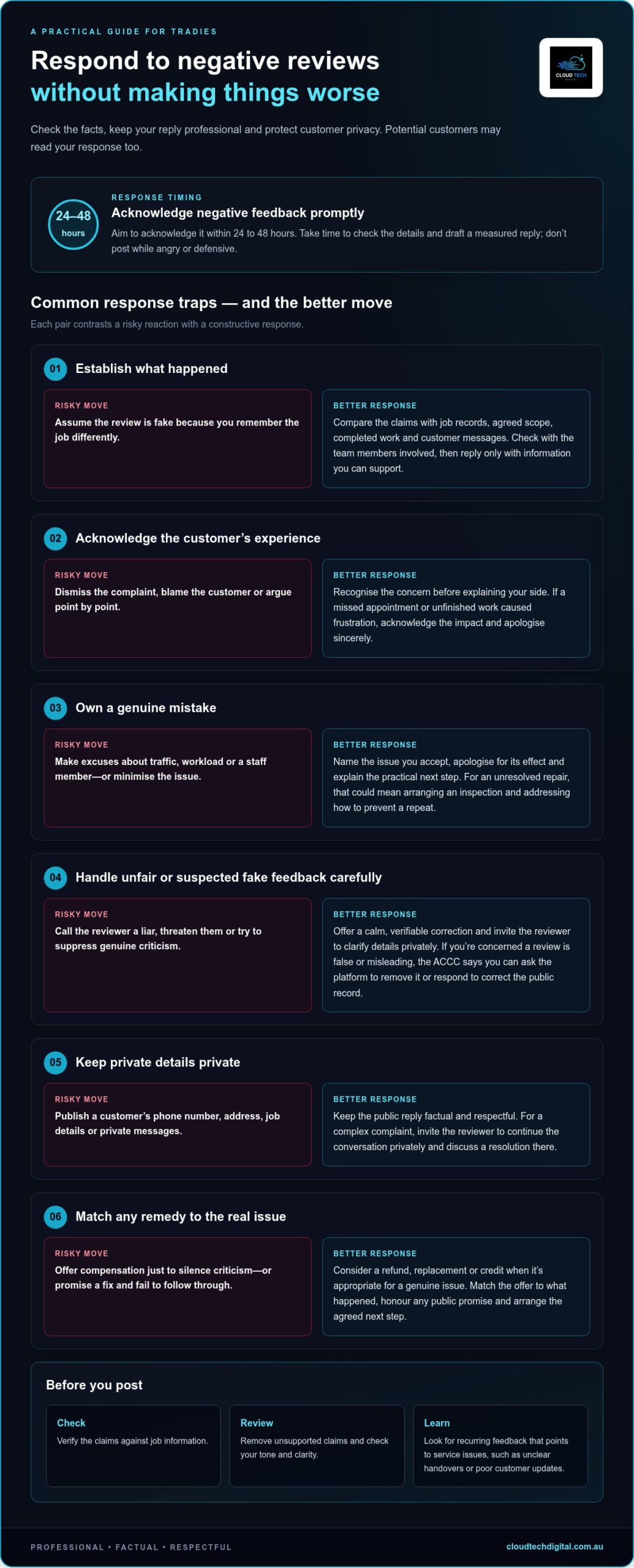
A fake review can feel like an attack, but a calm public response can help correct the record. For tradies, responding to negative reviews means checking the claims, reporting suspected fake feedback to the platform and replying professionally rather than arguing or trying to hide genuine criticism. Aim to acknowledge a negative review within 24 to 48 hours.
It’s understandable to feel frustrated by a review that seems unfair, especially when your reputation helps win work. But potential customers may read your reply too, so what you say matters as much as the complaint.
This guide explains how to assess and report fake reviews, acknowledge genuine mistakes without making excuses, and avoid common response errors. You’ll learn when to reply, what to say publicly and how to move a complaint into a private conversation while keeping your response professional.
Key Takeaways
- Check job records and assess the reviewer’s claims before replying; report suspected fake feedback to the platform and keep your public response professional.
- Protect customer privacy by keeping personal details out of public replies, then invite the reviewer to discuss complex complaints privately.
- If your business made a mistake, acknowledge it, apologise where appropriate and explain how you’ll work to put things right.
- Aim to acknowledge negative feedback within 24 to 48 hours, but pause to review your draft if you’re feeling upset.
- Use review patterns to spot recurring issues and show potential customers that you take feedback seriously.
What are common mistakes to avoid in review responses?
Before replying, check the facts, stay calm and protect customer privacy. A sound approach to responding to negative reviews for tradies starts with a fair assessment, then addresses the concern respectfully without revealing private information.
-
Check job records and complaint details
Compare the review with job records, the agreed scope, completed work and customer messages. Speak with the team members involved before deciding what happened. A review may leave out context, so don’t assume it’s fake just because you remember the job differently. Assess the specific claims and the author’s review history, then respond only with information you can support.
-
Acknowledge the complaint and apologise
Recognise the customer’s concern before explaining your side. If a missed appointment or unfinished work caused frustration, acknowledge the impact and apologise sincerely. Avoid dismissing the complaint or blaming the customer. A reply that shows you’ve considered the feedback can keep the conversation constructive, even if you disagree with some details.
-
Address legitimate complaints
If your review of the job confirms a mistake, take responsibility and focus on a practical remedy. Explain the next step, such as arranging an inspection of an unresolved repair, and how you’ll help prevent the same problem recurring. Don’t minimise the complaint or blame a busy schedule. Use recurring feedback to identify service issues, such as unclear handovers or poor customer updates.
-
Decide whether to offer compensation
Should tradies offer refunds or compensation in response to a negative review? Consider a refund, replacement or credit when it’s an appropriate remedy for a genuine issue, not a way to silence criticism. Match the offer to what happened and honour any public promise. For example, if you offer corrective work, arrange the agreed next step and update the customer.
- After acknowledging a complex complaint publicly, invite the reviewer to continue the conversation privately. Never publish their phone number, address or job details. Use the conversation to understand their experience and discuss a resolution. When responding to negative reviews for tradies, remember that future readers will see your public reply too. Ask someone else to review your draft before posting, and don’t try to suppress genuine feedback.
Acknowledging mistakes and avoiding excuses
A useful public reply recognises the customer’s experience and focuses on what happens next. Keep it genuine, factual and respectful, whether the feedback is fair, mistaken or clearly false.
-
Acknowledge mistakes without excuses
Name the specific issue you accept, then apologise for its effect on the customer. For example: “We’re sorry the appointment change disrupted your day. We should have updated you sooner.” Don’t follow the apology with a defence about traffic, workload or a staff member. If you’ve corrected the problem, briefly explain what you did and how you’ll help prevent a repeat.
-
Avoid mistakes in public replies
Write for both the reviewer and the next person who reads your business’s reviews. Avoid sarcasm, accusations, threats or a point-by-point argument that makes a small complaint seem bigger. Don’t reveal personal details or share private job communications. Before posting, remove claims you can’t support and ask someone else to check the draft’s tone and clarity.
- Respond to an unfair or mistaken review with a calm, verifiable correction. For example, if a review says you never attended but job records show the visit took place, say you’d like to clarify the details and invite the reviewer to discuss them privately. Don’t call the author a liar or assume a harsh review is fake. The ACCC says businesses concerned about false or misleading reviews can ask the platform to remove them or respond to correct the public record.
- Separate what you know from what you’re still investigating. A concise reply might say, “We’re sorry to hear this. Our records show the repair was completed on the agreed date, but we’d like to understand what remains unresolved.” This acknowledges the complaint without endorsing a claim you believe is inaccurate. It also avoids turning the exchange into a public dispute over differing recollections.
- Keep your response consistent with the customer experience you want to deliver. A positive review may highlight punctuality, while a negative one may point to poor updates; both can show what customers notice. Don’t seek only positive feedback or arrange fake reviews to counter criticism. Look for patterns in genuine feedback, then adjust communication or work practices where they point to a real problem.
How quickly should I respond to a negative review?
Aim to acknowledge negative feedback within 24 to 48 hours, while allowing time to check the facts and draft a measured reply. In Australia, consumer and defamation laws can be relevant; the ACCC says businesses concerned about false or misleading reviews can ask the platform to remove them or respond to correct the public record.
- Pause, then set a response time. Respond promptly, but don’t post while angry or defensive. Read the review, note its specific claims and check the relevant job information before drafting. If you need time to investigate, acknowledge the feedback and say you’re looking into the details. A timely message shows potential customers you take complaints seriously, while a considered reply helps prevent an emotional exchange from escalating.
- Use a brief, professional framework. Keep your public reply to three or four sentences. Thank the reviewer for raising the issue, acknowledge their experience, apologise for inconvenience where appropriate, then explain the practical next step. For example: “Thanks for letting us know. We’re sorry the installation didn’t meet expectations. We’d like to understand what needs attention, so please contact us privately.” Avoid promising a fix before you know what happened.
- Write for everyone reading online reviews. A Google review reply isn’t just a message to the reviewer; potential customers may read it when assessing your business. Keep your tone courteous, use plain language and address the complaint rather than attacking the person. Don’t publish private details, speculate about motives or make unsupported claims. If you disagree with a statement, correct it calmly using a relevant, verifiable detail.
- Review the draft before posting. Read your response aloud and remove sarcasm, blame and defensive explanations. Ask a trusted team member to check whether it sounds respectful and answers the complaint. Make sure any offer or next step is clear, realistic and something you can deliver. If the review seems unfair, avoid arguing publicly; invite a private discussion and keep your reply focused on resolving the concern.
- Keep your approach consistent. Reply to each negative review, even if you can initially offer only a brief acknowledgement. Use the same calm process across Google and other review platforms, then record the complaint and any promised follow-up. This helps your team handle feedback consistently and spot recurring service issues. If you’re considering legal action over alleged defamation, gather supporting evidence and consult a lawyer who specialises in defamation cases.
Australian consumer and defamation laws may be relevant when responding publicly to negative reviews. If a review seems false or misleading, businesses can ask the platform to remove it or respond to correct the public record.
Do online reviews really matter for tradies and home improvement businesses?
Reviews can shape how potential customers judge a tradie before requesting a quote. Take complaints seriously, then use private conversations to work towards a practical resolution.
Encourage genuine positive reviews by inviting customers to share honest feedback after completed work. Never buy, write or arrange fake reviews, or make incentives conditional on positive ratings.
- Acknowledge the complaint publicly, then invite a private conversation. Thank the reviewer and briefly recognise their concern before suggesting a direct way to discuss it. For example: “We’re sorry the repair hasn’t resolved the issue. Please contact us so we can understand what’s happened.” This shows readers you’re responding without exposing the customer’s personal details.
- Keep the public exchange focused on resolution. Use the private conversation to gather details, compare the complaint with job records and agree on a sensible next step. If a customer says the finished work needs attention, discuss it privately rather than posting addresses, appointment details or messages online. Return to the review platform only if a brief update helps clarify the outcome.
- Follow through on what you agree. Record the next action after speaking with the customer, whether that’s arranging an inspection or explaining what work was completed. If you promise a refund, replacement or credit, provide it as offered. A private conversation helps resolve a complaint only when your business carries out the agreed action and keeps the customer informed.
- Use review patterns to improve the customer experience. Look across complaints for repeated issues, such as unclear arrival updates or confusion about job scope. Business Victoria advises businesses to consider reviews with 2, 3 or 4 stars for a more rounded view of customer experience. Compare those comments with positive reviews to identify what works well and what needs attention.
- Invite honest feedback without steering the rating. Ask genuine customers to leave a review after their job, using a short, neutral request. If someone says they’ll review your work but forgets, follow up once. BrightLocal’s 2025 Consumer Review Survey found that 89% of consumers expect businesses to respond to all types of reviews. BrightLocal also reports that 46% say owner responses influence their perception.
- Keep a balanced review profile. Google says a mix of positive and negative reviews can make overall feedback feel more genuine to customers. Don’t try to suppress legitimate criticism or flood your profile with praise. Instead, respond respectfully to complaints, thank customers for useful feedback and show service improvements through your actions.
Why tradies should respond to negative reviews
A negative review gives a tradie a chance to show how the business handles a difficult situation. Responding to negative reviews for tradies can also help potential customers understand what happens when a job doesn’t go to plan.
- Show readers how you handle problems. Customers may judge your business by its response as well as the complaint. If someone says a repair wasn’t completed, acknowledge the concern and invite further discussion. This signals that you take follow-up seriously. A defensive argument can leave readers focused on conflict instead of how you intend to address the situation.
- Correct misleading claims with clear facts. If a review gives a false impression, state a relevant fact briefly and accurately. For example, explain that your records show an appointment took place, then invite the reviewer to discuss any unresolved concern privately. According to the ACCC, a response to a misleading comment must be enough to override the false impression made by the original post.
- Respond professionally to suspected fake feedback. Fake negative reviews can harm a business’s reputation, discourage potential customers and lead to lost sales. Report suspected fake feedback to the platform and avoid accusing the author publicly. If a complaint spreads on social media, a calm, factual reply can help readers understand your position without escalating the exchange.
- Turn genuine criticism into a practical improvement. A complaint may reveal a gap in the customer experience. If a reviewer mentions poor updates, discuss communication practices with your team and identify where job changes need clearer explanations. This gives the feedback a practical purpose and can help prevent the same issue arising for another customer.
- Make trust part of your customer journey. Appreciate feedback, explain what you can verify and offer a sensible next step. A consistent approach to responding to negative reviews for tradies can support trust, while a clear online presence helps customers assess your work. If you’re ready to build on that presence, strengthen your tradie business’s online presence with a focus on how customers find and consider your services.
Cloud Tech Digital: Lead Generation Agency in Australia
Cloud Tech Digital helps Australian tradies build visibility and attract enquiries through lead generation. If you’re ready to complement a considered review strategy with broader digital marketing, its Google Ads and Meta Ads services can support paid campaigns, while web design can give potential customers a clear place to learn about your work.
Choose the approach that fits your next business goal. A tradie looking to generate enquiries through advertising may consider paid campaigns, while a business refreshing its online presence may benefit from web design. These services complement reputation management; they don’t replace thoughtful responses to customer feedback.
Contact Cloud Tech Digital to discuss digital marketing for your trade business.
Turn a stronger reputation into your next opportunity
Make your review approach part of how your team works. A simple shared process can help everyone respond consistently and spot customer concerns that deserve attention. Over time, that discipline can support a clearer picture of your business, alongside the work quality and communication customers experience on the job. Responding consistently to negative reviews for tradies is one part of earning trust; helping the right customers discover your business is another.
When you’re ready to build on that trust, Cloud Tech Digital can support your next marketing step. Its lead generation, pay-per-click and Facebook Ad Management services help tradies reach potential customers through digital channels. Choose a direction that suits your business goals, then make sure your online presence gives people a useful next step towards enquiring about your work. Contact Cloud Tech Digital to discuss your marketing needs and take a confident step towards your next opportunity.
Frequently Asked Questions
How do I handle fake reviews?
Document why you believe the review is fake, then report it using the platform’s review tools. Save a screenshot and note details that don’t match your job records, such as a service you don’t provide. Don’t accuse the reviewer publicly or ask others to post counter-reviews. If the review remains visible, respond briefly with verifiable information so readers can assess your side.
Can I get a bad Google review removed?
Google may remove a review if it breaches the platform’s policies, but a low rating or negative opinion alone doesn’t mean it qualifies for removal. Use the review’s reporting option and explain the specific concern, such as suspected fake content or abusive language. Keep a copy of the review and your report. If Google leaves it up, a measured public reply can clarify your position.
How fast should you reply?
Aim to acknowledge a negative review within 24 to 48 hours. If you need more time to investigate, send a short acknowledgement first rather than leaving the reviewer without a response. For example, say you’ve seen their feedback and are checking the job details. This separates prompt communication from a final explanation, which should be based on accurate information rather than a rushed assumption.
What if the customer is genuinely in the wrong?
Correct the record with facts you can support, without turning your reply into a personal dispute. If a customer claims you missed an appointment but your work records show you attended, state that calmly and invite them to discuss any remaining concern. Avoid posting private messages or personal details. Readers can better understand your position when your correction is specific and restrained.
What is the best response template for a negative review from a customer?
Use a flexible template, then personalise it to the complaint: “Thanks for sharing your feedback. We’re sorry to hear about [specific issue]. We’d like to understand more and work towards a resolution. Please contact us privately so we can discuss the details.” Replace the bracketed words with the actual concern. Don’t paste identical replies everywhere, and include only an apology or commitment that fits the situation.
How quickly should tradies reply to negative Google reviews?
Use the same 24 to 48-hour aim for Google reviews, while checking the complaint before giving a detailed answer. If a review arrives during a busy workday, acknowledge it when you can and set aside time to verify the relevant job information. A brief response can show the reviewer you’ve noticed their concern; follow up with a fuller explanation once you’ve checked the facts.
How can tradies respond to fake, abusive or misleading reviews in Australia?
Keep evidence, report content that appears to breach the platform’s rules, and avoid matching abusive language. For a misleading claim, provide a concise correction supported by records. The ACCC says businesses concerned about false or misleading reviews can ask the platform to remove them or respond to correct the public record. If considering legal action over alleged defamation, gather supporting evidence and consult a lawyer specialising in defamation.
How do tradies report or dispute reviews on Google, Facebook and other platforms?
Open the review on the relevant platform and use its reporting option to identify your concern. Explain why the content appears fake, abusive or misleading, and keep screenshots and related job records. Platform processes differ, so follow the instructions shown in the account or review interface. If the platform doesn’t remove the review, consider posting a brief, factual response instead of repeatedly arguing with the reviewer.
