


What happens to a good enquiry when you’re halfway through a job, up a ladder or driving between sites? It can go cold before you get a chance to call back. Learning how to follow up on leads effectively isn’t about hard selling. It’s about responding promptly, staying organised and making it easy for the right customers to take the next step.
If you’re busy on the tools, follow-up can feel awkward or inconsistent. When several enquiries come in at once, it may also be difficult to decide which one needs your attention first. A simple, reliable process helps you handle both.
This guide explains how to respond professionally, qualify enquiries and prioritise leads by their needs and fit. You’ll also learn how to keep useful records and maintain natural conversations without putting pressure on potential customers. Clear enquiry capture and lead tracking can help you spot missed opportunities and give suitable enquiries a better chance of becoming booked work.
Key Takeaways
- Use a repeatable sequence to capture each enquiry, make contact, qualify the opportunity, agree on a next step and record it.
- Learn how to follow up on leads effectively by matching your next contact to the enquiry’s urgency, details and preferred channel.
- Compare phone, email and SMS to choose a practical way to continue the conversation without making every follow-up feel the same.
- Keep admin manageable by assigning an owner, noting each lead’s status and scheduling the next action.
- Connect enquiry capture and lead tracking with SEO, Google Ads and social media advertising to see how marketing enquiries are handled.
Why effective lead follow-up matters for busy trade businesses
A phone rings while you’re on a roof. A web enquiry lands while you’re under a sink. By the time you’ve packed up, a quote request may be buried beneath supplier emails and job updates. For a busy trade business, the challenge isn’t just getting enquiries. Each genuine enquiry needs a clear owner and a sensible next step.
Lead follow-up is timely, relevant contact that helps a potential customer understand what happens next, whether that’s answering a question, arranging a site visit or deciding whether to proceed with a quote. It’s one part of Lead management, the broader process of organising and progressing enquiries. Done well, follow-up keeps the conversation moving without pressuring the prospect.
When a response is delayed, a customer may forget which business they contacted or what they need to do next. A vague reply such as “We’ll get back to you” offers little direction. A quote sent without a follow-up can leave the customer unsure whether you’re available to answer questions. To learn how to follow up on leads effectively, start by identifying where conversations lose momentum.
Where trade business enquiries commonly lose momentum
Enquiries can arrive through missed calls, incomplete web forms or quote requests waiting in an inbox. First, sort genuine requests from spam, duplicate submissions and jobs outside your business’s scope. This helps you focus on relevant opportunities rather than treating every notification as a likely job.
Then make ownership clear. If several people assume someone else will reply, nobody may take the next step. Assign each enquiry to a person, even if you use a shared spreadsheet or inbox. Record whether you’ve called, replied or sent a quote so the next person can continue the conversation without starting from scratch.
Follow-up is helpful when it gives the prospect a reason to respond
It’s understandable to worry about sounding pushy. The difference is whether your message is useful. Repeating “Just checking in” without context can feel like pressure. Referring to the quote you sent, clarifying what it includes or asking whether the customer would like to discuss timing gives them something specific to respond to.
Keep each message relevant to the enquiry and make the next step clear. After discussing a repair, for example, confirm what you need to prepare a quote and ask when the customer would prefer to hear back. If they’ve stated a preferred contact method or time, use it where practical. Specific, respectful follow-up shows reliability, even if the customer decides not to proceed.
Not every enquiry will become work, and a clear process won’t remove the demands of being on the tools. It can help prevent avoidable gaps, such as unanswered messages, unclear responsibilities and quotes left without a follow-up. Suitable customers get a straightforward way to continue the conversation, while your team can focus on the opportunities that are most relevant.
How to follow up on leads effectively: a repeatable process
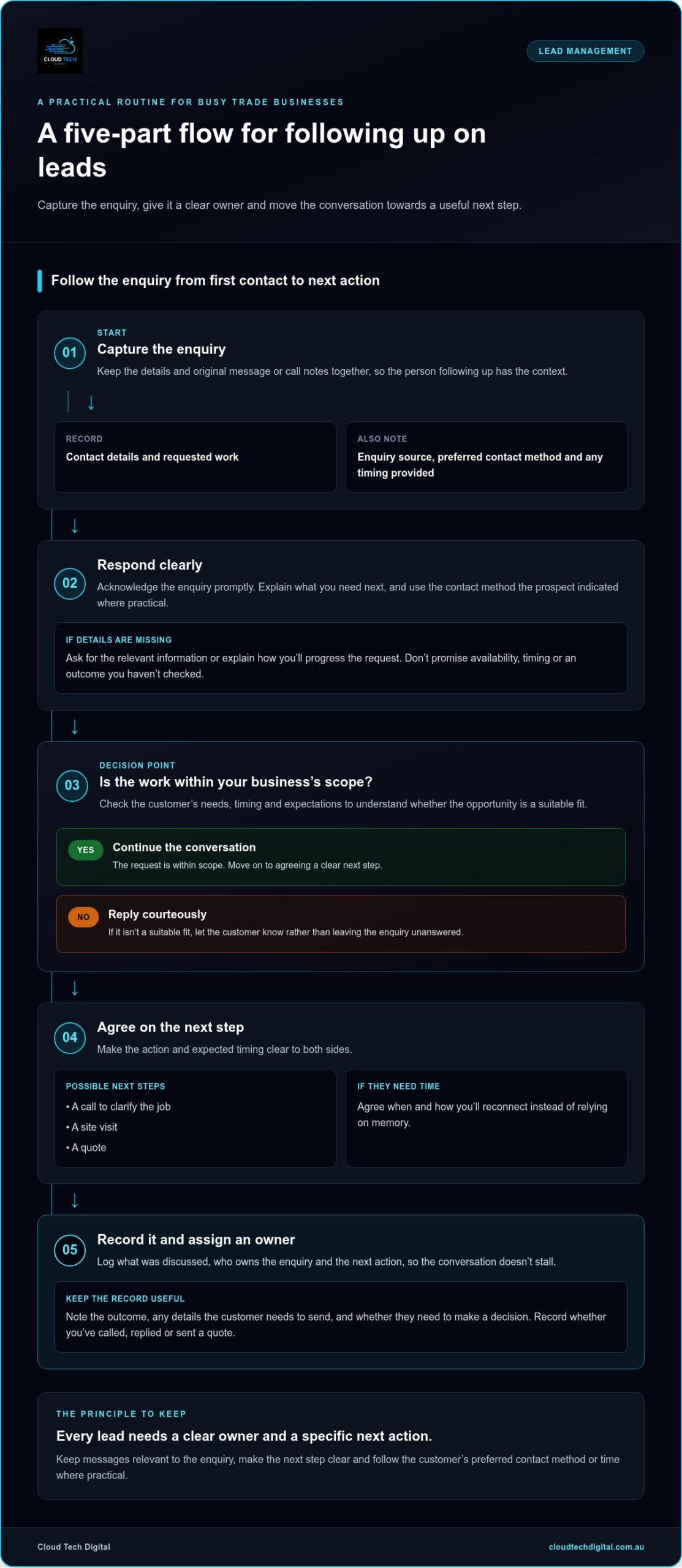
A reliable process turns follow-up from something you’re trying to remember into a clear part of handling each enquiry. Keep the sequence simple: capture the details, acknowledge the enquiry, check whether it’s suitable, agree on what happens next and record that action.
Every lead needs a clear owner and a specific next action, or the conversation can stall. Use this sequence as a working routine, adapting the timing and message to the enquiry instead of relying on a rigid script.
- Capture the enquiry. Note the customer’s contact details, requested work, enquiry source, preferred contact method and any timing they’ve provided. Keep the original message or call notes so whoever follows up has the necessary context.
- Respond clearly. Acknowledge the enquiry and explain what you need next. If a customer asks for a quote but hasn’t provided enough detail, ask for the relevant information or explain how you’ll progress the request.
- Qualify the opportunity. Confirm the work is within your business’s scope and understand the customer’s needs, timing and expectations. If it isn’t a suitable fit, reply courteously rather than leaving the enquiry unanswered.
- Agree on the next step. This could be a call to clarify the job, a site visit, a quote or a follow-up after the customer has had time to consider their options. Make the action and expected timing clear to both sides.
- Record and assign it. Log what was discussed, who owns the enquiry and the next action. If the customer needs to send details or make a decision, record that too, so the next contact reflects the conversation.
Capture the enquiry and make the first response useful
Acknowledge the message promptly, even if you can’t resolve everything straight away. A brief reply can confirm you’ve received the enquiry, ask for missing information and explain the next step. Don’t promise availability, timing or an outcome you haven’t checked. Tailor the wording to the work requested and use the contact method the prospect has indicated where practical.
For example: “Thanks for getting in touch about the hot water system. Could you send through a photo of the unit and let me know when you’re available to discuss the job? I’ll review the details and get back to you about the next step.” This is specific, courteous and gives the customer something useful to do.
Plan the next touchpoint and close the loop
If a prospect needs time or more information, agree on when and how you’ll reconnect instead of relying on memory. After each interaction, record the outcome and create a specific task with an owner, such as calling after the customer has reviewed the quote. If they decline or ask not to receive further messages, update the record and stop or adjust contact accordingly.
This approach complements the wider ideas in Lead Generation Agency in Australia: The 2026 Tradie Growth Guide: attracting enquiries is only one part of a workable growth process. Clear capture and consistent follow-up help you understand what happens after a potential customer gets in touch. For support aligning enquiry generation with tracking, explore lead generation strategy for trade businesses.
Which lead follow-up channel should you use: phone, email or SMS?
The best channel is the one that makes it easy for the prospect to respond. A phone call may suit an enquiry that needs a quick conversation, while email gives a customer space to review detailed information. SMS can work well for brief coordination if it suits the enquiry and the person’s preferences. Match the channel to the situation rather than choosing only what’s convenient for your business.
Use this comparison as a guide, then adapt it to what the prospect has asked for:
Phone
Strength: Allows direct discussion and quick clarification.
Limitation: The prospect may be unavailable, and complex details can be harder to track unless you record them afterwards.
Useful for: An enquiry that needs a conversation, such as clarifying the work requested or discussing a possible site visit.
Email
Strength: Gives you room to explain a scope, share written information or follow up on a quote.
Limitation: A detailed message can be difficult to scan, and a reply may take time.
Useful for: Sending quote-related details, summarising a discussion or asking the prospect to review information.
SMS
Strength: Keeps a short message easy to read and answer on a mobile phone.
Limitation: It’s not suited to long explanations or extensive job details.
Useful for: Simple coordination, such as confirming a suitable time to talk, when text suits the enquiry and the prospect.
When a phone call, email or text makes sense
Choose the channel that suits the next step. If you need to clarify the type of repair or ask a few questions, a call can make the exchange more natural. If the customer needs to consider a quote or written scope, email gives them something clear to refer to. A short text can help coordinate contact, but switch to a call or email when the discussion needs more detail. Don’t assume every customer prefers the same channel.
Keep messages personal, clear and easy to answer
Make it obvious that your message relates to the original enquiry. Refer to the requested job, identify your business and ask one straightforward question or offer one clear next step. For example: “Hi Sam, it’s Alex from the plumbing team. I’m following up on your hot water enquiry. Would a call this afternoon suit?” This gives the prospect useful context and an easy way to reply.
Avoid generic messages that could apply to anyone, misleading wording or repeated nudges that add no new information. If the prospect has asked you to use a particular channel, respect that preference where practical. For Australian commercial electronic messages, check current guidance from the relevant authority before sending them, and make sure your approach reflects the purpose and context of the contact.
Organise lead follow-up without the extra admin
A useful tracking system should save time, not create more admin. Start with one shared place to see who owns each enquiry, what stage it’s at and what needs to happen next. A spreadsheet or a customer relationship management (CRM) system can work. Choose one your team will keep up to date.
Prioritise by suitability and urgency. An enquiry describing a time-sensitive problem may need attention before a general quote request. A request for work outside your scope shouldn’t take the same follow-up effort as a suitable job. Use the customer’s stated needs and timing to guide priority instead of treating every new notification as identical.
Choose a tracking method your team will actually use
Keep records simple and consistent. For each enquiry, capture the customer’s details, source, requested work, assigned owner, current status, last contact and next action with a due date. A CRM can store contact history and tasks; a shared spreadsheet may be enough for a small team. Keep information accurate and accessible only to the people who need it.
Use clear status labels that describe progress, such as “new”, “contacted”, “quote sent”, “awaiting customer” and “won” or “closed”. Avoid vague notes like “follow up later”. Instead, record an action someone can complete, such as “call to discuss the quote on Thursday”. That makes responsibility and timing visible when the person who first handled the enquiry is back on the tools.
Review follow-up performance and improve the process
Set aside time to review response time, contact attempts, quote follow-up and eventual outcomes. Compare records by lead source to see where suitable enquiries are progressing and where they’re stalling. Look for practical gaps, such as new enquiries awaiting a first reply or quotes sent without a scheduled next step. Use these patterns to improve the workflow, not to blame whoever was busiest that week.
Tracking can also connect marketing activity to what happens after an enquiry arrives. If one source brings in requests that often fall outside your services, or a particular form regularly misses useful job details, review the campaign or enquiry experience. A well-structured form can prompt customers to provide relevant information upfront. The guide Web Design for Tradies: The 2026 Guide to Building a High-Performance Lead Machine explores how website forms can support clearer enquiry capture.
Keep the system lean as you learn. Add a field only if it helps your team make a decision or take action. For trade businesses, a dependable routine is more useful than a complicated setup nobody updates. If your lead tracking shows a gap between enquiries and booked work, explore lead generation support for trade businesses to strengthen how marketing and follow-up work together.
Turn better lead follow-up into a stronger marketing system
Follow-up is one part of the growth process. It works best when potential customers can submit an enquiry clearly and your team can track what happens next. SEO, Google Ads and social media advertising can each bring enquiries to a trade business, but it’s harder to assess their value if you can’t connect an enquiry to its source or see whether it progressed.
A shared tracking process closes that gap. Record where each enquiry came from, whether it suits your services, how it was handled and its eventual outcome. This gives you a more useful view than enquiry volume alone. If a campaign brings in requests but few lead to relevant conversations, investigate whether the audience, message, enquiry form or follow-up process needs attention.
Connect enquiry sources to a clear follow-up workflow
Bring website forms, search advertising and social advertising into the same core record-keeping process. Capture the source consistently, then compare the relevance and progress of enquiries across channels. Keep it straightforward: a consistent source label and a record of the next action can help reveal where enquiries are getting stuck.
For a channel-specific example, Google Ads for Plumbers Australia: The 2026 High-Performance Lead Blueprint explores how paid search can fit into a trade business’s lead-generation activity. Whatever channel brings a potential customer in, clear enquiry capture and consistent tracking make it easier to understand what happens next.
Build a marketing plan around measurable business goals
Start with the business outcome you want to work towards, then choose marketing activity and tracking that help you assess progress. Cloud Tech Digital manages SEO, paid advertising and social media campaigns, with performance monitoring, lead tracking and strategy adjustments as part of campaign management. Conversion-focused websites and landing pages can also support clearer enquiry capture, helping connect marketing activity with the enquiries your team needs to handle.
Learning how to follow up on leads effectively isn’t just about individual messages. It’s also about building a system where relevant enquiries are captured, assigned and reviewed, and campaign data informs practical improvements. A joined-up approach won’t guarantee sales, but it can help you identify gaps and make better-informed decisions about marketing and follow-up.
If you’re ready to align enquiry generation with a practical tracking process, talk with Cloud Tech Digital about growing your trade business.
To put these ideas into practice, choose one shared place to record enquiries, give every open lead an owner and a next action, and review outcomes regularly. Use what you learn to refine enquiry capture or marketing activity, then track whether the changes improve the quality and handling of new leads.
Make your next enquiry easier to progress
Your next step doesn’t need to be a major overhaul. Choose one part of your enquiry process to improve, then build on it as you learn what helps your team respond consistently and move suitable opportunities forward. A clearer marketing and follow-up system can connect the effort spent attracting enquiries with the conversations that support your business goals.
If you’re considering how to follow up on leads effectively as part of a broader growth plan, Cloud Tech Digital can help shape a digital marketing approach around your trade business. The agency has supported trade businesses since 2020, with campaign management that includes lead tracking, performance monitoring and strategy adjustments. Client testimonials highlight measurable sales increases and rapid lead turnover, though outcomes depend on each business and how it handles enquiries.
Talk with Cloud Tech Digital about growing your trade business and explore a practical next step for your marketing. With a clear plan and consistent attention to incoming opportunities, you can build a stronger foundation for growth.
Frequently Asked Questions
What should I do when a potential customer calls but I cannot answer?
Return the call when you can do so safely and give the caller a clear way to continue. If they leave a message, refer to the job they mentioned rather than making them repeat everything. If you reach voicemail, identify yourself and your business, say you’re returning their call, and invite them to suggest a suitable time to talk. Log the missed call so it doesn’t get lost among job tasks.
How should I respond to an enquiry for work outside my service area?
Reply courteously and be direct if the enquiry is outside the areas your business serves. Thank the person for getting in touch, and don’t leave them unsure whether you’ll call back or provide a quote. For example: “Thanks for contacting us about the fencing work. We’re unable to take on jobs in your area, so we won’t be able to quote.” Close the enquiry in your records so it doesn’t remain on your active follow-up list.
How do I follow up on a referral without making it awkward?
Keep the introduction simple and focus on the customer’s needs, not on pressure from the person who referred them. You might say, “Jordan suggested I get in touch about your bathroom renovation. Is that still something you’re looking for help with?” If the referrer hasn’t made an introduction, ask them to connect you first rather than assuming the prospective customer expects your call. That gives the conversation a natural starting point.
Should I contact a new lead outside normal business hours?
If an enquiry arrives after hours, note it and plan a response during your usual working hours, unless the prospect has asked for another time. Don’t assume a late-night message means they want an immediate conversation. If you use an automatic acknowledgement, keep it factual: confirm the enquiry was received and explain when you expect to respond, without implying that someone is available outside your normal hours.
What should I do if a prospect asks me to stop contacting them?
Stop contacting them and update your records so the request is visible to anyone who handles enquiries. Don’t send another sales message to explain or persuade them to reconsider. If you need to acknowledge the request, keep it brief and don’t use that reply to restart the conversation. Cancel any scheduled reminders for that prospect, including tasks set up by another team member.
How do I restart a conversation when a prospect returns after choosing another quote?
Welcome them back without criticising their earlier decision or the other business. Ask what has changed and what they need now, as the job scope, timing or expectations may differ from the first discussion. Revisit the details before relying on an old quote, and explain any updated information clearly. A calm, helpful response gives both sides a chance to confirm whether the work is still a suitable fit.
