


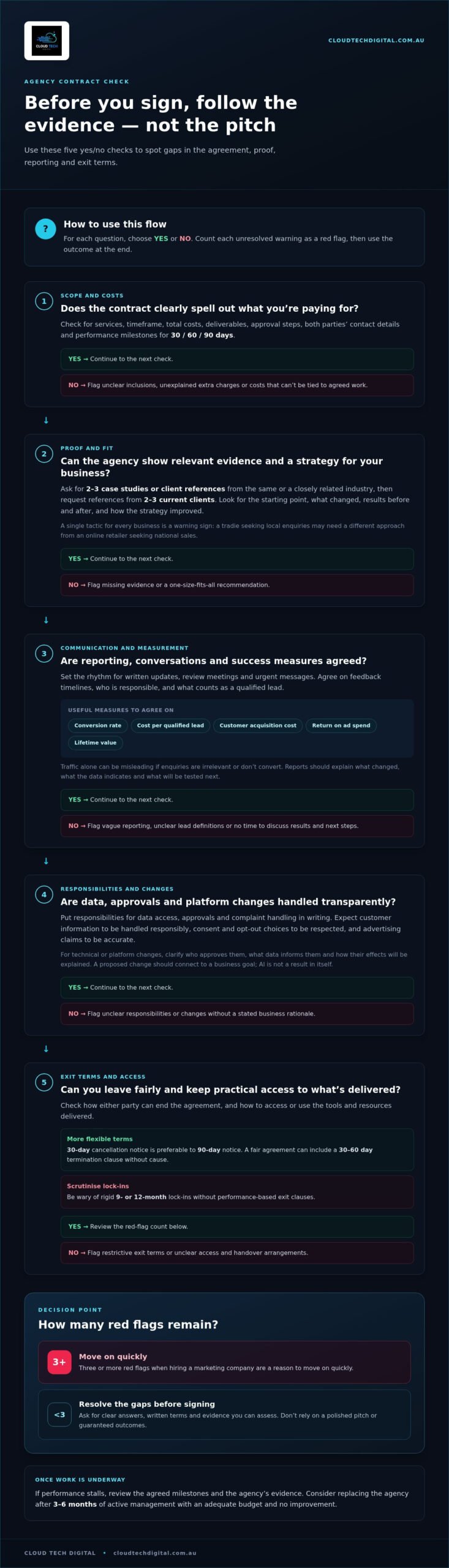
A polished pitch doesn’t mean a marketing agency will turn attention into leads. Three or more red flags when hiring a marketing company are a reason to move on quickly. Pay close attention to conversion rate: it shows whether your marketing is turning visits and clicks into meaningful actions, not just generating activity.
It’s reasonable to expect clear communication, useful reporting and a strategy tied to your business goals. If conversion rates aren’t improving, the agency should explain what it’s testing, what the results show and what it plans to change. Vague reports and guaranteed-outcome promises make it harder to judge performance.
This guide covers practical ways to assess an agency before signing, from contract terms and reporting metrics to strategy, results and services. Learn which warning signs deserve scrutiny, how to distinguish a poor fit from a normal learning period, and what a strong working relationship should make clear from the start.
Key Takeaways
- Make the contract spell out services, deliverables, costs, timelines and how either party can end the arrangement.
- Agree on communication, feedback timelines and reporting metrics so you can connect campaign activity to qualified leads and business outcomes.
- Look for a strategy shaped around your goals and customers, not a single marketing tactic applied to every challenge.
- Use access to performance data and clear explanations of next steps to judge whether campaigns are learning and improving.
- Assess whether the agency’s services work together to support the customer journey, from attracting prospects to converting them.
1. What should a marketing agency contract include?
A clear contract protects both the business and the marketing agency. Before signing, make sure it names the services, timeframe, total costs and contact details for both parties. It should also define deliverables, approval steps and performance milestones for 30/60/90 days, so expectations are clear from the first day.
Look beyond a polished pitch. Ask for 2–3 case studies or client references from the same or a closely related industry, then request references from 2–3 current clients. Check whether the examples explain results before and after the agency’s work, what changed and how the strategy improved. A single tactic for every business is a warning sign: a tradie seeking local enquiries may need a different approach from an online retailer seeking national sales.
Ask how the agency adapts when a platform changes its features or rules, and how it evaluates new tools such as AI. The contract or strategy should clarify who approves technical changes, what data informs them and how their effects will be explained. A proposal should connect a recommended platform change to a business goal, rather than presenting AI as a result in itself.
What Australian privacy, spam and advertising rules should a marketing company follow? Expect the agency to handle customer information responsibly, respect consent and opt-out choices for marketing messages, and keep advertising claims accurate. Put responsibilities for approvals, data access and complaint handling in writing.
What are typical marketing agency fees in Australia, and what pricing practices are warning signs? Fees depend on the work’s scope, channels and technical requirements, and are given after a quote request. Treat unclear inclusions, unexplained extra charges or spending that can’t be tied to agreed work as warning signs; the contract should set out total costs and what they cover.
What questions should I ask a marketing company before signing a contract? Ask who will do the work, what you’ll receive, how results will be assessed and what happens if performance falls short. Also ask how to end the agreement and retain access to or use of the tools and resources delivered.
Check the exit terms carefully. A 30-day cancellation notice is preferable to a 90-day notice, and a fair agreement can include a 30–60 day termination clause without cause. Be wary of rigid 9- or 12-month lock-ins without performance-based exit clauses. If two or more signs of Meta ads underperformance apply, seek a written 30-day recovery plan; an email marketing programme should explain what it includes during its first 90 days.
If performance stalls, review the agreed milestones and the agency’s evidence before deciding. Consider replacing an agency after 3–6 months of active management with an adequate budget and no improvement. At project handover, the agency should explain how to use the tools and resources it delivered, rather than leaving your team without practical access or guidance.
2. Agreeing on communication frequency and reporting metrics
Agree on a communication rhythm before work begins. A reporting dashboard can’t replace a useful conversation about what the numbers mean. Set a schedule for written updates, review meetings and urgent messages, and name the person responsible for each. Match the format to the work: an active campaign may need faster check-ins than long-term SEO.
Set feedback timelines, too. If the agency needs approval for new creative or a landing page, clarify how quickly your team will respond and how delays affect campaign changes. A red flag is receiving reports without time to discuss results, decisions or next steps. Ask for a sample report and make sure you can understand it without specialist marketing knowledge.
Prioritise metrics that connect activity to business outcomes. Useful KPIs include:
- Conversion rate, showing the share of visitors who take a desired action.
- Cost per qualified lead, measuring spend against leads that fit your criteria.
- Customer acquisition cost, comparing marketing and sales costs with new customers.
- Return on ad spend, showing revenue attributed to advertising against its cost.
- Lifetime value, helping assess the longer-term value of acquired customers.
Metrics need context. A rise in website traffic matters less if enquiries are irrelevant or don’t convert. Agree on what counts as a qualified lead, which conversion actions matter and how the agency will track them. For a trade business, that might mean distinguishing quote requests from general page visits. Use consistent definitions in reports to make comparisons meaningful.
What results and performance metrics should a reputable marketing agency promise? It should commit to transparent tracking, regular reporting and a clear plan to improve agreed KPIs, not guaranteed revenue or a fixed number of leads. Results also depend on factors such as the offer, competition, sales follow-up and campaign investment.
Case studies can show how an agency measures its work, but look beyond headline claims. Check whether each example explains the starting point, timeframe, channel and conversion definition. A claimed revenue increase means little without its measurement method and business context. Ask how the agency separates marketing-attributed sales from other sources, such as referrals or repeat customers.
Agree on how reports will lead to action. Each review should identify what changed, what the data indicates and what the agency will test next. If cost per qualified lead rises, the response might examine targeting, the offer or the landing-page journey. Ask why the agency recommends a particular test and when it will assess the effect. Clear metrics turn reporting into decisions, not just charts.
3. Assessing strategy across channels and business goals
A tailored strategy starts with questions, not a ready-made package. Expect 2–3 hours of detailed discovery before an agency presents its plan. That conversation should cover your business goals, customers, services, sales process, capacity and current marketing. For example, a plumber with room for urgent jobs needs a different lead flow from a builder seeking larger renovation projects. If the agency recommends channels before understanding these differences, its plan may be generic.
Templates can help organise a strategy, but they shouldn’t dictate it. Ask how each recommendation connects to your business priorities. If the goal is more qualified enquiries, the agency should explain which audience it will target, what message it will use and how prospects will act. A plan that gives every business the same social posts, ads and SEO work isn’t tailored just because it includes your logo.
Check whether the proposed channels work together. Google search can reach people actively looking for a service, while social media can introduce your business to potential customers earlier. Their roles should support a consistent customer journey, not compete for attention. Ask what each channel contributes, how that contribution will be measured and what the agency will adjust if results don’t match the plan.
A sound strategy draws on evidence from your business, not assumptions presented as certainty. Ask how social media engagement, popular website content and traffic sources will inform decisions. If visitors regularly read a particular service page but don’t enquire, for instance, the agency could examine its message, calls to action and path to contact. Any proposed change should address observed behaviour, rather than simply add another channel.
During the evaluation, look for a clear link between activity and business goals. If your priority is booked work, ask how the strategy will distinguish useful enquiries from clicks or general interest. A campaign can attract traffic without generating conversions, so the plan should explain how both will be assessed. The agency should also show how results will guide refinements to audience targeting, content and customer journeys over time.
Don’t mistake a viral post for a complete strategy. A video may attract attention without generating followers, enquiries or sales if the wider content plan gives viewers no next step. While specialised creative agencies like VISIOLAB can help communicate complex ideas through high-impact visual content, your broader marketing team must ensure those assets connect to a measurable commercial objective. Ask how each piece of content supports a business goal, what follows the initial interaction and how its performance will be assessed. A tailored approach connects channel choices, useful content and conversion paths, then adapts as evidence from your audience builds.
4. HOW CAN I TELL IF MY DIGITAL MARKETING AGENCY IS UNDERPERFORMING?
Start with access to the evidence. You should be able to view the advertising accounts, analytics and reports used to assess your campaigns. Check that reports show dates, channel activity, conversions and agreed business outcomes. An impressive chart doesn’t prove performance if you can’t trace its figures to an account or understand how each result was measured.
Set a baseline and a review point before judging progress. Expect a measurable performance signal within 60–90 days, such as enquiries from a campaign or improved conversion activity. That signal isn’t a promise of a particular revenue result. It gives you evidence to discuss what’s working, what’s not and what the agency plans to adjust.
SEO often takes months to show meaningful progress. Search algorithm updates and changing demand can also affect results beyond an agency’s full control. That makes transparent reporting more important, not less. Ask for updates that show completed work, changes in organic traffic and the next technical or content priorities. If an agency asks you to wait 6+ months before reporting results, treat that as a warning sign.
For paid campaigns, check whether the reports show testing and active management. A Meta campaign with a CTR below 1% for a month or more, and no creative-testing plan, is a warning sign. No new ad creative in the last 30 days may also point to a lack of iteration. For PPC, campaign structure and ad copy should change within 60 days to show testing activity. Ask what each change tested and what the results mean.
Account access matters throughout the work and at handover. Confirm you can access key performance data and see which campaigns, audiences and ads are running. If reports show only total clicks, request a clearer breakdown by campaign and conversion action. A business seeking quote requests, for example, needs to distinguish those enquiries from general website visits. Reports should make that difference visible.
Your website shouldn’t become a black box. If you have the interest and skills, you should be able to make your own website updates. Agree on who controls the content management system, how edits are handled and how changes are recorded. If a service page needs a corrected phone number, for example, clarify the update process so a simple fix doesn’t wait without explanation.
Judge the explanation as well as the numbers. Ask the agency to connect each report to a decision: keep the proven approach, revise the audience or test new creative. Assess social results against the campaign’s purpose, not likes alone. While boosting initial channel numbers through platforms like Greedier Social Media can offer early social proof, your agency should still be accountable for turning real engagement into qualified leads. If several reporting cycles show weak conversions and no clear adjustment, ask for a written recovery plan with actions and review dates. If the response remains vague, the reporting isn’t helping you manage performance.
5. Breadth of digital marketing services
A long service list doesn’t prove a strong digital marketing strategy. The key question is whether the agency can identify the right mix for your business and give each channel a clear role. A tradie might use search to reach people seeking a service, social media to build familiarity, and a focused landing page to turn interest into an enquiry. Each channel should support the same commercial goal.
Limited breadth can be a warning if an agency forces its only specialty onto every problem. If it recommends social media for a business whose customers mainly search when they need urgent repairs, ask how that channel will reach them. The reverse can happen, too: paid search may capture existing demand but do little to build awareness among people who haven’t started searching. Strong advice explains the trade-offs, not just the preferred channel.
Assess how the agency connects different parts of the customer journey. A prospect might discover a business through social content, compare services on its website, then submit an enquiry after seeing a relevant search result. If those touchpoints use different messages or lead to an unclear page, opportunities can be lost. Ask how the agency will keep the offer, audience and next step consistent across its recommended channels.
Broader capabilities can help when a campaign reveals a problem beyond its original channel. Paid traffic may reach the intended audience, for example, but visitors leave without enquiring. The next step could be reviewing the page’s headline, service details, trust signals and enquiry process, rather than increasing advertising activity. The agency should explain how it will identify the obstacle and what work could address it.
That doesn’t mean every business needs every service. Extra channels can spread attention and budget without improving the path to a sale. Ask the agency to separate essential work from optional opportunities, explain how each activity supports your goal and show how its contribution will be assessed. If it recommends a new channel, it should identify the audience, message and action the channel is expected to support.
Judge breadth by coordination, not volume. An agency that understands search, paid campaigns, social media and website journeys can spot when one part weakens another. Strong traffic with few enquiries, for instance, may point to a mismatch between an ad and its destination page. Choose a partner whose capabilities match the problems your business needs solved, and who can explain why each channel belongs in the plan.
If your campaign is attracting visitors but not enquiries, explore ways to improve the customer journey from first click to conversion.
Cloud Tech Digital: Lead Generation Agency in Australia
Cloud Tech Digital helps Australian trade businesses connect digital marketing with lead generation. If campaigns aren’t producing useful enquiries, its lead generation service can focus activity on attracting potential customers. Pay-per-click campaigns can reach people actively searching, while web design and landing pages can create a clearer path from click to enquiry.
The right starting point depends on where your marketing journey is breaking down. If potential customers aren’t finding your business, paid campaigns may help build visibility. If people visit your website but don’t enquire, a landing page or website review may better address the gap. Contact Cloud Tech Digital to discuss your marketing needs.
Choose a marketing partner that fits your next stage
Use your evaluation to decide what your business needs next, not just which agency has the sharpest pitch. The right fit should help you act on evidence, reach the customers you want and connect marketing with commercial priorities. Taking red flags when hiring a marketing company seriously can help you avoid a partnership that drains time without addressing the real problem.
For Australian trade businesses ready to generate enquiries, Cloud Tech Digital offers lead generation, pay-per-click and Facebook ad management. These services help businesses attract prospects through targeted digital campaigns. Outline your goals and discuss an approach that suits your business.
Contact Cloud Tech Digital to start the conversation. A clear plan can put your marketing decisions on firmer ground.
Frequently Asked Questions
WHY IS CONVERSION RATE IMPORTANT WHEN EVALUATING A MARKETING AGENCY?
Conversion rate shows whether marketing prompts people to take a meaningful action, such as submitting an enquiry. If a campaign brings visitors to a service page but few request a quote, for example, the agency should investigate the audience, message and page experience. This helps distinguish useful progress from traffic that looks impressive but isn’t creating opportunities for your business.
HOW CAN I TELL IF MY DIGITAL MARKETING AGENCY IS UNDERPERFORMING?
Look for a pattern of weak business outcomes paired with no clear response from the agency. Compare campaign activity with your agreed goal, such as qualified enquiries, and ask what the team has changed after reviewing results. A measurable signal should appear within 60–90 days. SEO can take 6–12 months to demonstrate traction, so assess progress against channel-specific work and evidence, not one short-term result.
How long should it take to know if a marketing agency is working?
You should expect an early measurable signal within 60–90 days, though the signal depends on the channel and campaign goal. Paid advertising can show testing activity through changes to targeting or creative, while SEO usually needs more time to demonstrate meaningful progress. Agree on what early evidence looks like before work starts, then review whether activity is generating learning and moving towards your business objective.
What are the biggest red flags of a bad marketing agency?
Warning signs include guaranteed rankings, unexplained reporting, restricted access to your campaign data and a strategy that ignores your business model. A promise of number-one Google rankings overnight deserves particular caution. So does a proposal that recommends the same channel mix to every business. Treat red flags when hiring a marketing company as reasons to ask for evidence, clear reasoning and specific next steps.
What should a marketing agency contract include?
A useful agreement identifies the services, deliverables, timeframe, total costs and contacts for both parties. It should also set out approval responsibilities, performance milestones, reporting arrangements and how either party can end the work. Read the handover terms closely: clarify what happens to campaign materials, website content and account access when the engagement finishes. Clear written expectations make it easier to resolve disagreements about what was promised.
What are the biggest red flags when hiring a marketing agency in Australia?
In Australia, be cautious of agencies that make absolute performance promises, avoid explaining their methods or can’t show relevant work. Check that advertising copy and marketing messages are accurate, and that campaigns handle customer information and email preferences responsibly. A proposal should explain who approves public claims, how enquiries are tracked and what happens when a campaign needs adjustment. Put those responsibilities in writing before signing.
How can I verify an Australian marketing agency’s case studies, references and reviews?
Ask for 2–3 case studies or client references from businesses in the same or a related industry. For each case study, look for the starting situation, work completed, measurement method and context behind the outcome. Request references from 2–3 current clients and ask about communication, reporting and how the agency handled challenges. For reviews, compare specific details across comments rather than relying on a rating alone.
What should an Australian marketing agency contract disclose about fees, deliverables, ownership and cancellation?
The contract should state total costs, what services and deliverables they cover, and when work will be completed. It should clearly explain who controls advertising accounts, website access and campaign assets during the engagement and after handover. Check the cancellation notice and any termination conditions before signing. If a term is unclear, ask for a plain-language explanation and written wording that matches your agreement.
