


What if your ads are bringing in clicks, but not the right jobs? For a busy trade business, that gap can make a pay per click agency in Australia hard to assess. The dashboard may look active while enquiries fail to turn into suitable work.
Clicks show attention, not whether a campaign is attracting work your team can take on. A capable PPC partner should make the path from ad spend to enquiry clearer, track lead quality and adjust campaigns based on what’s working. The measures that matter should connect to your business, not stop at a click count.
In this guide, you’ll learn what a tradie-focused PPC agency should manage, how to assess enquiry quality and how to judge ongoing management by business outcomes. You’ll also see how Cloud Tech Digital combines PPC management and lead tracking with conversion-focused websites and landing pages, helping you follow the journey from campaign to contact. The aim is practical: choose an accountable partner without adding another job to your already full day.
Key Takeaways
- Assess campaign management by how well it supports your trade-business goals, not simply by whether ads are running.
- Follow the journey from ad click to enquiry, qualification and follow-up to spot where useful leads may be getting lost.
- Compare agency, in-house and DIY management against the time, expertise and oversight your business can realistically provide.
- See how a pay per click agency in Australia can use ongoing monitoring, lead tracking and strategy adjustments to support tradie-focused campaigns.
- Prepare your services, lead goals, capacity and campaign details to make discussions about priorities and reporting more productive.
What an AU PPC Agency Should Deliver for Tradies
A PPC agency should do more than switch on ads and report that people clicked. Its role is to plan paid campaigns around your business, monitor performance, track enquiries and adjust the strategy as useful information comes in. For tradies, that means connecting advertising activity with relevant work opportunities, not treating a busy dashboard as the end result.
A click is an advertising event; a useful, trackable enquiry is a business outcome. Impressions show that an ad appeared, clicks show that someone visited, and click-through rate shows the share of impressions that led to clicks. These are useful signals, but none proves that a person needs your service, suits your work or becomes a customer.
What does a PPC agency manage?
Pay-per-click (PPC) describes an online advertising model where advertisers pay when someone clicks an ad. Professional management covers the planning and follow-through: setting up campaigns, monitoring performance, tracking leads and making strategy adjustments. The agency management fee and the advertising spend paid to the platform are separate costs, so reporting should clearly distinguish between them.
If an ad attracts visits but few people enquire, the next step isn’t simply to chase more clicks. The campaign setup, the ad’s promise and the page a visitor lands on are all worth reviewing. Lead tracking helps connect advertising activity with incoming enquiries, while ongoing monitoring gives the agency information to guide adjustments. This supports better decisions, but it can’t guarantee a fixed number of leads, booked jobs or a particular return.
Why tradies need a business-first PPC brief
Campaign priorities depend on the trade, the services offered, available capacity and the types of jobs that make commercial sense. A tradie who wants more of one service may need a different focus from a business promoting several services. If your team is already fully booked for a particular job type, attracting more enquiries for that work may not be the best use of campaign effort.
For example, a business that takes on both urgent repairs and larger planned projects may need to promote those services differently. The customers’ needs and the value of each enquiry can vary. A business-first brief clarifies which services to promote, what a suitable enquiry looks like and what your team can take on. That gives campaign planning a practical direction instead of relying on broad click and traffic targets.
When setting expectations, consider whether an enquiry matches your services, can be handled by your team and represents a worthwhile job opportunity. A high volume of low-fit clicks can absorb time without helping the business. Depending on your goals and capacity, a smaller number of relevant enquiries may be more useful.
For a wider view of how paid campaigns fit into a tradie’s growth plan, explore this Australian tradie lead-generation guide. A clear brief gives a pay per click agency in Australia a stronger basis for planning, tracking and improving campaigns around the work you want.
How a PPC agency tracks campaign performance beyond clicks
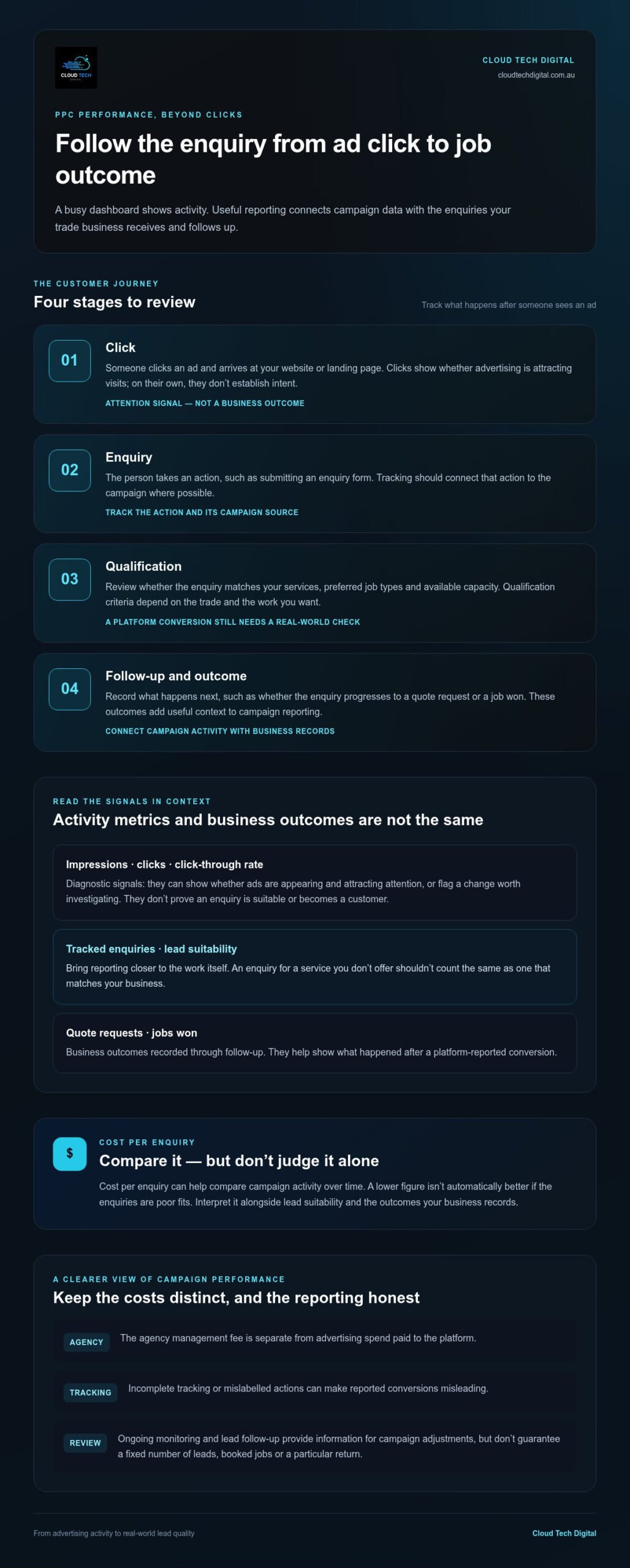
Useful reporting follows the customer journey, not just activity inside the ad platform. A platform may record a conversion when someone completes a tracked action, but that doesn’t tell you whether the person needs your service, fits your capacity or becomes a customer. A practical measurement process connects campaign data with the enquiries your business receives and follows up.
A qualified PPC lead is an enquiry that fits the business’s services and is worth reviewing against its capacity and job priorities. The criteria depend on the trade and the work you want. There’s no single qualification rule that suits every tradie.
- Click: A person clicks an ad and arrives at your website or landing page. Clicks show whether advertising is attracting visits, but don’t establish intent on their own.
- Enquiry: The person takes an action, such as submitting an enquiry form. Tracking should connect that action to the campaign where possible.
- Qualification: Your business reviews whether the enquiry relates to your services, preferred job types and available capacity. A platform-reported conversion may not pass this real-world check.
- Follow-up and outcome: Record what happens next, such as whether the enquiry progresses to a quote request or a job won. These outcomes add useful context to campaign reporting.
Which PPC metrics help a trade business make decisions?
Clicks, impressions and click-through rate are diagnostic metrics. They can show whether ads are appearing and attracting attention, or flag a change worth investigating. Tracked enquiries bring the analysis closer to the work itself. Lead suitability adds another layer: an enquiry for a service you don’t offer shouldn’t count the same as one that matches your business.
Cost per enquiry can help you compare campaign activity over time, but it needs context. A lower figure isn’t automatically better if the enquiries are poor fits. Keep marketing measures separate from business outcomes, too. The platform can report a conversion; your records can show whether it led to a quote request or a job won.
How lead tracking supports optimisation
Reliable tracking gives an agency a clearer basis for reviewing which campaigns produce enquiries and whether those enquiries appear relevant when your business follows them up. If tracking is incomplete or actions are mislabelled, reported conversions can be misleading. Reporting should distinguish platform-recorded actions from enquiries your business has reviewed, so decisions don’t rely on a conversion count alone.
Monitoring and strategy adjustments should follow the available data. If a campaign generates enquiries but few are relevant, investigate the campaign and its message rather than assuming more clicks will solve the problem. This Google Ads guide for plumbers offers an example of campaign planning in a specific trade context.
For a clearer view of this approach, explore Cloud Tech Digital’s PPC management. A pay per click agency in Australia should explain what its reporting counts, how it uses lead tracking and how observed performance informs campaign adjustments.
PPC agency, in-house management or DIY: compare the trade-offs
There isn’t one right way to manage paid campaigns. The practical choice depends on how much time you can set aside, how complex the campaigns are and whether someone can regularly review enquiries and campaign data. An agency can provide specialist support, but ongoing management is most useful when its work and reporting help you make clearer decisions.
| Management approach | Time | Expertise | Oversight |
|---|---|---|---|
| Agency management | Requires time for communication, sharing business priorities and reviewing updates, while the agency handles campaign management. | Provides access to specialist campaign planning and ongoing management. | Can offer consistent monitoring and reporting, with clarity depending on how the relationship is managed. |
| In-house management | Needs dedicated staff time for campaign tasks as well as the business’s other responsibilities. | Builds internal knowledge, though expertise depends on the person’s experience and time for development. | Offers direct visibility, provided someone regularly checks performance and lead quality. |
| DIY management | Places setup, monitoring and adjustments on the owner or another team member. | Requires the business to learn the advertising tools and apply that knowledge to its campaigns. | Offers hands-on control, but oversight can become inconsistent when trade work takes priority. |
This comparison isn’t a scorecard. A straightforward campaign and a hands-on owner may suit in-house or DIY management. A business with several services, limited time or a need for regular campaign reviews may prefer outside support. Weigh the commitment against the time and attention your business can realistically provide. An agency won’t automatically produce better results simply because it manages the campaign.
When does agency management make practical sense?
Agency management may suit an owner who wants campaign expertise without taking on every setup and monitoring task personally. That can help when quoting, scheduling jobs and managing staff already fill the week. Regular oversight is also useful when you need to review whether enquiries align with your work priorities. The arrangement should have a clear purpose and communication that fits your working day.
What should clear PPC reporting show?
Reports should connect advertising activity with tracked enquiries and the priorities agreed with your business. They should explain what changed, what the available data suggests and what action is proposed next, in plain English. A report full of platform terms isn’t useful if you can’t see how it informs decisions. Look for a clear distinction between campaign activity, recorded enquiries and business outcomes.
Paid campaigns can sit alongside organic search rather than being treated as a separate plan. An SEO strategy for Australian tradies, for example, can help explain how paid and organic activity may complement each other. A pay per click agency in Australia should make its role, reporting and adjustments understandable, so you can judge whether ongoing management is useful to your business.
If you’re weighing up managed support, explore PPC management support as an option for maintaining campaign oversight while you focus on running your trade business.
How Cloud Tech Digital manages PPC for trade businesses
Tradie campaigns need management grounded in the realities of running a trade business. Cloud Tech Digital is an Australian-owned digital marketing agency specialising in lead generation for tradies. Its PPC management includes ongoing performance monitoring, lead tracking and strategy adjustments, connecting campaign decisions with the enquiries a business wants to attract.
A plumber, electrician or builder may offer different services, have different job priorities and face different capacity constraints. Campaign management needs to reflect those differences rather than treating every trade business as interchangeable. Campaign and lead information can guide decisions, but no single approach will suit every business.
Ongoing campaign management and lead tracking
Campaigns need attention after launch. Ongoing monitoring shows how advertising is performing, while lead tracking helps connect campaign activity with enquiries. Together, these give the agency useful information to review whether campaigns are attracting the kinds of enquiries your business wants to consider.
Strategy adjustments can respond to what the data shows. If tracked enquiries suggest a campaign isn’t aligned with your priorities, that’s a reason to review its direction, not a promise that a particular change will produce a set result. The value is in monitoring, learning and making considered adjustments instead of leaving campaigns untouched or changing them without a clear reason.
Cloud Tech Digital’s client testimonials describe measurable sales increases and rapid lead turnover. These accounts offer insight into client experiences, not a guarantee of what another trade business will achieve. Campaign performance depends on each business and its circumstances.
PPC alongside other digital marketing services
PPC is one part of Cloud Tech Digital’s wider digital marketing work, which also includes SEO, social media advertising, websites and landing pages. These services can help a business consider how different channels support its visibility and lead generation, rather than viewing every campaign in isolation.
The page a person reaches after clicking an ad matters. A relevant landing page can keep the message focused on the advertised service and give prospective customers a clear next step. If the page doesn’t relate clearly to the ad, visitors may struggle to work out what to do. A purpose-built page can support the journey from ad visit to enquiry, although it can’t guarantee that every visitor will take action.
If your campaigns need a more focused destination, explore web design for tradies for ideas on conversion-focused pages. Cloud Tech Digital combines PPC management with supporting digital services, keeping campaign monitoring, lead tracking and adjustments connected to trade-business priorities.
To discuss PPC support for your trade business, explore Cloud Tech Digital’s PPC management and consider how ongoing campaign oversight could support your lead-generation goals.
Take the next step with a PPC agency in Australia
A productive PPC conversation starts with the realities of your trade business, not a generic promise about clicks. Be ready to explain the work you want more of, what your team can take on and how you judge whether an enquiry is worth pursuing. This context helps shape campaign priorities and makes it easier to discuss what useful progress looks like.
Prepare your business for a PPC conversation
You don’t need a polished marketing plan. A few practical details can make the discussion more focused:
- Services and job types: Note the services and work you most want to promote, including any jobs that aren’t a priority.
- Lead goals: Describe the enquiries you hope to attract and what makes one worthwhile for your business.
- Capacity: Be clear about the work your team can currently take on. Campaign priorities should reflect operational capacity, not just demand.
- Existing campaign information: Gather available advertising records, website or landing page details and previous reporting.
- Enquiry follow-up: Explain how your business handles incoming enquiries and what you know about which ones progress.
These details help distinguish a campaign that needs a new direction from one that needs clearer tracking or a more relevant page. If you don’t have every record to hand, share what you do know. A straightforward picture of your current setup is more useful than guessing at past results.
Agree on goals, tracking and communication
Before ongoing management begins, clarify what the campaign is intended to support and how performance will be reviewed. Agree on what counts as an enquiry in reporting, how lead tracking connects campaign activity to incoming enquiries, and how to distinguish a recorded action from a relevant lead or job opportunity. Clear definitions make reports easier to interpret and decisions more grounded.
Discuss what regular communication should cover, too. Useful reporting explains activity in plain English, highlights what the data can and can’t show, and outlines proposed strategy adjustments. You should understand which business priorities guide those adjustments and how your feedback about enquiry quality informs future reviews. That’s more practical than relying on a dashboard without context.
Keep expectations realistic. PPC results can vary with competition, campaign setup, landing pages and how enquiries are followed up. Tracking can help clarify what’s happening, but it can’t remove those variables or guarantee a set number of leads, booked jobs or return. A capable pay per click agency in Australia should be clear about what it measures and how it uses the available information.
If you’re ready to discuss campaign priorities, lead tracking and ongoing management for your trade business, Talk to Cloud Tech Digital about PPC.
Make your next PPC decision with confidence
The most useful next step isn’t to chase a bigger dashboard. Decide what you want advertising to make possible, then build a working relationship around that aim. Keep a simple record of incoming enquiries and what happens to them. Over time, those notes can give campaign discussions more context than a click count alone.
That feedback keeps decisions connected to the work your team can take on. It also gives you a clearer basis for reviewing whether the campaign still fits as your services, priorities or capacity change. A pay per click agency in Australia should explain its recommendations plainly and adapt its approach as useful information builds.
Cloud Tech Digital works with tradies on PPC management focused on generating and tracking enquiries. If you’re ready to explore an approach that fits your business priorities, talk to Cloud Tech Digital about PPC management. Take the next step with a clear view of the work you want and build from there.
Frequently Asked Questions
How quickly can a PPC agency start generating enquiries?
There’s no dependable fixed timeframe for enquiries to begin. Timing depends on factors such as setup, competition, the page people land on and whether the service matches what they’re searching for. Before launch, clarify what needs to be ready, including campaign information and enquiry tracking. Once ads are running, treat early activity as information to learn from, not a promise that enquiries or booked jobs will arrive by a particular date.
Can PPC work for a small trade business?
Yes, PPC can suit a small trade business when the campaign reflects its priorities and the owner can manage the enquiries it attracts. A focused approach might promote one service the team has capacity to take on, rather than trying to advertise everything at once. A pay per click agency in Australia can shape campaign management around your services and lead goals without assuming every small business needs the same setup.
Does a PPC agency guarantee leads or booked jobs?
No agency should treat a particular number of leads or booked jobs as certain. Advertising can create opportunities to reach potential customers, but demand, competition and customer decisions all affect what happens next. Booked work also depends on factors beyond campaign management, including whether the enquiry fits your services and how your business handles it. Set clear expectations about what the agency manages and what outcomes it can track, rather than relying on a guaranteed figure.
Do I pay the PPC agency or the advertising platform?
These are usually separate costs: the agency charges for campaign management, while advertising spend goes to the platform running the ads. Reporting should clearly distinguish the amount allocated to advertising from the professional management fee. This makes it easier to understand what you’re paying for and assess campaign activity against the agreed plan.
Can I pause a PPC campaign if my trade business is fully booked?
You can discuss pausing or adjusting campaigns if your team has no capacity for more work. Let the campaign manager know which services are fully booked and whether other work remains a priority. That context can guide the next step, rather than stopping all advertising when only one service is at capacity. Clarify how the adjustment will appear in campaign management and reporting.
What should I do if PPC enquiries are not turning into jobs?
Start by looking at where enquiries fall away. Check whether they match your services, whether prospective customers receive a clear next step and whether your follow-up helps them progress towards a quote. Share that feedback with your campaign manager and compare it with the available tracking. If enquiries are unsuitable, the campaign may need review. If they’re relevant but don’t proceed, look at the contact and quoting process before assuming advertising is the only issue.
