


Most Australian tradies treat marketing like a lucky dip, throwing a few hundred bucks at Facebook when the phone stops ringing and wondering why the leads don’t stick. The truth is, creating a trade business marketing budget isn’t about finding money you have left over; it’s about building a predictable system that buys you new customers at a profit. You likely already know the frustration of watching your hard-earned cash disappear into ads that don’t convert, leaving you with an unpredictable schedule and a lot of unnecessary stress.
This guide is here to change that by giving you a clear, percentage-based roadmap for 2026. We’ll show you how to calculate your spend based on your specific growth goals, whether you’re a solo operator or scaling a larger team. You’ll learn how to stop the “spray and pray” approach and start allocating funds to the channels that actually move the needle, from high-performance local SEO to precision PPC. We are diving into the exact formulas you need to ensure every dollar you invest generates the high-quality leads your business deserves.
Key Takeaways
- Stop treating marketing as a leftover expense. Learn how shifting to a proactive investment model ensures your phone keeps ringing even during quiet seasons.
- Follow our proven step-by-step formula for creating a trade business marketing budget that factors in your average job value and 2026 growth targets.
- Compare the “bang for buck” between high-intent Google Ads and long-term SEO to build a balanced lead generation engine.
- Identify the critical metrics, like Customer Acquisition Cost (CAC), that tell you exactly which ads are making you money and which are just burning cash.
- Understand why professional management and high-performance landing pages are essential to stop wastage and maximise your return on investment.
Why Most Australian Tradies Fail with Their Marketing Budget
Most Australian trade business owners treat their marketing like a luxury rather than a necessity. They fall into the “Leftover Trap,” waiting until the end of the month to see what’s sitting in the bank before deciding if they can afford an ad or two. This reactive approach kills growth. When you’re creating a trade business marketing budget, you have to stop viewing it as a bill to be paid and start seeing it as a customer acquisition engine. If you only fuel the engine when you feel flush, you’ll never achieve the momentum needed to scale.
There’s a fundamental difference between a fixed cost and a strategic investment. High-performing firms understand that marketing spending is a variable investment designed to produce a specific, measurable result: more booked jobs. Many tradies get distracted by “brand awareness,” a vague concept that works for multi-billion dollar corporations but does very little for a local plumber or sparkie. In the volatile 2026 digital landscape, you don’t need people to “know your name” eventually. You need them to click your ad and call you right now. This requires a shift toward direct-response marketing where every dollar has a job to do.
The Cost of Inaction: What “Zero Marketing” Actually Costs You
Relying solely on word-of-mouth is a dangerous game. While referrals are great, they’re unpredictable. This lack of control leads to the “feast or famine” cycle that keeps business owners awake at night. The true cost of zero marketing is the opportunity cost of missed high-value projects. While you’re waiting for the phone to ring, competitors with structured budgets are aggressively capturing the most profitable leads in your area. They aren’t better at the trade; they’re just better at being found when a customer is ready to buy.
Common Budgeting Blunders in the Trade Industry
We often see businesses over-investing in low-intent social media channels without a proper funnel in place. Posting a photo of a finished bathroom on Facebook might get a few likes, but it rarely converts into a high-margin contract unless it’s backed by a strategic Lead Generation Agency in Australia. Another common pitfall is underestimating the “Google Tax.” As competition increases, the cost-per-click for high-intent keywords continues to rise. If your budget is static and doesn’t account for these market shifts, your visibility will drop. Failing to track the source of every lead is the final nail in the coffin. Without data, you’re just guessing which parts of your spend are working and which are simply wasting cash.
Calculating Your 2026 Trade Marketing Budget: The Step-by-Step Formula
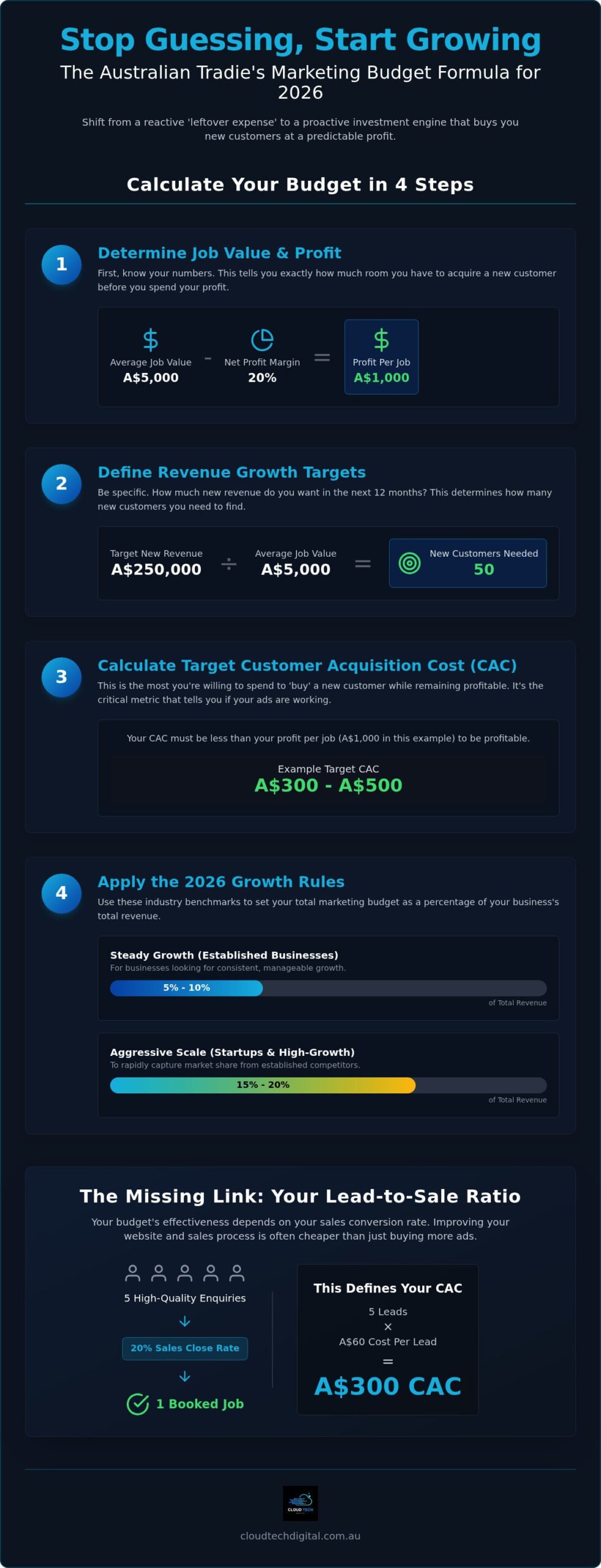
Creating a trade business marketing budget is a mathematical exercise, not a guessing game. To build a lead machine that delivers consistent results, you need to work backward from your financial goals. Use this four-step formula to find your numbers:
- Step 1: Determine your average job value and net profit margin. If your average installation is A$5,000 and your net profit margin is 20%, you have A$1,000 in profit per job. This tells you exactly how much “room” you have to acquire a customer.
- Step 2: Define your revenue growth targets. Be specific about the next 12 months. If you want to add A$250,000 in new revenue, and your average job is A$5,000, you need 50 new customers.
- Step 3: Calculate your Target Customer Acquisition Cost (CAC). This is the maximum amount you’re willing to pay to “buy” one of those 50 customers.
- Step 4: Apply the 2026 Growth Rules. For established businesses looking for steady growth, allocate 5% to 10% of your total revenue. If you are in aggressive scale mode or a startup, you should aim for 15% to 20% to capture market share from established competitors.
The Lead-to-Sale Ratio: The Missing Link in Your Budget
Your sales conversion rate is the invisible lever in your budget. If your team closes 20% of enquiries, you need five leads to secure one job. If each lead costs A$60, your CAC is A$300. However, if your website is a high-performance machine, you will convert more visitors into callers. This is why investing in web design for tradies is often more cost-effective than simply increasing your ad spend. An optimised site effectively doubles your budget by turning more of your existing traffic into booked jobs without spending an extra cent on Google Ads.
Adjusting for Seasonality in Australia
Australian weather patterns heavily dictate trade demand. Plumbers should allocate a higher portion of their budget for emergency calls during the winter months, while sparkies and AC technicians need to go hard when the summer heat hits. Smart operators build a “War Chest” during these peak times. This allows you to maintain brand dominance and keep your best technicians busy when competitors are pulling back during slower periods. For an Australian trade business, Marketing ROI is defined as the total net profit generated from marketing-sourced leads divided by the total marketing spend over the financial year. If you want to ensure your seasonal spikes remain profitable, a specialist lead generation partner can help you map out your annual spend with precision.
Where to Allocate Your Spend: Comparing High-ROI Tradie Channels
Deciding where your money goes is just as vital as the total amount you spend. When you’re creating a trade business marketing budget, you need to think like an investor building a diversified portfolio. Putting all your eggs in one basket is a bingle that leaves your lead flow vulnerable to algorithm changes or price hikes. A high-performance strategy in 2026 balances immediate “emergency” leads with long-term brand equity.
Google Ads (PPC) remains the fastest way to get the phone ringing. When a pipe bursts or the power goes out, customers don’t scroll social media; they search Google. This high-intent traffic is expensive but delivers immediate cash flow. Conversely, Search Engine Optimisation (SEO) is your long-term play. It builds a foundation that allows you to show up organically, eventually reducing your reliance on paid ads. For builders and chippies, visual platforms like Instagram and Facebook provide the “proof in the pudding,” allowing you to showcase craftsmanship and build local trust before a prospect even asks for a quote.
SEO vs PPC: Balancing Short-Term Wins with Long-Term Value
PPC is essential for new businesses or those entering a growth phase because it buys you a seat at the table instantly. You don’t have to wait months to see a return. However, as your business matures, SEO for tradies becomes the most valuable asset you own. It works 24/7 to lower your average cost-per-lead. For an established firm, we typically recommend a budget split of 60% toward SEO and 40% toward PPC. This ratio ensures you’re capturing immediate demand while simultaneously building an organic lead machine that doesn’t stop the moment you turn off the ad spend.
The Role of Social Media for Trade Professionals
Social media shouldn’t be your primary lead source, but it’s a powerful tool for conversion. Use a portion of your budget to create high-quality “Before and After” content. This visual evidence does the heavy lifting in the sales process. We also suggest using Facebook ads for tradies specifically for retargeting. This means showing ads only to people who have already visited your website but didn’t call yet. It keeps your brand top-of-mind for a fraction of the cost of cold targeting. Avoid the trap of “Boosted Posts,” which are designed to drain your budget with vanity metrics like likes rather than actual enquiries. Managed campaigns with specific lead-generation objectives are the only way to ensure a real return on investment.
Managing Your Marketing Cash Flow and Tracking Performance
Managing the cash is just as vital as spending it. When you’re creating a trade business marketing budget, your first move should be setting up a dedicated marketing bank account. This simple step ensures you aren’t accidentally “borrowing” from your GST, PAYG, or Super obligations to pay for ads. Once your funds are separated, you need a clear view of how they’re performing. Setting up robust lead tracking is non-negotiable. This includes call tracking to see which ads trigger phone enquiries, form tracking for website submissions, and CRM integration to follow a lead from the first click to the final invoice.
Every month, you must conduct a performance review. Compare your actual Customer Acquisition Cost (CAC) against the target CAC you established earlier. This is the time to identify and kill “Zombie” campaigns. These are ad sets or keywords that look active and eat your budget but never actually result in a booked job. If a high-volume keyword is costing you A$100 per lead but your conversion rate on those leads is zero, it’s a zombie. Cut the spend immediately and reallocate that capital to the keywords that are actually putting vans on the road.
Key Metrics That Actually Matter to Your Bottom Line
Don’t get distracted by vanity metrics like “impressions” or “reach.” Cost Per Lead (CPL) is a helpful benchmark, but Cost Per Sale (CPS) is the metric that dictates your bank balance. You also need to monitor your Lead Quality Score. Ten “tyre-kicker” leads who are just price-shopping are significantly worse for your business than two “ready-to-book” leads who need an emergency fix. To see the full picture, calculate your Return on Ad Spend (ROAS). For a service business, this is your total revenue generated from ads divided by the total ad spend. If you spend A$2,000 and book A$10,000 in work, your ROAS is 5x, which is a solid baseline for most Australian trades.
Scaling Your Budget as You Grow
Once you’ve proven that your marketing engine is profitable, it’s time to reinvest. Scaling isn’t just about spending more; it’s about knowing when you’ve hit the point of “Diminishing Returns.” This happens when you’ve tapped out the local demand in your primary service area. If doubling your spend only results in a 10% increase in leads, you’ve reached the limit of that specific market. At this stage, you need to expand your service radius or introduce new high-margin services to keep growing. For a deeper look at these scaling strategies, read our Marketing for Tradies guide. If you’re ready to stop guessing and start tracking every dollar, talk to our lead generation experts today.
Scaling Your Trade Business with Professional Marketing Management
Many business owners fall into the DIY trap, thinking they’re saving money by managing their own Google Ads on the weekend. In reality, this often costs significantly more in wasted spend than a professional management fee ever would. Google’s default settings are designed to maximise their profit, not your booked jobs. When you’re creating a trade business marketing budget, you have to account for the efficiency of your spend. A specialist Lead Generation Agency in Australia doesn’t just run ads; they optimise every touchpoint to ensure your cost-per-lead stays low and your lead quality remains high.
Transparency is the foundation of a good partnership. You should demand to see exactly where every cent of your budget is going. If an agency hides behind vague reports or “proprietary data,” it’s time to walk away. At Cloud Tech Digital, we focus on keeping your marketing budget lean and mean by cutting out the fluff and focusing solely on high-intent leads. We understand that trade margins are tight, so we treat your ad spend as if it were our own, constantly refining campaigns to squeeze the maximum value out of every dollar.
The ROI of Expert Management
Professional optimisation goes far beyond picking a few keywords. It involves constant A/B testing of landing pages, negative keyword auditing to stop your ads showing for irrelevant searches, and bid management to keep you at the top of the page when it matters most. This expertise directly reduces your CPL and frees up your time to focus on quoting and on-site work. Furthermore, we offer fixed-price web design to prevent the budget blowouts that often occur with traditional agencies. This ensures your online “shop front” is a high-performance lead machine without the unexpected financial sting.
Your 2026 Growth Plan Starts Here
Success in 2026 requires a shift from reactive spending to proactive investment. Remember the framework: established businesses should aim for 5 to 10 percent of revenue, while those in aggressive growth mode should push toward 15 to 20 percent. By separating your marketing funds, tracking every enquiry, and balancing short-term PPC wins with long-term SEO value, you build a business that isn’t reliant on luck or a few good referrals. It’s time to stop guessing and start growing with a data-driven strategy. If you’re ready to see exactly where your current strategy is leaking cash, contact Cloud Tech Digital for a comprehensive performance audit and let’s get your vans moving.
Fuel Your Trade Business Growth for 2026
Moving away from the “leftover” trap is the first step toward scaling your business with confidence. By creating a trade business marketing budget based on average job values and clear revenue targets, you turn your marketing into a predictable customer acquisition engine. Success requires balancing immediate cash flow from high-intent PPC with the long-term sustainability of SEO, while keeping a sharp eye on your customer acquisition costs.
You don’t have to navigate the complexities of digital advertising alone. Cloud Tech Digital is Australian-owned and operated since 2020, offering specialist lead generation specifically for plumbers, sparkies, and builders. We focus on delivering proven ROI with measurable sales increases so you can spend more time on-site and less time worrying about the phone. Stop wasting your marketing budget and start generating high-quality leads with Cloud Tech Digital today.
Your growth is just a strategic plan away. It’s time to stop guessing and start building the stable, high-performing trade business you’ve worked so hard for.
Frequently Asked Questions
What is a good marketing budget for a small trade business in Australia?
A solid marketing budget for a small Australian trade business typically ranges from 5% to 10% of total revenue. If you are in an aggressive growth phase, you should expect to invest between 10% and 20% to capture market share. Creating a trade business marketing budget requires looking at your specific goals rather than just following industry averages. This ensures you have enough capital to fuel your lead generation without overextending your cash flow.
How much should I spend on Google Ads as a plumber or electrician?
Most plumbers and sparkies find that a monthly Google Ads spend between A$1,000 and A$4,000 delivers a meaningful volume of high-intent leads. In highly competitive metro markets, a budget of A$1,200 to A$2,000 per month is usually the minimum required to maintain visibility against larger competitors. This spend should be paired with high-performance landing pages to ensure you aren’t wasting your budget on clicks that don’t convert into booked jobs.
Is SEO worth the investment for a local trade business in 2026?
SEO remains a vital investment in 2026 because it builds long-term organic equity that reduces your reliance on paid ads. While Google Ads provides immediate results, SEO lowers your average cost-per-lead over time. A monthly local SEO retainer in Australia typically ranges from A$800 to A$2,500. It is the most sustainable way to ensure your business remains visible to local customers without having to pay for every single click indefinitely.
How do I calculate my Customer Acquisition Cost (CAC)?
To calculate your Customer Acquisition Cost (CAC), divide your total marketing spend by the number of new customers acquired during that same period. For example, if you spend A$2,000 on ads and secure 10 new jobs, your CAC is A$200. Understanding this number is critical when creating a trade business marketing budget. It allows you to see exactly how much profit is left over after you’ve paid to get the customer through the door.
Should I manage my own Facebook Ads or hire an agency?
Hiring an agency is almost always more cost-effective than the DIY approach. Managing your own ads often leads to the “DIY trap,” where small mistakes in targeting or bidding result in significant wasted spend. A specialist agency understands trade margins and uses advanced tracking to optimise your campaigns for actual sales. This frees up your time to focus on quoting and on-site work while experts handle the technical side of lead generation.
What percentage of my revenue should go toward marketing?
Established trade businesses should allocate between 5% and 10% of their gross revenue to marketing to maintain their current position. If you are a startup or an established firm looking to scale rapidly, you should aim for 10% to 20%. This higher percentage is necessary to break into new markets and outbid competitors for high-value search terms. Your budget should be a dynamic investment that shifts based on your specific growth objectives.
How long does it take to see a return on a new marketing budget?
The timeline for results depends on the channels you choose. Pay Per Click (PPC) advertising can generate high-quality leads within days of a campaign going live. In contrast, Search Engine Optimisation (SEO) is a compounding investment that typically takes three to six months to show significant movement in organic rankings. A balanced budget uses PPC for immediate cash flow while SEO builds a foundation for lower lead costs in the future.
Can I grow my trade business with just word-of-mouth in 2026?
While word-of-mouth is a great source of high-quality referrals, it is too unpredictable to rely on for consistent growth in 2026. Relying solely on referrals often leads to the “feast or famine” cycle that makes it impossible to hire new staff or invest in equipment with confidence. A structured marketing plan provides a predictable lead flow, allowing you to control your schedule and choose the high-margin jobs that actually grow your bottom line.
