


The cheapest plumbing lead can turn out to be the most expensive one if it’s irrelevant, duplicated or outside your service area. So, what is a good cost per lead for plumbers? It depends on whether those enquiries become suitable jobs that contribute to profit, not just how low the number looks in a marketing report.
It’s understandable to want a clear benchmark. Each channel may define a “lead” differently, and marketing spend can be hard to connect to completed work. A form submission, a phone enquiry and a booked job aren’t the same outcome. Comparing them as if they were can lead you to cut a channel that’s delivering value or keep funding one that isn’t.
This guide will help you set a realistic, business-specific CPL target and compare marketing channels using consistent definitions. You’ll learn how to assess lead quality, bookings and profitability, and what to track before changing your spend. We’ll also look at how SEO, paid search, social advertising and landing pages can be judged against the same business outcomes, so you can make decisions based on clearer evidence rather than the cheapest headline figure.
Key Takeaways
- To answer “what is a good cost per lead for plumbers”, start with your job economics and conversion history rather than relying on a universal benchmark.
- Use consistent formulas to distinguish the cost of each enquiry from the cost of a qualified lead and a completed job.
- Compare Google Ads, SEO, social advertising and referrals using the same lead definitions, while accounting for differences in attribution and customer intent.
- Set a baseline before changing budgets, targeting, landing pages or follow-up processes so you can tell what’s driving a change in results.
- Ask a marketing partner how they define leads, track attribution and report on quality and outcomes beyond CPL.
What Is a Good Cost Per Lead for Plumbers in Australia?
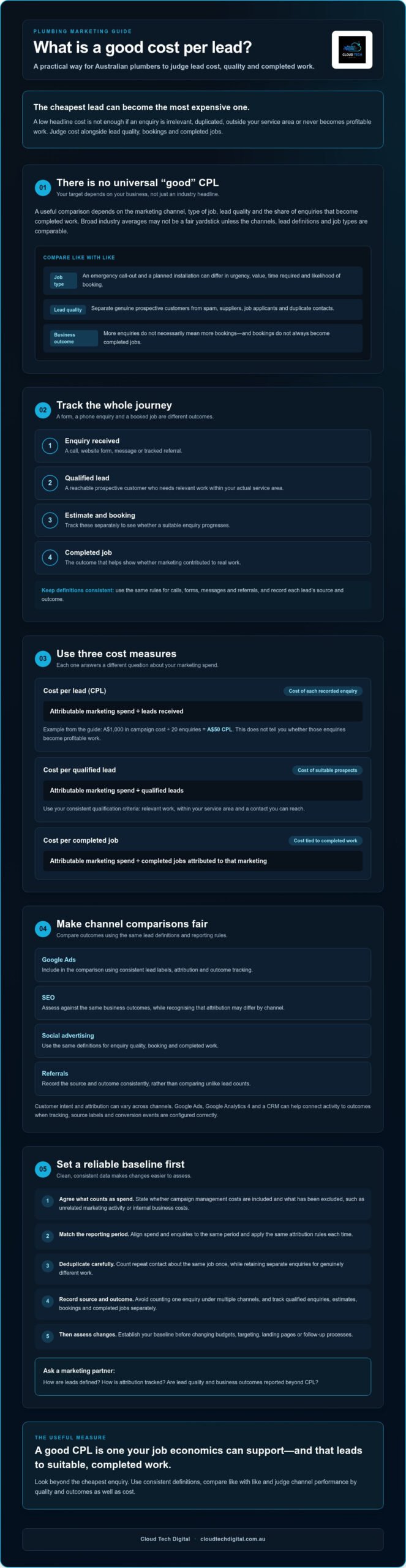
Cost per lead (CPL) is the attributable marketing spend divided by the number of leads received in the same period. If a campaign costs A$1,000 and generates 20 enquiries, its CPL is A$50. That figure tells you what each recorded enquiry cost, but not whether those enquiries can become profitable work.
So, what is a good cost per lead for plumbers? There isn’t one reliable figure for every Australian plumbing business. A useful comparison depends on the channel, job type, lead quality and the proportion of enquiries that become completed work. Treat broad industry averages cautiously. Unless a current Australian benchmark uses comparable channels, lead definitions and job types, it may not be a fair yardstick for your business.
Job economics matter, too. An emergency call-out and a planned installation enquiry can differ in urgency, job value, time required and likelihood of booking. Their acceptable acquisition costs may differ as a result. Compare like with like before deciding whether a CPL is high or low.
What counts as a plumbing lead?
Start with one definition across your marketing reports. Count calls, website forms, messages and tracked referrals consistently, then separate genuine prospective customers from spam, suppliers and job applicants. A raw enquiry isn’t automatically qualified, booked or completed work. Record whether the person needs a service you provide, is within your actual service area and can be contacted. Clear labels make channel comparisons more useful and show where enquiries drop out.
For background, lead generation describes the process of attracting and identifying potential customers. For a plumbing business, the practical question is whether an enquiry represents a real customer with a relevant job.
Why the cheapest lead may not be the best lead
A low CPL can look attractive while hiding unreachable contacts, unsuitable work or duplicate enquiries. More leads don’t necessarily mean more bookings, and bookings don’t always become completed jobs. Track each stage separately, using consistent dates and attribution, so you can see which marketing spend contributes to real work rather than relying on enquiry volume alone.
A qualified plumbing lead is a reachable prospective customer who needs relevant work within your service area. Use that definition consistently, then track whether the lead progresses to booking and completion. This gives you a stronger basis for judging lead costs than a headline CPL on its own.
Calculating Plumber CPL, Qualified Lead and Job Costs
Use the same reporting period and spend rules each time you calculate performance. The basic formula is:
CPL = attributable marketing spend ÷ leads received
For a fuller picture, calculate the cost of leads that meet your qualification criteria and the cost of completed work:
- Cost per qualified lead = attributable marketing spend ÷ qualified leads
- Cost per completed job = attributable marketing spend ÷ completed jobs attributed to that marketing
The Australian Bureau of Statistics classification identifies Plumbing Services as a distinct industry category. For your own reporting, define which plumbing work and enquiries count, then apply that scope consistently across campaigns and channels.
Calculate CPL from clean, consistent data
Agree what counts as attributable spend before comparing results. This might include advertising media spend and the relevant share of campaign management costs. State what you’ve excluded, such as unrelated marketing activity or internal business costs. Match spend and enquiries to the same period, and use the same attribution rules each time. If invoices and enquiries cover different date ranges, the result won’t be a fair comparison.
Deduplicate repeat contact from the same prospective customer about the same job, while retaining separate enquiries for genuinely different work. Record each lead’s source and outcome so you don’t count one enquiry under multiple channels. Google Ads, Google Analytics 4 and a CRM can help connect campaign activity to outcomes, but only when tracking, source labels and conversion events are configured correctly.
Measure what happens after the enquiry
Don’t stop at the first contact. Track qualified enquiries, estimates, bookings and completed jobs as separate stages. This helps show whether the issue lies in lead relevance, the quoting stage or the path from booking to completed work.
CPL alone cannot establish whether a marketing campaign is profitable. Consider this hypothetical example, not an industry average: a plumber attributes A$1,200 in media and management costs to a campaign, with 24 enquiries, 12 qualified leads and four completed jobs. The CPL is A$50, the cost per qualified lead is A$100, and the cost per completed job is A$300. Each measure answers a different question, so keep them visible together.
For a clearer view of results, look for transparent lead tracking and reporting that connects marketing activity with downstream outcomes. Explore digital marketing and lead tracking as part of that assessment.
How to Compare Plumbing Lead Costs Across Channels and Job Types
A channel comparison only works if each source is judged by the same standards. Apply consistent definitions for a lead, qualified lead, booking and completed job, then compare what happens after the first enquiry. This gives you a fairer answer to what is a good cost per lead for plumbers than comparing headline CPL figures alone.
Compare channels on the same scorecard
Use one reporting period and record spend, lead volume, qualified share, bookings, completed jobs and attributable revenue for each source. Add notes about how confidently each enquiry can be attributed, particularly when a customer may have found your business through one channel and later contacted you through another.
| Channel | Measurement considerations |
|---|---|
| Google Ads | Separate campaign spend and enquiries by campaign where tracking allows. Check that calls and website actions are recorded and attributed consistently. |
| SEO | Consider relevant organic enquiries over a clearly defined period. Account for how ongoing SEO activity and delayed customer decisions can make attribution less direct. |
| Social advertising | Track enquiries attributed to ads, then check their qualification and progress through to completed work. Use the same lead criteria as for other channels. |
| Referrals | Record the referral source and any associated marketing spend. Don’t assume referrals have no acquisition cost if you invest in activities that generate them. |
Attribution won’t always be exact. A prospective customer might see a social ad, search for your business later and then call. Choose a consistent rule for assigning credit, explain its limits in reports and avoid claiming that multiple channels each produced the same completed job. For campaign-specific detail, see the Google Ads for plumbers guide.
Compare job types without mistaking revenue for profit
Where your records allow, separate urgent repairs, routine maintenance and higher-consideration installations. These enquiries can differ in timing, customer decision-making and the work involved, so pooling them may hide differences in booking and completion rates. Use the same channel scorecard for each job category rather than judging a source by lead volume alone.
Revenue is only part of the picture. Consider labour, materials, travel and available operational capacity when reviewing completed jobs. A higher-value job may also require more resources, while a smaller job may fit your schedule more easily. Compare outcomes in context, and don’t draw firm conclusions from a small sample or a brief reporting period. A steady, like-for-like view helps you distinguish a promising pattern from a short-term fluctuation.
How Plumbers Can Set and Improve a Realistic CPL Target
There’s no useful target without your business’s numbers behind it. To work out what is a good cost per lead for plumbers, start with the profit each completed job contributes, your conversion history and the work your team can take on. A campaign that attracts more enquiries than you can service may not be the right one to scale.
Build a business-specific CPL ceiling
Work backwards from the amount you’re prepared to spend acquiring a completed job. For example, if a job contributes A$360 in gross profit and you decide that up to 25% can go towards acquisition, your maximum cost per completed job would be A$90. If your records show one in five leads becomes a completed job, an illustrative CPL ceiling would be A$18. These figures are hypothetical, not industry benchmarks. Use your verified results, and define whether the conversion rate starts from all enquiries or qualified leads.
Keep GST treatment consistent across revenue, costs and your financial records. Don’t compare campaign spend that includes GST with job figures that exclude it, or mix different accounting treatments. Set a separate target where job types have different margins, conversion histories or demands on your available labour and schedule.
Diagnose a CPL that’s rising
First establish a baseline using a consistent reporting period and lead definition. Then investigate before cutting spend or changing several things at once:
- Check that tracking still records the right calls, forms and campaign sources.
- Review search terms and targeting for irrelevant enquiries or work outside your service area.
- Check whether the landing page clearly explains the plumbing work offered and how to enquire.
- Review lead quality, response speed and what happened between enquiry, quote, booking and completed job.
A higher CPL may reflect poor-fit enquiries, a tracking change or a drop in bookings, not simply an expensive channel. Test one measurable change at a time, note when it was made and review the same downstream outcomes afterwards. Treat any improvement as something to measure, not a guaranteed result.
For broader ideas on building a consistent approach, read the Australian tradie lead generation guide. If you want support reviewing campaign tracking and performance, explore Cloud Tech Digital’s marketing services.
Choose a Plumbing Marketing Partner Who Reports Beyond CPL
A useful marketing report should show more than how much each enquiry cost. It should help you see which sources attract suitable plumbing work, how enquiries progress and where tracking leaves unanswered questions. That context matters when deciding what is a good cost per lead for plumbers in your business.
Questions to ask before comparing agencies
Before engaging a provider, ask how they define and report on plumbing leads. Clear answers help you judge whether the numbers will be useful, comparable and accessible to your business.
- How do you identify, qualify and deduplicate enquiries? Ask how the reporting distinguishes genuine prospective customers from spam, repeat contacts and unsuitable jobs.
- Which costs and outcomes appear in reports? Confirm whether figures include media spend and management costs, and whether reports separate enquiries, qualified leads, bookings and completed jobs.
- How often will you review performance? Agree on a reporting frequency that gives you a consistent view without drawing conclusions from incomplete data.
- Can I access the campaign accounts and lead data? Make sure you can see the information behind the report and understand how each result has been attributed.
CPL still has a place, but it needs to sit alongside lead quality and downstream outcomes. A report that shows enquiry volume without relevance or booking progress can’t tell you whether that spend is supporting the work your business wants. Ask how the provider will handle gaps in call, form or source tracking, too. Transparent limitations are more useful than a confident-looking number with unclear attribution.
Turn the CPL review into a practical next step
Before choosing a partner or changing your marketing, bring together a simple snapshot of your current position:
- List your lead sources and the spend attributed to each.
- Note how many enquiries were suitable, booked and completed.
- Identify where source tracking or outcome records are missing.
This gives you a grounded starting point for discussing your goals and what needs to be measured. Cloud Tech Digital provides SEO, Google Ads, social advertising and website services, including landing pages. Its ongoing management includes lead tracking, campaign monitoring and strategy adjustments, so activity can be reviewed against shared business outcomes. For broader channel-planning ideas, read the marketing guide for tradies.
If you’d like to talk through your measurement gaps and lead-generation goals, talk with Cloud Tech Digital about tracking plumbing leads. Start with what you currently track and what you want your reports to show.
Make Your Lead Costs Work Harder
A useful CPL target isn’t a borrowed industry number. It’s grounded in your plumbing business’s job economics, conversion history and capacity. Keep lead definitions consistent, then compare channels by qualified enquiries, bookings and completed work as well as cost per lead. That’s the practical way to answer what is a good cost per lead for plumbers and decide where your marketing deserves attention.
Clear tracking also helps you identify what needs fixing before changing spend. You can see whether the challenge is lead relevance, attribution or the path from enquiry to completed job, then assess changes using the same measures.
Cloud Tech Digital is an Australian-owned and operated agency serving trade businesses nationally. Operating since 2020, it works across SEO, paid advertising and conversion-focused websites, with lead tracking and campaign optimisation included in ongoing management.
Ready to make your marketing reports more useful? Talk with Cloud Tech Digital about tracking plumbing leads and your lead-generation goals. Start with consistent measurement, then use the results to make clearer decisions about the work your marketing supports.
Frequently Asked Questions
How do you calculate cost per lead for a plumbing business?
Divide attributable marketing spend by the number of leads received during the same reporting period. Include the campaign costs you’ve agreed to count, then divide by genuine, deduplicated enquiries attributed to that activity. Keep the spend period and lead dates aligned, and apply the same rules each time. To understand performance beyond enquiries, separately calculate cost per qualified lead and cost per completed job.
Is a lower cost per lead always better for plumbers?
No. A lower CPL can be misleading if enquiries are spam, duplicates, unreachable or for work you don’t take on. Compare lead cost with qualification, booking and completed-job outcomes before deciding whether a campaign is performing well. A more expensive source could prove more useful if it brings suitable customers who book and complete work, while a low-cost source may produce little value after the initial enquiry.
What should plumbers include when comparing lead generation costs?
Use a consistent reporting period and compare attributable media and management costs with deduplicated enquiries. Record each lead’s source, job type, service relevance and service-area fit, then track whether it was qualified, quoted, booked and completed. Include revenue or job contribution if you can attribute it reliably. Apply the same definitions across channels, and note where tracking gaps or customer journeys involving several channels make attribution uncertain.
How much should a plumber spend to get a new customer?
Set an acquisition limit using your own job economics rather than a generic spend figure. Start with the gross profit a typical completed job contributes and decide what share you can reasonably allocate to winning that work. Then use your records to estimate how many leads become completed customers. Keep job types separate if their margins or conversion histories differ, and check available capacity before increasing marketing spend.
Can plumbers compare SEO leads with Google Ads leads?
Yes, provided you compare them using the same lead, qualification and outcome definitions. Track SEO and Google Ads enquiries separately where attribution is reliable, then assess qualified leads, bookings and completed jobs alongside spend. Their timelines and attribution may differ, so don’t treat a short reporting window as a definitive comparison. Note when a customer interacts with both channels and use a consistent rule for assigning credit.
What should a plumbing marketing report show besides CPL?
A useful report should show lead volume, qualified enquiries, bookings, completed jobs and, where available, attributable revenue or job contribution. It should explain which costs are included, how leads are defined, how duplicates are handled and how each source receives credit. Check that you can access the underlying campaign and lead data. Cloud Tech Digital includes lead tracking, performance monitoring and strategy adjustments in its ongoing campaign management.
