


A cheap electrician lead can become your most expensive marketing result if it never turns into a booked job. So, what is a good CPL for electricians? It isn’t a single industry figure. It’s a cost your business can sustain while generating work that’s worth doing.
It’s reasonable to question whether your current CPL is too high, especially when enquiries turn out to be out of area, duplicated or hard to contact. But CPL on its own won’t show whether a campaign is paying off. You need to connect lead costs with lead quality, your close rate and the profit each job contributes.
This guide shows you how to set a defensible target CPL using your own business economics, then compare channels and campaigns on a consistent basis. It also covers the measures that reveal whether leads become profitable booked jobs, so you can make clearer decisions about where to invest and what to improve. The aim isn’t to chase the lowest cost per enquiry. It’s to build a dependable flow of worthwhile work.
Key Takeaways
- There’s no universal answer to “what is a good CPL for electricians”. Set a target that fits your job economics and lead-to-job conversion rate.
- Define what counts as a lead before calculating CPL. Distinguish enquiries from qualified leads, booked jobs and completed work.
- Compare Google Ads, social ads and SEO using consistent cost definitions, timeframes and lead-quality measures.
- When CPL rises or lead quality falls, check tracking, targeting, landing pages and follow-up processes before changing budgets.
- Use a scorecard to track the journey from campaign spend to revenue, and allow enough lead volume before judging performance.
What’s a good CPL for electricians? Benchmarks explained
There’s no single CPL that makes sense for every electrical business. The answer to what is a good CPL for electricians depends on what you count as a lead and whether those leads turn into profitable work.
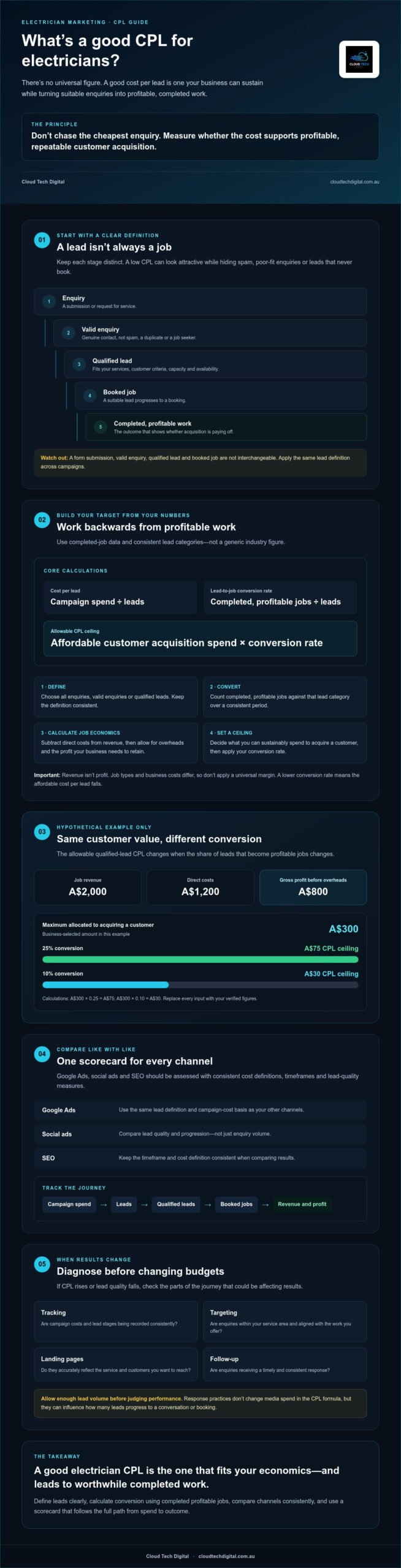
Cost per lead (CPL) is a basic efficiency measure: divide campaign spend by the number of leads generated. For example, if a campaign generates 20 leads, divide its spend by 20 to calculate CPL. Be clear about what “spend” includes, such as advertising costs alone or other campaign costs as well. Use the same definition when comparing results.
A form submission, a valid enquiry, a qualified lead and a booked job are not interchangeable. A submission might be spam; a valid enquiry might be for work you don’t offer. Even a suitable, qualified lead may not book. Track these stages separately so a low CPL doesn’t disguise weak lead quality or poor conversion.
Service mix, competition, advertising channel and target geography can all affect the cost of generating enquiries. So can how quickly and consistently enquiries receive a response. Response practices don’t change media spend in the CPL formula, but they can influence how many leads progress to a conversation or booking. That’s why a broad industry average can be a poor yardstick for your business.
A good CPL is one that supports profitable, repeatable customer acquisition, not simply the cheapest possible enquiry.
What counts as an electrician lead?
Start by separating genuine service enquiries from spam, duplicates, job seekers and requests from outside your service area. Then define a qualified lead according to the work you offer, your capacity and availability, and the customers you want to serve. Apply that definition consistently across campaigns. Otherwise, one channel may appear to deliver more leads simply because it counts a wider range of enquiries.
Why a low CPL can still be poor value
Low-cost enquiries can consume time without producing suitable work if they don’t match your services or customer criteria. Compare the path from raw enquiries to qualified leads, booked work and completed jobs instead of judging a campaign by enquiry volume alone. The lowest CPL isn’t automatically the strongest result. A higher-cost source may prove more valuable if its leads are a better fit and progress further.
How to calculate a profitable target CPL for your electrical business
Build your target from your own completed-job data, not a generic industry figure. The key is to connect the cost of an enquiry with the profit left after the work is done.
- Choose a lead definition. Decide whether you’re measuring all enquiries, valid enquiries or qualified leads. Keep the definition consistent across campaigns.
- Calculate your conversion rate. Divide the number of completed, profitable jobs by the number of leads in your chosen category. Use a consistent period so leads have time to progress.
- Work out job economics. For the type of work you’re assessing, subtract direct costs from job revenue to find gross profit. Then allow for overheads, the contribution you need to retain and the marketing capacity of your business.
- Set a CPL ceiling. Decide how much of the remaining amount you can sustainably allocate to acquiring a customer, then multiply that figure by your lead-to-job conversion rate.
Your allowable CPL depends on the proportion of qualified leads that become completed, profitable jobs and the amount you can afford to spend to acquire each one. A lower conversion rate means each lead is less likely to produce a job, so the affordable cost per lead falls.
Work backwards from a profitable completed job
Revenue isn’t profit. Start with the revenue from a representative job, deduct direct costs such as materials and labour, then account for overheads and the profit your business needs to retain. The remaining amount helps establish your marketing capacity. Avoid applying a universal margin: job types and business costs differ.
Turn conversion data into a CPL ceiling
Hypothetical example only: Say a job generates A$2,000 in revenue and has A$1,200 in direct costs. That leaves A$800 in gross profit before overheads and other business needs. If your business decides A$300 is the maximum it can allocate to acquiring that customer, and 25% of qualified leads become completed, profitable jobs, the qualified-lead CPL ceiling is A$75 (A$300 × 0.25). At a 10% conversion rate, it falls to A$30. Replace every input with your verified figures.
Use external figures carefully. Digital advertising benchmarks by industry can provide broad context, but they can’t account for your job costs or close rate. For a clearer view of how campaign data connects to business outcomes, consider reviewing your tracking and lead definitions with an Australian digital marketing agency.
How should electricians compare CPL across Google Ads, social ads and SEO?
A channel comparison only means something if you measure each source on the same terms. Define a consistent lead, attribution method and cost basis first. Otherwise, one channel may look cheaper because it counts more low-intent enquiries or excludes costs included elsewhere.
Decide whether CPL means advertising spend alone or a broader figure that also includes management fees and other campaign costs. Either approach can be useful, but label it clearly and apply it consistently. For SEO, include the costs you’ve chosen to allocate to the channel, and assess results over a suitable period. Organic visibility and enquiries may build differently from paid campaign results.
| Channel | Typical lead intent | Measurement window | Lead quality to check | Follow-up considerations |
|---|---|---|---|---|
| Google Ads | Often active service searches, depending on keywords and targeting. | Track spend and enquiries over a defined period, then allow leads time to book and complete. | Check service fit, location, urgency and whether the enquiry relates to the advertised work. | Review how consistently suitable enquiries are contacted and progressed. |
| Social ads | May reach people who aren’t actively searching at that moment. | Use a consistent reporting period and allow for the time between seeing an ad and enquiring. | Assess whether enquiries understand the offer and match your services and customer criteria. | Make sure the enquiry source and next step are recorded clearly. |
| SEO | Can include active searches as well as people researching options. | Review organic leads over a period suited to the work and account for ongoing investment. | Separate relevant service enquiries from general information requests where tracking allows. | Record the original source and connect enquiries to later bookings where possible. |
Compare like with like across lead sources
Where reliable tracking allows, separate branded searches, non-branded searches and referrals. Don’t credit the same enquiry to multiple channels without stating your attribution method. If someone first finds your business through an organic search and later clicks an ad, your reporting should make clear how that journey is counted. For an adjacent example of search advertising in the trades, see this Google Ads guide for plumbers, not as an electrician CPL benchmark.
Read CPL alongside quality and conversion
Compare qualified-lead rate, contact rate, booking rate and completed-job rate alongside CPL. A higher-cost channel may produce more valuable work, but verify that with your own results rather than assuming it. Broader organic search context is available in this guide to SEO for tradies. To judge what is a good CPL for electricians, follow each source through to completed jobs and the revenue they generate.
What should electricians check when CPL rises or lead quality drops?
A change in CPL doesn’t automatically mean your campaign needs a bigger budget or a complete overhaul. First confirm the numbers are accurate, then trace where performance changed. A tracking fault can make a steady campaign look worse, while a genuine shift in enquiry quality can stay hidden behind a stable CPL.
Diagnose campaign and website friction
Start with the measurement. Test forms, check that phone enquiries are recorded, remove duplicates consistently and confirm each enquiry is attributed to the right source. Compare campaign records with actual enquiries so missing or mislabelled conversions don’t distort the picture.
Next, review what prospective customers see and who your ads reach:
- Check search terms for irrelevant intent, and confirm audience settings still match the customers you want.
- Make sure ad copy and landing pages clearly describe the electrical services you offer, with a clear next step for enquiring.
- Confirm targeting reflects the areas you serve and that enquiry details show whether a request is within your service coverage.
- Review conversion actions against real enquiry records. A click or page visit shouldn’t be treated as a qualified lead.
If visitors reach a page but don’t enquire, look for unclear service information, confusing navigation or a difficult form. The web design guide for tradies offers broader context on how website experience can support lead generation.
Check what happens after an enquiry arrives
Marketing doesn’t turn every enquiry into a job. Review the follow-up process separately: check response times, unanswered calls, missed follow-ups and whether someone records the outcome. Ask staff to use consistent labels such as invalid, unqualified, booked and completed. This helps distinguish a campaign issue from a gap in how enquiries are handled.
Then consider whether the change reflects a broader market or seasonal shift, or a specific campaign problem. Compare a consistent period and allow enough enquiries to judge the pattern. Sparse data can make normal variation look like a trend.
Prioritise one high-impact fix at a time, such as correcting a broken form or removing clearly irrelevant search traffic. Record what changed and monitor the same quality and conversion measures afterwards. If you change targeting, landing pages and budget together, it becomes harder to know what helped. A useful answer to what is a good CPL for electricians depends on reliable tracking and lead outcomes, not a rushed reaction to one fluctuation.
For a practical review of campaign tracking and optimisation, speak with an Australian digital marketing agency.
Build a dependable electrician CPL scorecard and choose your next step
A useful CPL scorecard follows an enquiry beyond the initial click. It shows whether campaign spend is producing suitable work, and gives you a clearer basis for decisions than a headline lead count alone.
Use a scorecard that connects marketing to jobs
For each channel and campaign, record the same measures and define where each figure comes from:
- Spend: the campaign costs included in your CPL calculation.
- Valid leads: genuine enquiries, excluding spam and duplicates according to your agreed rules.
- Qualified leads: enquiries that fit your services and customer criteria.
- Booked jobs: qualified leads that agree to proceed with work.
- Completed jobs and revenue: work finished and the revenue it generated, linked back to the lead source where tracking permits.
Include the channel, campaign, lead status and eventual job outcome wherever your records allow. Make sure your marketing team and staff use the same labels, so a “qualified lead” means the same thing in campaign reports and business records.
Set a review rhythm that reflects how many enquiries you receive and how long they take to become completed jobs. Low lead volume calls for patience: avoid declaring a winner based on a handful of enquiries. Review trends alongside workload and capacity too. A campaign that produces more suitable jobs may not help if your team can’t take on the extra work.
Choose a practical next step for improving CPL
If the tracking is incomplete, fix measurement before shifting budgets or judging campaign performance. If leads are recorded accurately but aren’t suitable, investigate targeting, service fit, landing-page clarity and qualification rules. Change one priority at a time, document what was adjusted and check whether lead quality and job outcomes move in the right direction.
If you’re assessing outside support, ask how the provider defines a lead, attributes enquiries to channels and reports quality through to booked or completed work. Look for clear evidence of what was monitored and what campaign adjustments were made, not just a lower reported CPL. This lead generation agency guide can help you assess broader support options.
Cloud Tech Digital provides lead tracking and ongoing campaign management for trade businesses. If you’d like a practical view of how your current reporting connects campaign activity with job outcomes, request a campaign review. The right answer to what is a good CPL for electricians comes from consistent definitions and evidence of profitable work, not a target chosen in isolation.
Make your next CPL decision with confidence
The answer to what is a good CPL for electricians comes from your own numbers, not a standalone industry average. Set a target using job economics and the proportion of qualified leads that become profitable completed work. Then compare channels using consistent lead definitions, cost inputs and attribution rules.
Keep a scorecard that follows enquiries from spend through to completed jobs and revenue. If costs rise or lead quality slips, check tracking and campaign relevance before changing budgets. Review enough data to spot a meaningful pattern, and account for your team’s capacity to take on new work.
Cloud Tech Digital’s campaign management includes lead tracking, performance monitoring and ongoing strategy adjustments, helping trade businesses assess campaign activity against lead outcomes. Talk with Cloud Tech Digital about tracking and improving your electrician leads.
With clear measurement and steady optimisation, you can make more confident decisions and focus your marketing on the work that supports your business.
Frequently Asked Questions
What is a good CPL for electricians in Australia?
A good CPL is one your electrical business can sustain while attracting leads that turn into profitable jobs. There’s no universal figure that suits every business, because service mix, competition, lead quality and conversion rates vary. To decide what is a good CPL for electricians, use your own job costs and lead-to-job results, and define clearly whether you’re counting all enquiries or only qualified leads.
How do you calculate cost per lead for an electrician?
Divide the campaign costs you’ve chosen to include by the number of leads that meet your agreed definition. For example, if you count valid enquiries, exclude spam and duplicates before calculating. Decide whether your cost includes advertising spend alone or also management fees and other campaign costs. Keep the same cost inputs and lead definition across campaigns so the comparison is consistent and useful.
Is a lower CPL always better for an electrical business?
No. A lower CPL can look attractive but still deliver poor value if enquiries are irrelevant, outside your service coverage or unlikely to book. Compare qualified leads, booked jobs and completed work as well as lead cost. A campaign with a higher CPL may be more valuable if its leads fit your services and generate profitable jobs. Judge performance using recorded outcomes, not enquiry volume alone.
What is the difference between CPL and cost per booked job?
CPL measures campaign costs divided by the leads generated under your chosen definition. Cost per booked job divides those costs by the number of leads that become bookings. The second measure accounts for what happens after an enquiry arrives, so it can reveal whether a low CPL actually produces work. Track completed jobs too, because a booking doesn’t necessarily become finished, profitable work.
Why are my electrician leads expensive or low quality?
Several factors can contribute, including competitive searches, broad targeting, unclear service information or enquiries that don’t match your work or coverage. Tracking problems can also inflate or misrepresent results if forms fail, calls go unrecorded or duplicates count as separate leads. Check campaign relevance and actual enquiry records before changing budgets. Review follow-up separately, since missed or delayed contact can prevent suitable leads from progressing.
Should electricians compare Google Ads CPL with SEO CPL?
Yes, but use consistent lead definitions and cost inputs, and account for the different ways these channels generate enquiries. Paid campaigns produce costs that can be reviewed alongside campaign activity, while SEO investment and organic leads may need assessment over a different period. Label what you’ve included in each channel’s costs, track lead quality and avoid crediting the same enquiry to multiple sources without a clear attribution method.
How can an electrician tell whether paid leads are profitable?
Track paid enquiries from source through qualification, booking and completed work. Compare campaign costs with the gross profit from completed jobs, allowing for direct job costs and the contribution needed for business expenses. Assess conversion rates as well as revenue: revenue alone doesn’t show profit. Use a consistent review period and enough lead data to spot a reliable pattern before deciding to scale, adjust or pause a campaign.
