

You didn’t start a trade business to work 70 hours a week and spend your Sundays on paperwork while your family is at the beach. Most solo tradies eventually hit a wall where they are forced to turn away profitable jobs because they have simply run out of capacity. It is a frustrating position to be in, but it is also a clear sign that you have outgrown your current setup. Taking the leap and hiring the first employee for a trade business is the only way to reclaim your time and scale your revenue; yet, many owners hesitate because of the complex compliance landscape in 2026.
We understand that the shift from solo operator to boss feels risky, especially with new Payday Super requirements and the 12% superannuation guarantee now in full effect. This guide provides a pragmatic roadmap to master this transition with confidence. You will learn how to navigate Fair Work obligations, manage the latest 2026 wage increases, and build a high-performance lead flow that keeps your new team productive. We are going to show you how to stop trading your life for a paycheck and start building a genuine business asset that maintains your high standards.
Key Takeaways
- Assess your consistent workload and profit margins to ensure your trade business is financially ready to support a full-time team member and their associated on-costs.
- Navigate the latest 2026 compliance requirements for hiring the first employee for a trade business, including the new Payday Super obligations and updated Modern Award rates.
- Source high-quality talent by moving beyond traditional job boards and leveraging industry networks that value your specific business culture and growth potential.
- Establish robust onboarding systems and WHS inductions to protect your business and ensure your new starter maintains your high standards of workmanship from day one.
- Secure a steady pipeline of work through targeted SEO and PPC strategies so your new hire stays productive and your business remains profitable.
Recognising the Signs: Is Your Trade Business Truly Ready to Hire?
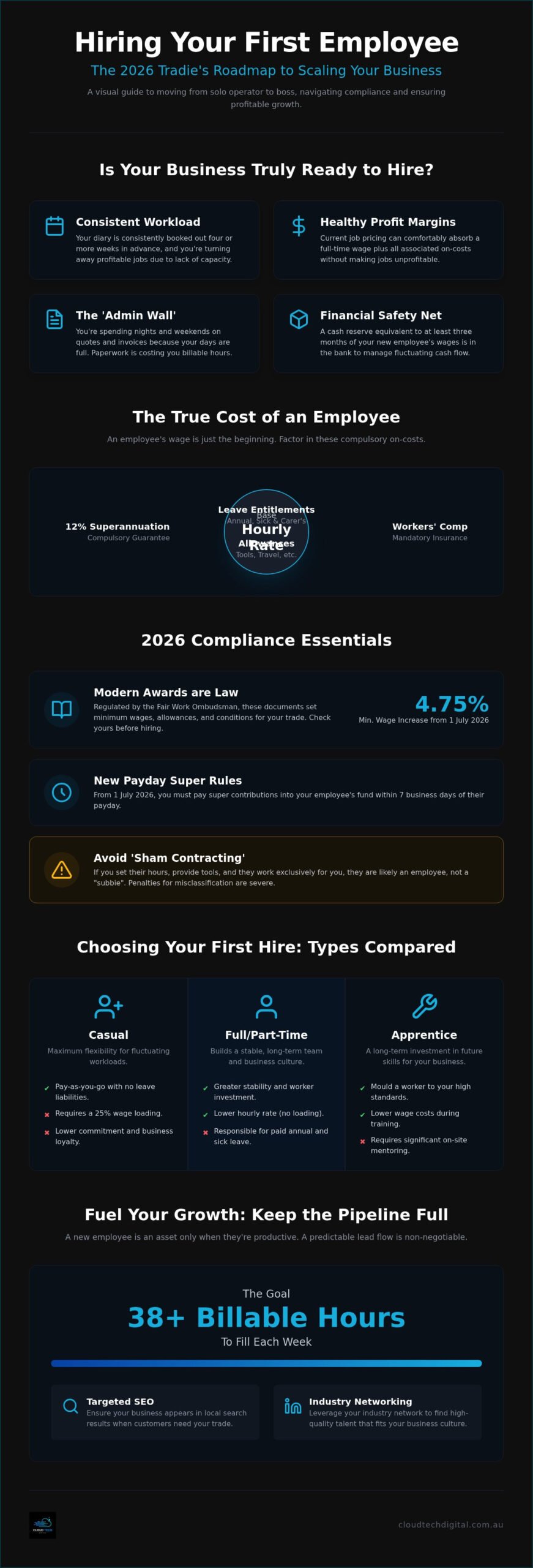
Being flat out is a great problem to have, but it is not the only metric for success. Many tradies mistake a seasonal rush for permanent growth. Before you commit to a full-time wage, you must analyse your workload over the last six months. If your diary is consistently booked out four weeks in advance, you have likely reached your limit. Hiring the first employee for a trade business is a massive milestone, but it only works if your margins can absorb the extra weight.
The “Profitability Test” is your first hurdle. You aren’t just paying an hourly rate. You are responsible for a 12% superannuation guarantee, workers’ compensation insurance, and public holiday pay. If your current job pricing is razor-thin, adding a staff member will actually lose you money. You also need to watch for the “Admin Wall”. This happens when you spend your nights writing quotes and chasing invoices because your days are spent on-site. When paperwork starts costing you billable hours, your business is screaming for more hands.
The Lead Generation Safety Net
Signing an employment contract without a predictable pipeline is a recipe for stress. You need to know exactly where your next twenty jobs are coming from before you put someone on payroll. Partnering with a lead generation agency in Australia provides the volume required to keep a team productive. This is about calculating your “Cost of Capacity”. If a new hire adds 38 billable hours to your week, your digital presence must be strong enough to fill them. A professional website and a sharp SEO strategy ensure that when your new starter arrives, they aren’t sitting in the van waiting for the phone to ring.
Emotional vs. Financial Readiness
Managing people is a completely different skill set from fixing a leak or wiring a house. You are moving from “doing” to “managing”, which requires a shift in mindset. You have to trust someone else to maintain your reputation, which is often the hardest part for solo operators. This transition involves starting a formal recruitment process and setting clear expectations from day one.
Financial stability is non-negotiable. When hiring the first employee for a trade business, you should ideally have a three-month payroll buffer sitting in the bank. Cash flow in the trades is often lumpy. Having this reserve ensures that even if a large commercial client is late on a payment, your employee still gets paid on time. If you aren’t prepared for the responsibility of someone else’s mortgage, you aren’t ready to be a boss.
Compliance Essentials: Navigating Fair Work, Super, and Tax in Australia
Compliance is not just a hurdle; it is the foundation of your growth. When hiring the first employee for a trade business, you enter a highly regulated space managed by the Fair Work Ombudsman. Most Aussie tradies fall under specific Modern Awards, such as the Plumbing and Fire Sprinklers Award or the Electrical, Electronic and Communications Contracting Award. These documents dictate everything from minimum hourly rates to tool allowances. As of 1 July 2026, minimum wages in modern awards increased by 4.75%. You must ensure your payroll software is updated to reflect these new rates immediately.
Don’t fall into the “sham contracting” trap. The ATO and Fair Work are cracking down on business owners who hire “subbies” who are actually employees. If you provide the tools, set the hours, and they work exclusively for you, the law likely views them as an employee. Getting this wrong leads to massive back-pay claims and penalties. You are also responsible for compulsory on-costs. This includes the 12% Superannuation Guarantee and Workers’ Compensation insurance. From 1 July 2026, you must also comply with “Payday Super,” which requires contributions to reach the employee’s fund within seven business days of payday.
Choosing the Right Employment Type
Casual roles offer flexibility but come with a 25% loading to compensate for a lack of leave. Full-time or part-time staff provide stability and lower hourly rates, but you owe them annual and sick leave. If you are looking to build a long-term legacy, an apprentice is a great investment. They require significant on-site mentoring but allow you to mould a worker to your specific standards. Regardless of the type, always include a three-to-six month probation period in your offer. This gives you a legal window to ensure they actually have the skills they claimed to have during the interview.
The Legal Paperwork Checklist
Every new starter must receive a Fair Work Information Statement. It is a legal requirement. Beyond that, a signed employment contract is your best defence. It should clearly outline their role, hours, and intellectual property protections. To make this commitment sustainable, ensure your tradie marketing is firing on all cylinders. A steady lead flow is the only way to justify these fixed costs and keep your new team member busy. You will also need to collect a TFN declaration and set up Single Touch Payroll (STP) to report tax and super data to the ATO in real-time.
Recruitment Strategies: Finding a Legend, Not a Liability
Finding talent requires looking beyond traditional job boards. While Seek is a standard choice, some of the best hires are found in industry Facebook groups or through your own local network. For business owners who eventually need to scale their digital or marketing operations, TrustTech Recruitment provides access to specialist talent that can help take a company to the next level. Don’t be afraid to post on your business social media pages. Your followers already know the quality of your work and might know someone looking for a change. Once you have a shortlist, the resume becomes secondary to a paid trial day. This is the ultimate vetting tool. Seeing how a candidate handles a complex task and interacts with a client tells you more than a dozen interviews ever could.
It is easier to teach a plumber how to use a specific drain camera than it is to teach them how to be polite to a customer. When you are hiring the first employee for a trade business, prioritise attitude over raw technical skill. Look for someone who takes pride in their appearance and their tools. If you have a reliable subbie you have worked with for months, they are often the lowest-risk option for a permanent role. They already understand your standards and have proven they can represent your brand without constant supervision.
The Interview Process for Tradies
Keep the process pragmatic. A formal boardroom meeting is awkward and unnecessary. Instead, meet at a local cafe or even on a job site where they can see the work in action. During this conversation, watch for red flags. If a candidate blames their previous boss for every problem or lacks basic hand tools, they are likely a liability. They need to show they have the initiative to solve problems on their own.
Remember that you are also being interviewed. Top-tier tradies have options. You need to sell the vision of where the business is going. Explain how their role will evolve as the company grows and how you plan to support their professional development. When you check references, ask specific questions about their reliability. Don’t just ask if they were good; ask if they were the first person on-site every morning. Reliability is the foundation of a successful trade team.
Setting the Standard: Onboarding and Managing Your New Starter
Success doesn’t stop at the signed contract. The first 90 days are the most critical period when hiring the first employee for a trade business. This is when you set the tempo for the entire relationship. Clear KPIs (Key Performance Indicators) take the guesswork out of their role and provide a objective baseline for performance reviews. If they don’t know what “good” looks like, they won’t hit the mark. Define specific milestones, like completing a standard service call within a set timeframe or maintaining a zero-callback rate for their first month on the tools.
Safety isn’t just a box to tick; it’s your biggest legal liability. Inducting your new starter into your WHS/OH&S systems is your first priority on day one. Beyond safety, you need Standard Operating Procedures (SOPs). These documents ensure they do the job your way, every time. For those looking to digitise their onboarding, bespoke elearning content development uk provides a professional way to standardise training across a growing team. Equipping them with the right gear and job management apps makes following these systems seamless. High-quality tools show you value their work, while modern tech keeps the office and the field in sync without the need for constant phone calls.
Management is an ongoing conversation. Weekly “Toolbox Talks” are the perfect tool for regular feedback loops. Use this time to discuss upcoming jobs, safety issues, and performance wins. Transitioning from “Mate” to “Boss” is often a challenge for solo tradies. You can still be approachable, but you must be assertive about standards. Incentivise quality by rewarding clean job sites or positive client reviews. It doesn’t always have to be cash; sometimes, a new piece of kit or an early mark on Friday goes a long way in building loyalty.
Quality Control and Brand Consistency
Your reputation is now in someone else’s hands. Your web design for tradies should showcase the high professional standards you expect your staff to mirror on-site. Implement site checklists for every job to ensure your “signature” standard is met before the van leaves the driveway. When mistakes happen, don’t just blast them. Turn errors into training opportunities. If they understand the “why” behind the process, they are less likely to repeat the blunder. Consistent quality is what allows you to charge premium rates and keep the phone ringing.
Ready to scale your operations? Partner with Cloud Tech Digital to ensure your lead flow matches your growing capacity.
Fueling Future Growth: Keeping the Pipeline Full for Your Growing Team
Word of mouth is a fantastic bonus, but it is a dangerous business plan for a growing company. When you were a solo operator, a quiet week simply meant you had more time for fishing or catching up on sleep. Now that you are responsible for a weekly payroll, a quiet week means you are losing money. Hiring the first employee for a trade business fundamentally changes your relationship with marketing. You no longer have the luxury of waiting for the phone to ring; you need a lead generation system that is as reliable and predictable as your best power tools.
Scaling your lead flow requires a strategic balance between immediate results and long-term stability. With an extra pair of hands on deck, you finally have the capacity to take on larger, more profitable commercial contracts that were previously out of reach. These bigger jobs often come with better margins, but they require a team that can handle the volume. As your lead flow becomes consistent, you can begin drafting the “Next Hire” plan. If your pipeline is full and your first employee is hitting their KPIs, you should already be looking for employee number two to further multiply your revenue.
Dominating the Market with SEO and PPC
Stability comes from a balanced digital strategy. Investing in SEO for tradies is about winning the long game. It builds a permanent presence in search results that delivers high-quality leads without an ongoing cost-per-click. However, SEO takes time to mature. To fill sudden gaps in the schedule or keep a new apprentice busy during a slow patch, Facebook ads for tradies offer a tap you can turn on and off as needed. The key is tracking your ROI with precision. In 2026, a high-performing campaign should aim to return at least five dollars in billable work for every dollar spent on advertising, ensuring your team remains a profit centre rather than a cost.
The Role of a Professional Digital Partner
Top-tier trade businesses don’t waste their evenings trying to figure out Google’s latest algorithm updates. They outsource their marketing to specialists so they can stay focused on their “Zone of Genius”, which is leading their team and ensuring every job meets their signature standard. Your time is now more valuable as a manager, estimator, and leader than as a marketing amateur. By partnering with a dedicated agency, you ensure that your digital presence is constantly optimised for performance and local expertise. It is time to stop guessing and start growing. Scale your trade business with Cloud Tech Digital and build the high-performance enterprise you envisioned when you first started out.
Take Command of Your Business Growth
Scaling beyond a solo operation is the only way to stop the 70-hour work weeks and start building a genuine asset. By mastering the 2026 compliance landscape and focusing on cultural fit during recruitment, you protect your reputation while expanding your capacity. However, the most important takeaway is that your team is only as effective as the work you provide them. Hiring the first employee for a trade business requires a shift from being a technician to becoming a leader who prioritises a high-performance pipeline.
Cloud Tech Digital is Australian-owned and operated, specialising in specialist tradie lead generation for plumbers, electricians, and builders. We focus on measurable sales growth, acting as your safety net to ensure your new hire stays productive and profitable from day one. Don’t leave your expansion to chance or rely solely on word of mouth. Book a Lead Strategy Session with Cloud Tech Digital today and secure the lead flow your growing team deserves. It’s time to get off the tools and start leading your business toward the success you’ve worked so hard to achieve.
Frequently Asked Questions
How much does it actually cost to hire a first employee in Australia?
Hiring your first staff member involves more than just the hourly rate. You must budget for the base wage, which is $26.44 per hour for those not covered by an award, plus a 12% superannuation guarantee. Add roughly 2% to 5% for workers’ compensation insurance and account for leave entitlements. Most tradies find that a staff member costs about 25% more than their raw salary once all on-costs are included.
What is the difference between an employee and a sub-contractor for a tradie?
The main difference lies in control and financial risk. An employee works under your direction, uses your tools, and bears no commercial risk. A sub-contractor generally provides their own equipment and has their own insurance. Hiring the first employee for a trade business requires moving beyond subbies to gain more control over quality, but it also brings higher compliance responsibilities under the Fair Work system.
Do I need to pay superannuation for a casual employee in 2026?
Yes, you must pay superannuation for casual employees at the current rate of 12%. The old $450 monthly threshold was abolished years ago, so almost every worker is eligible from their first dollar earned. Under the 2026 “Payday Super” rules, these contributions must reach the employee’s fund within seven business days of their payday. Staying on top of these payments is essential to avoid heavy ATO penalties.
How do I find a good apprentice for my trade business?
Finding a top-tier apprentice starts with looking where they hang out. Contact your local TAFE or trade school to identify high-achieving students who show genuine initiative. You can also use a Group Training Organisation (GTO) to host an apprentice, which reduces your administrative burden. Look for candidates who have already completed a pre-apprenticeship course; it proves they have a basic understanding of the tools and the trade.
What happens if I hire someone and the work dries up?
Having a lead generation safety net is the best way to prevent work from drying up. If you hire a casual, you have the flexibility to reduce hours, but permanent staff require more notice or redundancy pay. This is why we recommend scaling your marketing before you hire. Ensuring you have a consistent flow of leads through SEO and PPC keeps your team on the tools and your cash flow positive.
What insurances do I need before my first employee starts on-site?
Workers’ compensation insurance is legally mandatory the moment you hire a staff member. You also need to update your public liability policy to ensure it covers the actions of your employees on-site. Check if your state requires specific certificates for certain trades. It is also worth encouraging your staff to have their own income protection, though your primary focus must be protecting the business from site-related accidents.
Can I hire my first employee as a sole trader or do I need to be a PTY LTD?
You can hire employees as a sole trader, but many tradies switch to a PTY LTD structure for better asset protection. As a sole trader, you are personally liable for business debts and legal claims. A company structure provides a layer of separation between your personal assets and the business. While the setup costs are higher, the long-term tax benefits and reduced personal risk often make it the smarter choice.
How do I set up Single Touch Payroll (STP) for my trade business?
Setting up Single Touch Payroll (STP) is most easily done through modern accounting software like Xero or MYOB. You simply connect your software to the ATO using your Software ID. Every time you run payroll, the system automatically sends the tax and super data to the government. It is a mandatory requirement for hiring the first employee for a trade business, ensuring you stay compliant with real-time reporting obligations.
