


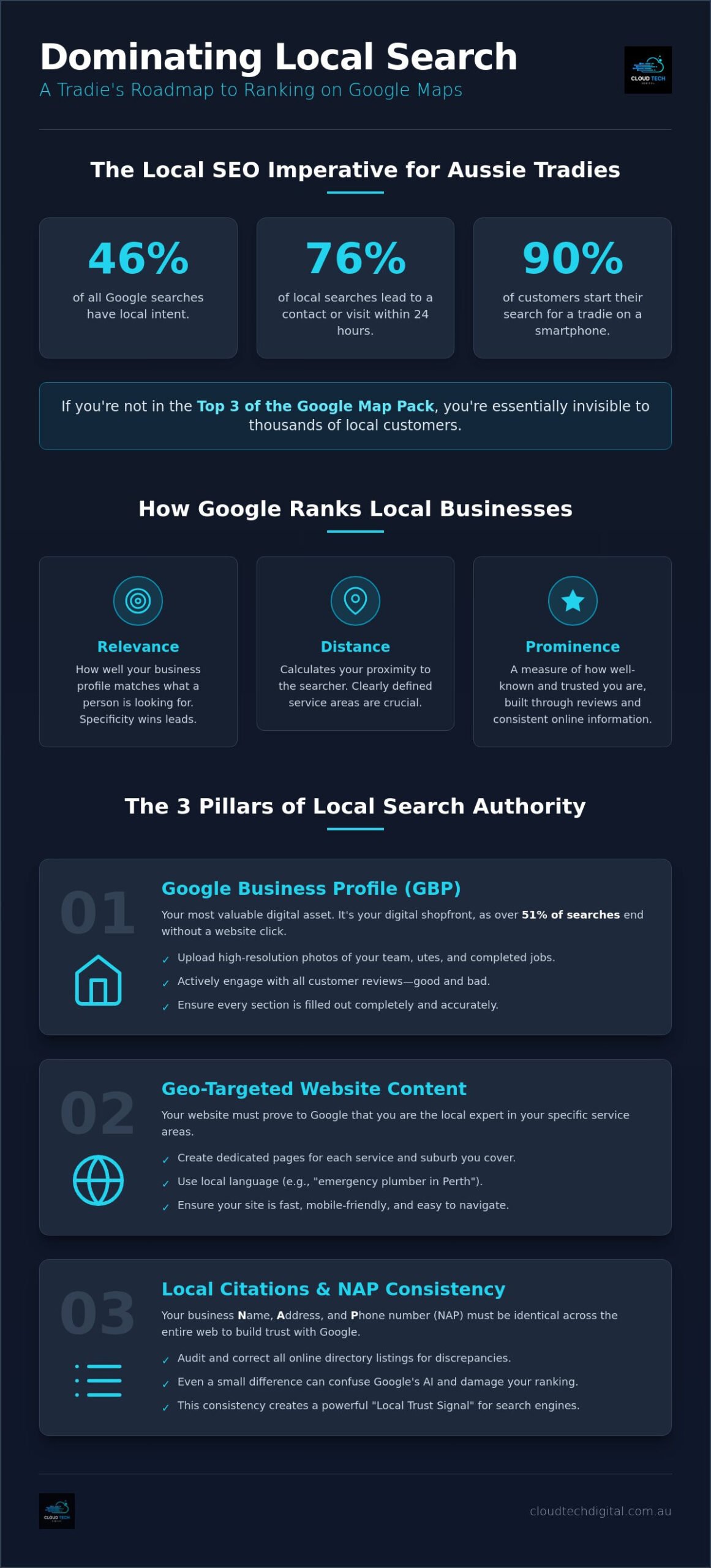
If your business isn’t sitting in the top three results on Google Maps, are you even open for business in the eyes of your local customers? With 46% of all Google searches now having local intent, missing out on that top spot means you’re handing leads directly to your competitors. You’ve likely felt the sting of wasting hard-earned cash on old-school ads that don’t deliver, leaving you with an inconsistent lead flow and a lot of technical jargon that doesn’t make sense. Mastering local SEO for trade businesses is no longer optional because 76% of local searches result in a contact or visit within just 24 hours.
We understand that you’d rather be on the tools than staring at a screen, which is why this roadmap focuses on tangible results rather than abstract concepts. You’ll learn exactly how to outrank the competition and build a professional online reputation that wins trust instantly. We’re going to dive into the latest strategies for dominating the Map Pack, navigating the 2026 algorithm updates, and ensuring your business is the first one locals call when they need a pro they can rely on. It’s time to stop guessing and start growing with a strategy that actually works for Australian tradies.
Key Takeaways
- Learn why the Google Map Pack is the most valuable digital real estate for Australian tradies in 2026 and how to secure your spot.
- Discover the three essential pillars of local SEO for trade businesses that ensure your digital presence remains stable and authoritative.
- Follow a proven roadmap to verify your Google Business Profile and audit your NAP consistency to build instant trust with local customers.
- Understand why ranking number one is only half the battle and how conversion-focused web design turns clicks into actual jobs.
- Calculate the real opportunity cost of DIY marketing and why staying on the tools while experts handle the heavy lifting accelerates your growth.
What is Local SEO for Trade Businesses and Why Does it Matter in 2026?
Local search engine optimization (local SEO) is the strategic process of tuning your online presence to catch the eyes of people searching for specific services in your immediate area. For a plumber in Perth or an electrician in Epping, ranking for national terms is a waste of time and money. You don’t need to be seen by someone in Sydney if your ute only travels within a 30km radius of your home base. Local SEO for trade businesses focuses purely on winning the local market, ensuring that when a pipe bursts or the power cuts out nearby, your business is the one that appears on their screen.
In 2026, the battleground for these leads is the Google Map Pack. This is the cluster of the top three local results that appear at the very top of the search page, often before the standard website links even show up. On mobile devices, these three spots take up almost the entire screen. If you aren’t in that top three, you’re essentially invisible to the thousands of locals looking for help right now. Google has also levelled up its game. Following the March 2026 Core Update, its AI now cross-references your physical presence and service quality through real-time data, making it harder for “ghost” businesses to cheat the system. This means your reputation and physical location are more intertwined than ever before.
The Death of the Traditional Phone Book
The days of flipping through a yellow book are long gone. Today, 90% of customers start their search for a tradie on a smartphone. They aren’t just browsing; they’re looking for immediate solutions. “Near me” searches have become the primary way people find emergency call-outs. This shift means local SEO for trade businesses acts as a high-speed digital referral system. Instead of asking a neighbour, customers trust Google to tell them who is nearby, available, and highly rated. If your business doesn’t show up in those critical seconds, you simply don’t exist to that customer.
Understanding Google’s Local Ranking Factors
To win the local game, you have to satisfy three main criteria that Google uses to rank your business:
- Relevance: This is about how well your business profile matches what the person is looking for. If you’re a roof tiler but your profile just says “builder,” you might miss out on specific roofing leads.
- Distance: Google calculates how far you are from the person searching. While you can’t change your location, you can define your service areas clearly to help Google understand your reach.
- Prominence: This is a measure of how well-known and trusted you are. It’s built through a combination of consistent business information across the web, your total number of reviews, and your overall star rating. Trust is your digital currency.
The 3 Pillars of Local Search Authority for Tradies
Dominating your local market requires more than just a functional website. To stay ahead of the competition, you need to build a digital foundation that Google trusts implicitly. Think of your online presence as a three-legged stool. If you neglect any of the core pillars, your visibility will collapse. These pillars are your Google Business Profile, your geo-targeted on-page content, and your local citations. When combined, they create a powerful “Local Trust Signal” that tells search engines you are the most reliable option in the area. A critical part of this is NAP consistency, ensuring your Name, Address, and Phone Number are identical across every corner of the web. Even a small discrepancy, like a different phone format or a slightly varied business name, can confuse Google’s AI and tank your rankings.
Pillar 1: Your Google Business Profile (GBP)
In 2026, your GBP is the most valuable asset your trade business owns. With over 51% of searches now ending without a single click to a website, your profile is often the only thing a customer sees before they call. You must treat it like a digital shopfront. This means uploading high-resolution photos of your branded utes, your team on the tools, and crisp shots of completed projects. Google’s AI now scans these images to verify you are a legitimate local entity. Reviews are equally vital. While a high star rating matters, active engagement is what wins in 2026. A 4.8-star rating where you reply to every comment, good or bad, shows more authority than a silent 5.0-star profile.
Pillar 2: Geo-Targeted Website Content
Your website needs to speak the language of your local area. Instead of generic service descriptions, you should structure your pages to mention specific regions and suburbs naturally. This isn’t about keyword stuffing; it’s about providing context. For businesses that travel to clients, dedicated Service Area pages are essential for capturing leads in surrounding suburbs. Local content allows Google’s AI to map your physical service boundaries with surgical precision. If you want to stop guessing and start seeing results, our team can help you optimise your digital strategy to capture these high-intent local searches.
Pillar 3: Local Citations and Backlinks
Citations are mentions of your business on digital directories like TrueLocal, Yellow Pages, and industry-specific portals. These act as a digital paper trail that confirms your legitimacy. However, the real power in 2026 comes from local backlinks. A link from a local footy club you sponsor or a community organisation carries more weight for local SEO for trade businesses than a link from a generic global site. It proves you are physically present and invested in your community. By organising your digital footprint this way, you ensure Google sees you as a permanent, trusted fixture in your local market.
DIY SEO vs. Professional Agency: Calculating the Opportunity Cost
It is a common instinct for sparkies and plumbers to try and handle their own marketing when they first start out. When you’re trying to keep overheads low, taking a crack at local SEO for trade businesses seems like a smart way to save a few quid. However, as your business grows, you quickly realise that your time is your most valuable asset. Every hour you spend staring at a computer screen trying to figure out why your website isn’t ranking is an hour you aren’t on the tools earning a high hourly rate. This is the ultimate opportunity cost. If you’re spending five hours a week on marketing that could have been spent on a billable job, you’re actually losing money.
Professional SEO isn’t just a monthly expense; it’s an investment in a “Lead Machine” that works in the background while you’re on-site. When an agency handles the heavy lifting, they build a system designed for long-term stability. If you DIY it and make a technical mistake, you risk “Technical Debt.” This happens when you implement shortcuts or “thin” content that might work for a week but eventually triggers a Google penalty. Fixing these errors often takes months of corrective work, costing you far more in lost leads than the original “saving” was worth. You wouldn’t ask a digital marketer to wire a switchboard, so why tackle complex search algorithms yourself?
When Should You Tackle SEO Yourself?
There are parts of the process where you are actually the best person for the job. You should always handle the initial setup of your Google Business Profile and ensure your basic contact info is spot on. Gathering reviews is another DIY win. No one can get a glowing testimonial better than the tradie who just finished a top-notch job. We also recommend taking high-quality “on-the-job” photos. These provide the social proof that Google’s AI craves and show potential customers that you’re active and reliable in their local area.
The Limits of DIY: Why Technical SEO Requires Specialists
Once you move past the basics, things get technical fast. Professional local SEO for trade businesses involves Schema markup, which is hidden code that helps Google understand your exact service area and operating hours. Without it, you’re leaving your ranking to chance. Specialists also conduct advanced keyword research to find high-value terms your competitors have completely missed. Finally, there is Conversion Rate Optimisation (CRO). There’s no point getting a thousand visitors to your site if your “Call Now” button is broken or hidden. An agency ensures that the traffic you get actually picks up the phone. For electricians specifically, understanding how SEO for electricians Australia works at a technical level can be the difference between dominating your local market and watching national franchises take your most lucrative jobs.
The Step-by-Step Roadmap to Ranking Your Trade Business
Success in local search isn’t an accident. It is the result of a deliberate, repeatable sequence of actions designed to prove your authority to Google. While we’ve discussed the theoretical pillars of local SEO for trade businesses, executing the roadmap requires a focus on precision and speed. If you want to dominate your territory in 2026, you need to follow these five essential steps to transform your online presence into a lead-generating machine.
- Step 1: Claim and Verify your Google Business Profile. This is your digital shopfront. Ensure every detail is filled out, from your specific service categories to your exact opening hours.
- Step 2: Audit your NAP consistency. Your Name, Address, and Phone Number must be identical across every directory. Use a spreadsheet to track every mention of your business online and correct any discrepancies immediately.
- Step 3: Optimise for mobile-first search. Since 90% of customers start their search on a smartphone, your site must load in under two seconds and have clear, thumb-friendly “Call Now” buttons.
- Step 4: Launch a proactive review strategy. Don’t leave your reputation to chance. Create a system where every technician asks for a review the moment a job is completed.
- Step 5: Create local-first content. Write articles or FAQ pages that address specific local issues, such as “How to deal with hard water in Western Sydney” or “Common electrical faults in older Queenslanders.”
If this sounds like a lot of technical heavy lifting, you aren’t alone. Most successful tradies realise that their time is better spent on-site while an expert manages their search engine optimisation to ensure the phone never stops ringing.
Optimising for 2026: Voice Search and AI
The way people search is changing rapidly. With 45% of consumers now using generative AI for local recommendations, your content needs to be structured for “conversational” queries. People no longer just type “plumber”; they ask Siri or Google, “Who is the best plumber for a blocked drain near me?” To capture these leads, your website should include FAQ sections that mirror these natural speaking patterns. By providing direct, clear answers to common questions, you make it easy for AI Search Generative Experience (SGE) to pull your business data and recommend you as the local expert.
The Review Loop: Turning Happy Clients into Salesmen
A high-performing review system is your most powerful sales tool. You should implement a process to ask for a review before you even leave the customer’s driveway. If you receive a rare negative review, don’t panic. Responding professionally and offering to make things right actually increases trust with 88% of consumers who read reviews. When you reply, naturally include keywords like your service and suburb. For example, “We were happy to help with your hot water repair in Geelong.” This subtle tactic boosts your local relevance without looking like spam.
Turning Traffic into Jobs: The Cloud Tech Digital Performance Framework
Ranking at the top of Google is a hollow victory if your website looks like it was built in 2005. You’ve worked hard to build a reputation in the real world; your digital presence should reflect that same level of professionalism. Our performance framework is built on the simple philosophy that while SEO brings the horse to water, it’s your web design that makes it drink. For local SEO for trade businesses to be profitable, it must be paired with high-performance landing pages that load instantly and answer the customer’s most pressing question: “Can I trust these blokes to do the job right?”
This is why we integrate specialised strategies like SEO for plumbers with conversion-focused design. On a dusty worksite or in the middle of a household emergency, no one has the patience to hunt for a contact form. Your Call-to-Action buttons must be large, high-contrast, and easy to tap with a thumb on a cracked mobile screen. We don’t just aim for traffic. We aim for high-quality leads that turn into billable hours and long-term clients.
Beyond SEO: The Multi-Channel Growth Strategy
Dominating your market often requires more than just one source of leads. We combine our expertise in local SEO for trade businesses with comprehensive Lead Generation for Tradies to create a multi-channel engine. While organic SEO builds your long-term authority, Google Ads allow you to jump the queue and secure immediate emergency call-outs. The key is visibility and precision. We track every single enquiry to ensure your marketing spend is actually putting money back into your pocket, not just generating vanity metrics that look good on a spreadsheet but don’t pay the bills.
Next Steps: Secure Your Local Dominance
The best time to start your SEO was 12 months ago. The second best time is today. Your local competitors are already eyeing off your territory, and in the digital world, the first-mover advantage is real. We provide a professional audit of your current local presence to identify exactly where you’re losing leads to the bloke down the road. It’s about taking control of your growth and ensuring you aren’t left behind by the 2026 algorithm shifts.
Ready to stop chasing every scrap of work and start choosing the high-value jobs you actually want? Book a Strategy Session with Cloud Tech Digital today and let’s build a roadmap that puts your business at the top of the pile.
Own Your Local Territory Before Your Competitors Do
The digital landscape for tradies is moving fast. By 2026, simply having a website won’t be enough to keep your calendar full. You’ve seen how the combination of a rock-solid Google Business Profile and consistent NAP data creates the authority needed to own the Map Pack. You also know that traffic is worthless without a high-converting website designed to turn local searchers into paying clients. Mastering local SEO for trade businesses is about building a lead machine that works as hard as you do.
Cloud Tech Digital has been the specialist tradie marketing experts since 2020. As a no-fluff, results-driven Australian agency, we handle the technical heavy lifting so you can stay on the tools. We don’t just focus on rankings; we build custom-built high-converting websites that actually put money in your pocket. It’s time to stop letting the bloke down the road take your leads.
Get a Free Lead Generation Audit for Your Trade Business
Your future growth is waiting in the search results. Let’s go get it.
Frequently Asked Questions
How long does it take for local SEO to start working for my trade business?
Local SEO typically takes three to six months to show significant results. While you might see small movements in your rankings earlier, Google needs time to crawl your site and verify your authority in the local market. This timeframe allows for the building of consistent citations and a steady stream of reviews. It’s a long-term play that creates a stable lead flow rather than a quick fix.
Do I really need a website if I have a Google Business Profile?
You definitely need a website even if you have a great Google Business Profile. While many searches are now zero-click, your website acts as the conversion engine that proves your expertise through detailed case studies and service pages. Google also uses your website content to verify the information on your profile. Without a site, you’re missing out on the chance to build real trust and capture high-quality leads.
How much does local SEO for tradies cost in Australia?
The cost of local SEO for trade businesses depends on your specific market and how many competitors you’re trying to outrank. Some industry professionals report that prices vary based on the number of locations you service and the technical state of your current website. It’s better to view this as a performance investment rather than a flat fee. A tailored strategy focuses on high-quality leads that provide a measurable return on your marketing spend.
Can I do my own local SEO or should I hire an agency?
While you can manage basic profile updates yourself, hiring an agency usually delivers a better return on your time. Professional local SEO for trade businesses involves complex tasks like technical site audits and conversion rate optimisation that require specialist tools. Most tradies find that staying on the tools and leaving the digital heavy lifting to experts is the fastest way to scale their business without burning out on admin.
What is the most important factor for ranking in the Google Map Pack?
Proximity and prominence are the most critical factors for the Google Map Pack. Google wants to show searchers the most relevant, trusted business that is closest to their current location. Having a complete profile with weekly posts and a high volume of positive reviews tells the algorithm that you’re an active, reliable local authority. Consistent NAP data across the web also reinforces this trust signal and keeps your rankings stable.
How do I handle negative reviews on my Google Business Profile?
You should respond to every negative review professionally and promptly. Ignoring a bad review looks like you don’t care; however, a calm, helpful response can actually increase trust with potential customers. Offer to take the conversation offline to resolve the issue. This shows you’re a “straight-shooter” who stands by their work, which is often more persuasive to a customer than a perfect five-star record with zero engagement.
What is the difference between Google Ads and local SEO?
Google Ads provide immediate visibility by placing you at the top of the page for a fee, while local SEO builds organic authority over time. Ads are perfect for jumping the queue and getting emergency calls right now. SEO is the long-term engine that reduces your reliance on paid clicks. A high-performance strategy often combines both to ensure you’re capturing leads in the short and long term without overspending.
Does my business need a physical office address to rank locally?
You don’t need a physical office that customers visit, but you do need a verified address to rank. If you operate from home and travel to clients, you can set up a Service Area Business profile. This allows you to hide your home address while still appearing in local searches for the suburbs you cover. It’s a standard setup for mobile tradies like plumbers and electricians across Australia who want to protect their privacy.
