


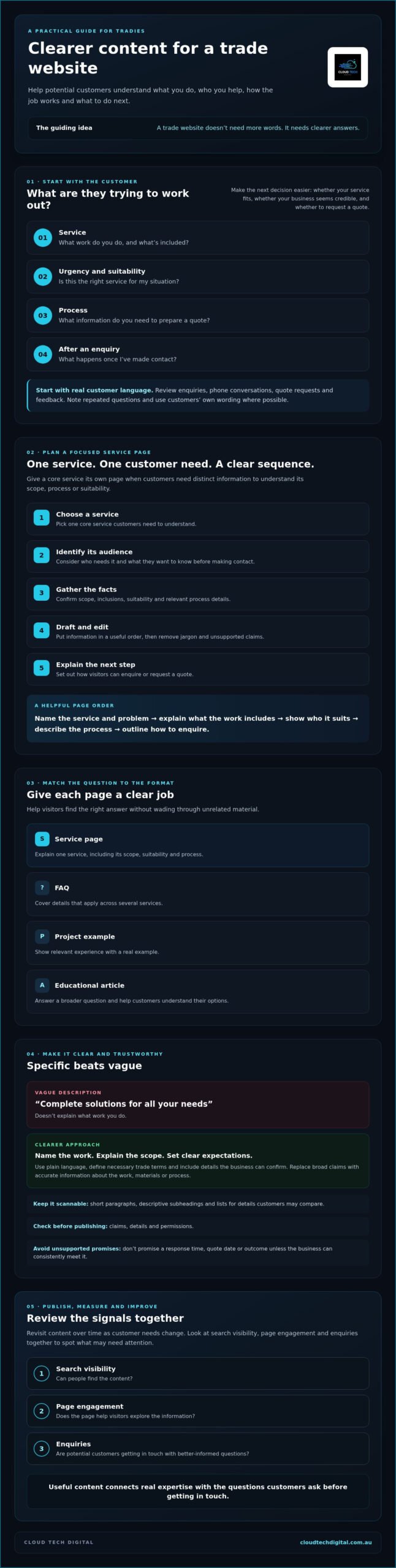
A trade website doesn’t need more words. It needs clearer answers. If you’re wondering how to write content for a trade website, start with what potential customers want to know: what you do, who you help, how the job works and what they should do next.
Choosing the right pages and topics can feel like a job in itself. If every service description could belong to any business, the right customers may struggle to understand why they should enquire. Useful content connects your real expertise with the questions customers ask before getting in touch.
This guide gives you a practical process for planning, writing and improving your website content. Learn how to choose the pages your business needs, explain services in plain language and make each page more helpful to potential customers. You’ll also see how to use real examples, answer common questions and review content over time so your website stays relevant and supports better-informed enquiries.
Key Takeaways
- Plan content around what customers need to know before they compare services, assess trust or request a quote.
- Use a repeatable process to create focused service pages, starting with one service and one customer need.
- Match each question to the right format, whether that’s a service page, FAQ, project example or educational article.
- Learn how to write content for a trade website that’s clear, specific and trustworthy by checking claims, details and permissions before publishing.
- Review search visibility, page engagement and enquiries together to spot what to improve as customer needs change.
Start with the customer: what should trade website content help them do?
Trade website content should help potential customers understand whether your service suits their needs and what to do next. They may be comparing providers, checking whether your business seems credible or deciding whether to request a quote. Each page should make that decision easier by answering relevant questions clearly.
Unclear descriptions create doubt. “Complete solutions for all your needs” doesn’t explain what work you do. Unexplained trade jargon can leave customers unsure whether a service applies to their situation, while vague promises give them little to use when assessing your business. Useful content marketing starts with the reader’s needs and provides relevant information to support a sensible next step.
Every page should answer a real question for a defined customer. That’s a practical starting point for how to write content for a trade website that’s clear, relevant and useful.
Identify the questions customers ask before contacting you
Review enquiries, phone conversations, quote requests and customer feedback. Note the questions people ask repeatedly, using their own wording where possible. Group them to identify what information your website needs to provide:
- Service: What work do you do, and what’s included?
- Urgency and suitability: Is this the right service for my situation?
- Process: What information do you need to prepare a quote?
- After an enquiry: What happens once I’ve made contact?
Keep the language natural. If customers ask, “Can you repair a leaking roof?”, don’t make them decipher a technical phrase before they understand the service. Explain trade terms in plain English when they’re useful.
Match each page to one clear customer need
Give a core service its own page when customers need distinct information to understand it. If two services have different scopes, processes or suitability, separate pages can explain those differences without crowding one general description. Keep each page focused on one service and the questions a relevant customer is likely to have.
Let other pages do their own jobs. An about page can explain who you are and how you work; project examples can show relevant experience; and FAQs can cover details that apply across several services. This structure helps visitors find answers without wading through unrelated material.
Once you’ve defined the customer and their question, plan the content around their decision rather than writing for its own sake. For broader context on how content fits into a trade business’s marketing, read this guide to marketing for tradies.
How to plan and write a clear trade service page
A focused service page gives customers enough detail to judge whether your business may suit their job. Keep it centred on one service and one customer need. A general page that tries to cover every service can leave visitors unsure which details apply to them.
Use this sequence to plan the page:
- Choose a service: Pick one core service customers need to understand.
- Identify its audience: Consider who needs it and what they want to know before making contact.
- Gather the facts: Confirm the service’s scope, inclusions, suitability and relevant process details.
- Draft and edit: Put information in a useful order, then remove jargon and unsupported claims.
- Add a next step: Explain how visitors can enquire or request a quote.
Draft a service page in a customer-friendly order
Open by naming the service and the problem it helps address. Then explain what the work includes, who it suits and what a customer can expect from the process. For example, a fencing contractor could clarify which fencing work they handle, what details they need to understand a job and how customers can ask about a quote. Include only information the business can confirm.
Be specific, not grandiose. Replace “the best service around” with accurate details about the work, materials or process. Describe the enquiry steps without promising a response time, quote date or outcome unless the business has confirmed it can consistently meet that expectation. A useful page sets clear expectations rather than creating new ones.
Make technical trade information easy to understand
Technical terms can help explain a job, but define each necessary term the first time it appears. Keep paragraphs short, use descriptive subheadings and present details customers may compare as a list. This makes the page easier to scan, especially for someone checking whether your service suits their needs.
A useful service page explains the service, who it suits, what’s included, how the process works and what to do next. Use that checklist to review your draft before it goes live. For further ideas on presenting information clearly, see this web design for tradies guide.
That structure is a practical foundation for how to write content for a trade website. If you’d like support reviewing how your website presents its services, explore website design support for trade businesses.
Choose the right content format for each trade website question
The right format depends on what a customer needs to know and how much explanation the answer takes. A quick question may fit in an FAQ. A detailed question about a process may deserve its own article. Choose the format that gives the answer enough room to be clear rather than publishing content just to fill the website.
When to use service pages, FAQs and project examples
Use a service page to explain the scope of a specific service, who it suits and how to enquire. FAQs work well for concise, recurring questions that don’t need a full page. Project examples can show what a job involved and how it addressed a customer’s needs, but check that the details are accurate and you have permission to share them.
Educational articles suit questions that need more context than a service page can comfortably provide. The same topic may call for different formats depending on intent and complexity. A short question about what a service includes may belong in an FAQ; a broader question about choosing an approach could need a guide.
| Format | Best use | Useful information | Appropriate next step |
|---|---|---|---|
| Service page | Explaining a specific service | Scope, suitability, process and enquiry details | Ask about the service or request a quote |
| FAQ | Answering a brief, recurring question | A direct answer with necessary context | Read the relevant service page |
| Project example | Showing how a particular job was approached | Verified project details and the work completed | Explore the related service |
| Educational article | Explaining a topic that needs more detail | Practical guidance, steps or comparisons | Read a relevant service page |
How to turn customer questions into useful article topics
Start with recurring questions that need more explanation than a service page can provide. Give each article a distinct purpose: check existing pages first, then decide what additional value the article will offer. If it repeats the same information without adding useful detail, it may not need to be a separate page.
For example, a service page can outline what a job involves, while an article can help readers understand factors they may need to consider before choosing an option. Link the article to the relevant service page so readers can move from learning about a topic to exploring the service.
That’s a practical part of how to write content for a trade website: match the format to the question, then make the next step relevant. To understand how search visibility can help people discover useful pages, read this SEO for tradies guide. Publishing on a fixed schedule won’t guarantee rankings or enquiries; focus on answering real questions well.
Edit trade website content for clarity, trust and action
A strong first draft still needs a careful edit. Read each page as a potential customer would: can they understand the service, find the details they need and see what to do next? Use plain English, short paragraphs, descriptive headings and specific information that helps someone make a decision. Keep the Australian English voice consistent across service pages, forms and supporting content.
Check every statement before publishing. This includes service details, qualifications, testimonials, project descriptions and image captions. Confirm that claims are accurate and that you have permission to use customer feedback or project details. If you can’t verify a statement, remove it or rewrite it to reflect what you can confidently support.
Put clarity and evidence ahead of inflated claims. Avoid absolute statements such as “the best” or promises about results that your business can’t substantiate. If a service has limits or important conditions, explain them directly instead of burying them in broad wording.
Build trust without making unsupported promises
Use genuine credentials, clear process details, customer feedback and work examples only when they’re verifiable and you have permission to share them. Be precise about what a service includes and who it suits. For example, replace a general promise of “complete support” with a clear explanation of the work covered. Straightforward detail gives visitors a better basis for deciding whether to enquire.
Make the next step easy to understand
Choose one main action for each page and describe it plainly. “Request a quote” or “Ask about this service” is more specific than “Get started”. Tell visitors what information to provide, such as the service they’re interested in and a brief description of the job. Only explain what happens next if you can confirm the process; don’t imply a response time or outcome you haven’t verified.
Then check the page on a mobile phone. Make sure headings are easy to scan, contact options are visible and any form is clear and usable. If visitors have to hunt for the next step or guess what to write, simplify the page.
These checks make how to write content for a trade website a repeatable process, not a one-off writing task. For help refining your website’s content and presentation, explore web design for trade businesses.
Publish, measure and improve trade website content over time
Publishing a page is the start of the work, not the finish. Set a review routine that suits your business, then update content when services, processes or customer questions change. A useful page should reflect what you actually do today, not how the business worked when the copy was first written.
Use website data to decide what to improve
Google Search Console can show which search queries bring people to your pages and which pages attract search activity. Use that information to spot relevant topics you may not have answered clearly. Google Analytics 4 (GA4) can help you assess engagement and tracked enquiry actions, provided the account and event tracking are set up correctly. Check that data is being recorded before drawing conclusions.
Look at several signals together. Search visibility may show that a page is being found, while engagement and enquiries help you judge whether it’s useful to visitors and supports a next step. Rankings alone don’t tell you whether the content attracts suitable customers or helps them enquire.
Be cautious with small or incomplete datasets. Record what you changed, when you changed it and what you’re monitoring. This gives you a clearer basis for reviewing the page later, without treating a short-term fluctuation as proof that an edit worked or failed.
Create a simple content maintenance routine
During each review, check that service descriptions, contact details, credentials and calls to action are still accurate. Refresh useful pages when customer questions or business processes change. If two pages overlap substantially, consider combining them, but keep distinct content that serves a clear customer need.
There’s no need to publish to an arbitrary timetable. Prioritise accurate, useful information, then add content when you have a genuine question worth answering. That’s a practical way to keep improving how to write content for a trade website while staying focused on customers and enquiries.
If you’d like support with your website and content, explore Cloud Tech Digital’s website and content services.
Make your next website update count
Useful trade website content starts with customer questions and gives visitors a clear path to the information they need. Focus each page on a service or topic, choose a format that suits the question, and use accurate details instead of broad promises. A careful edit and regular review help keep your content clear as your services and customer needs change.
Knowing how to write content for a trade website doesn’t mean publishing more for the sake of it. It means making each page more useful, checking how it performs and improving it when there’s a good reason. Start with one page and one practical improvement.
Cloud Tech Digital provides SEO, pay-per-click and social media advertising, as well as bespoke website design and landing pages for trade businesses. If you’d like support with your trade website, explore practical website and content support for your trade business.
Clear, helpful content is within reach. Make a start, learn from your customers and keep building from there.
Frequently Asked Questions
How do I write content for a trade website if I am not a professional writer?
Start with how you’d explain the service to a customer in person. Use their questions to shape the page, write in plain English and focus on one service at a time. Include accurate details about what the work involves and how to enquire. Read the draft aloud to catch awkward phrases or jargon. If writing still feels difficult, professional website copywriting can help organise your knowledge into clear, customer-focused pages.
What pages should a trade business website have?
Most trade websites need a homepage, a page for each core service that needs its own explanation, an about page and clear contact details. You may also benefit from FAQs, project examples or educational articles if they answer questions customers regularly ask. Build the site around your actual services and customer needs rather than adding pages for the sake of it. Make sure visitors can move easily from useful information to an appropriate enquiry step.
How long should a trade website service page be?
There’s no ideal word count for every service page. Include enough detail for a potential customer to understand the service, its suitability, what’s involved and how to enquire, then edit out repetition. A straightforward service may need less explanation than one with several stages or important conditions. Check whether the page answers the questions customers commonly raise. If key details are missing, add them; if a section doesn’t help the reader, tighten it.
How do I write a service description that gets customers to enquire?
Describe the service clearly, explain who it suits and outline what the customer can expect. Use specific details you can verify, such as the work included or information needed to discuss a job. Avoid generic claims and promises you can’t substantiate. Finish with one direct next step, such as asking a question or requesting a quote, and explain what information the customer should provide. Clear expectations help people decide whether they’re ready to get in touch.
Can website content help a trade business appear in Google Search?
Useful website content can help Google understand what your pages cover and help potential customers find relevant information through search. Write clearly about your services and answer genuine customer questions, but don’t treat keywords or rankings as a guarantee of visibility. Search performance also depends on factors beyond the words on a page. Review Google Search Console to see which queries and pages attract search activity, then improve content where it can better meet a customer need.
What should I include in a trade website FAQ?
Include concise answers to questions customers repeatedly ask before enquiring. These might cover what a service includes, who it suits, what details are needed to discuss a job and what happens after someone makes contact. Use customers’ own wording where it’s clear, and answer directly rather than filling the page with promotional claims. Keep each answer accurate and easy to scan. If a question needs a fuller explanation, consider giving it a dedicated page or article instead.
How often should I update content on a trade website?
Review pages often enough to keep important details accurate, and update them whenever your services, processes or customer questions change. Check service descriptions, contact details, credentials and enquiry steps as part of your review. You don’t need to publish new content on a fixed schedule if there’s no useful topic to cover. When reviewing performance, consider search activity, page engagement and enquiries together, and be cautious about drawing conclusions from limited or incomplete data.
