


A higher-paying trade job isn’t won by chasing the biggest salary figure. It comes from building skills employers value, showing what you can do and choosing opportunities with the right mix of pay and conditions. If you’re asking how to get higher paying trade jobs, look beyond salary lists: advertised figures don’t always show the hours, overtime or progression behind them.
It can be hard to know which qualification or licence to pursue, especially when requirements vary across trades and states or territories. A focused plan can help you target roles that fit your experience and build a stronger case for better pay.
This guide explains the career factors that can lift your earning potential, from specialised skills and higher-responsibility work to different industries and settings. You’ll also learn how to document your capability, map a realistic training or licensing pathway, and compare offers by pay, hours, employment conditions and future prospects. Whether you’re starting out or ready to move up, use these steps to make your next career decision with confidence.
Key Takeaways
- Learn how to get higher paying trade jobs by targeting roles where in-demand capability, work setting and responsibility align with your goals.
- Compare electrical, plumbing, welding, boilermaking and construction supervision pathways by their entry points, skill demands and progression options.
- Use a practical four-step process to choose a target role, map its requirements, close skill gaps and keep evidence of your experience.
- Build a focused job-search routine, then weigh the full offer, including base pay, hours, overtime, allowances, travel, superannuation and leave.
- Consider whether your next move is deeper expertise, leadership or independent work, and remember that business revenue isn’t the same as personal earnings.
How to get higher-paying trade jobs: understand what drives earnings
Want better pay? There’s no single trade or job title that guarantees a higher income. Earnings depend on the role, your capability, demand for the work and the conditions attached to the offer. Rather than asking only which trade pays most, consider which opportunities fit your skills and provide a worthwhile overall package.
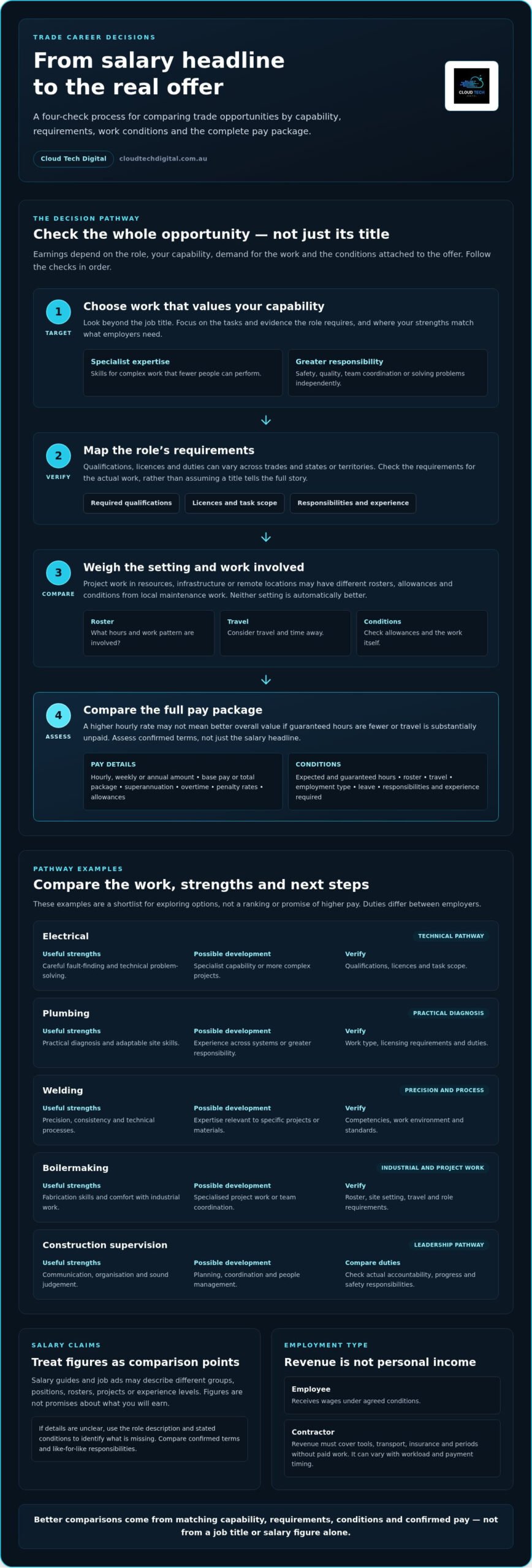
Separate the headline rate from what you’ll actually earn. Check whether the offer states base pay, and how overtime, penalty rates, allowances and travel are handled. Look at expected hours, superannuation and leave as well. A higher hourly rate may not mean better overall value if it comes with fewer guaranteed hours or substantial unpaid travel.
A job title alone can’t predict your take-home earnings. The duties, hours, pay structure and conditions matter just as much.
What can make one trade role pay more than another?
Specialist skills can help you qualify for work that fewer people can perform. Experience with complex projects, responsibility for safety or quality, and the ability to coordinate a team or solve problems independently can also add value. Employers assess these capabilities differently depending on the role, so focus on the tasks and evidence the job requires, not just its title.
Demand and work setting also shape opportunities. Project work in resources, infrastructure or remote locations may come with different rosters, allowances and conditions from a local maintenance role. Neither setting is automatically better: weigh the total package against travel, time away and the work involved. The broad range of skilled trades also reflects how varied training and practical expertise can be.
Employment and contracting involve different calculations. An employee receives wages under agreed conditions. A contractor’s revenue must cover business expenses, such as tools, transport and insurance, as well as periods without paid work. Revenue isn’t personal income, and it can vary with workload and payment timing. Compare like with like before treating a contractor’s gross earnings as equivalent to an employee salary.
How to read salary claims without being misled
Salary guides and advertisements can describe different things. A guide may draw on reported salaries across a broad group, while an ad may show a range for one position, roster or project. Figures can also refer to different periods or experience levels. Treat them as comparison points, not promises about what you’ll earn.
Before comparing figures, check the details:
- Is the amount hourly, weekly or annual, and is it base pay or a total package?
- Does it include superannuation, overtime, allowances or penalty rates?
- What hours, roster, travel requirements and employment type sit behind the figure?
- Are the responsibilities and experience requirements comparable to your own?
If an advertisement leaves these details unclear, use the role description and stated conditions to identify what’s missing. Assess the offer using confirmed terms. This gives you a stronger basis for deciding how to get higher paying trade jobs: target the capabilities employers need and compare the real package, not just the salary headline.
Which trade career paths can lead to higher-paying work?
There’s no reliable one-size-fits-all ranking of trades. Compare how you enter a pathway, the work setting, the skills it demands and where it can lead next. The Australian Bureau of Statistics groups occupations under Technicians and Trades Workers, but jobs within that broad group can involve very different tasks and responsibilities.
Use the examples below to build a shortlist, not to assume a particular trade guarantees higher pay. Titles and duties differ between employers, so read the job description and check the qualifications or licences relevant to the work and state or territory.
Compare specialist, project-based and supervisory pathways
Specialist technical work can build value through depth: employers may seek people who handle complex tasks and demonstrate reliable, high-quality work. Project and site leadership add responsibilities such as planning, coordinating people and materials, and being accountable for progress and safety. These pathways suit different strengths. Compare the duties, not just titles such as “supervisor” or “leading hand”.
| Pathway | Useful strengths | Possible development step | Details to verify |
|---|---|---|---|
| Electrical | Careful fault-finding and technical problem-solving | Develop capability in a specialist area or more complex projects | Required qualifications, licences and task scope |
| Plumbing | Practical diagnosis and adaptable site skills | Build experience across systems or take on greater responsibility | Work type, licensing requirements and duties |
| Welding | Precision, consistency and technical processes | Develop expertise relevant to specific projects or materials | Required competencies, work environment and standards |
| Boilermaking | Fabrication skills and comfort with industrial work | Progress towards specialised project work or team coordination | Roster, site setting, travel and role requirements |
| Construction supervision | Communication, organisation and sound judgement | Build planning, coordination and people-management experience | Scope of authority, accountability and relevant experience |
Match a pathway to your experience and preferred work
Your best next step depends on where you are now. An apprentice might compare skill areas to pursue within their trade. A qualified worker could target specialist tasks or more complex projects. An experienced tradie may be ready to explore supervision if they’re interested in planning and coordinating others. Compare the additional training and experience each option requires, and consider whether it fits your circumstances.
- List the tasks you’re strongest at and the skills you’d like to build.
- Compare hands-on work with leadership duties, and consider site conditions, travel and roster expectations.
- Shortlist roles that suit your lifestyle and identify the realistic training or experience gap for each.
A practical answer to how to get higher paying trade jobs starts with a pathway you can credibly progress towards, not a salary ranking that ignores fit. If you eventually choose independent work, winning jobs is a separate challenge from securing employment. A clear online presence and lead generation for trade businesses can help support a flow of commercial opportunities.
Build the qualifications and proof that employers value
A qualification can open a door, but employers also want evidence that you can do the work safely and consistently. To plan how to get higher paying trade jobs, connect your target role with the specific credentials, skills and practical examples that support your application. Use this four-step process to turn a broad ambition into a clear development plan.
- Choose a target role. Pick a specific job or next-step responsibility, such as specialist electrical work, plumbing on complex projects or a supervisory position. A clear target helps you focus your effort.
- Map its requirements. Compare several current job descriptions. Note repeated qualifications, licences, tickets, technical skills and experience. Separate mandatory requirements from desirable experience and preferences that may be specific to one employer.
- Close the skill gaps. Identify what you can gain through supervised work, further study or relevant training. Apprenticeships combine workplace learning with formal study; TAFE and other recognised training pathways may suit people at different career stages. The right option depends on your existing experience and target role.
- Document your evidence. Record relevant work, responsibilities, training and results as you build them. Keep your examples organised so you can quickly show how they match a role’s requirements.
Map training and licence requirements to your target role
Start with the work itself, not assumptions about what a job title requires. If several electrical job ads ask for a particular qualification or ticket, note it and check whether it’s mandatory for the duties. Requirements can vary by occupation and jurisdiction, especially for licensed work. Verify current rules with the relevant Australian regulator, licensing authority or training authority before enrolling or applying.
Not every line in an advertisement is a formal credential. A required licence or qualification is different from an employer’s preference for experience with a particular system or type of project. Confirm regulated requirements first, then decide which experience gaps you can address through work, training or a related role.
Show employers what you can do
A skills portfolio is dated evidence of relevant work and capability. It can include project summaries, tasks you completed, the level of responsibility you held, safety practices you followed and outcomes you can describe accurately. Keep it current, protect private or commercially sensitive information, and get permission before sharing photographs, documents or other people’s details.
Make each application specific. Match a short example to a requirement in the job description. For instance, describe the fault you diagnosed, the process you followed and your part in completing the work. Include relevant qualifications and tickets, and keep references up to date. This gives an employer a clearer picture than a list of unsupported skills, and helps you see what evidence to strengthen next.
Find and compare better-paid trade jobs with a clear plan
A focused search is more useful than sending the same application everywhere. To put how to get higher paying trade jobs into practice, treat each opportunity as a decision: shortlist roles that fit your next step, show how your experience meets their requirements, then compare the full offer before deciding.
- Shortlist roles. Save advertisements that match your trade, experience and preferred work setting. Look for responsibilities that build on your strengths or move you towards specialist or leadership work.
- Track requirements. Use a simple spreadsheet to record qualifications, licences, experience, duties, pay details and application dates. Note gaps you can address and questions the advertisement leaves unanswered.
- Tailor each application. Adjust your résumé and cover letter to reflect the specific tasks, credentials and experience requested. Lead with relevant evidence rather than a generic list of duties.
- Follow up professionally. Keep a record of your application and any agreed follow-up date. If you haven’t heard back, send a brief, courteous message that restates your interest without pressuring the employer.
Make your application demonstrate value
Employers need to see how you work, not just what roles you’ve held. Choose examples that demonstrate reliability, quality workmanship, safety awareness and problem-solving. Explain the issue you faced, the steps you took and the result, making your own contribution clear. Prepare a few concise examples for interviews, then adapt them to the role’s priorities. Be accurate and protect confidential site or client information.
Pay discussions work best when they’re grounded in the job. Refer to your relevant qualifications, demonstrated capability and the responsibilities in the advertisement. You might say, “I’ve completed similar work independently and can show examples. Could you explain how the pay reflects the scope of this role?” This keeps the discussion professional and focused on evidence, rather than an unsupported comparison with another job.
Assess the whole package before accepting
Before you decide, compare the written offer and conditions, not just the advertised figure. Record what’s stated and clarify anything that affects your likely hours, take-home pay or time away from home.
- Pay structure: base pay, pay period, overtime arrangements, penalty rates and allowances.
- Time and travel: ordinary hours, roster, expected travel, travel time and how work-related expenses are handled.
- Employment conditions: employment type, superannuation, leave and any relevant written terms.
- Role and progression: responsibilities, how performance is assessed, training opportunities and skills you could carry into a higher-responsibility position.
Ask clear questions before accepting, and compare offers using the same checklist. A role with valuable development opportunities may support your longer-term plan, but weigh that against its conditions and immediate needs.
If your next step is independent work rather than employment, winning jobs requires a different approach. Build your trade business’s online visibility with marketing that supports lead generation and helps potential customers find your services.
Turn trade experience into your next step, including business ownership
Trade experience can open several doors. You might deepen your technical expertise, move into leadership or use your skills to build an independent business. The right route depends on what you want from your work, the responsibilities you’re ready to take on and the lifestyle you want to maintain. Each option uses your experience differently and brings its own demands.
Keep the goal in view: how to get higher paying trade jobs is about making deliberate moves that suit your skills and circumstances. Business ownership is one possible next step, not a guaranteed shortcut to higher personal earnings. It changes how you earn, manage your time and take responsibility.
Weigh employment progression against going out on your own
Employment can offer defined duties, agreed pay and conditions, and a clearer separation between trade work and business administration. Progression might mean developing deeper expertise or taking on team coordination and site responsibilities. Consider whether the role gives you the experience and support you need for your next move.
Running a business brings more autonomy, but you’re also responsible for finding suitable work, quoting jobs, administration and cash flow. Revenue is not personal earnings: the business must meet its expenses, and time spent on paperwork or quoting isn’t necessarily time spent on paid work. Workloads and payment timing can vary, so plan for quieter periods rather than assuming every week will be full.
Before making the switch, weigh the practical trade-offs. How much time can you commit to the work and the business tasks around it? Do you understand your likely costs and how you’ll manage periods with fewer jobs? A realistic view helps you compare independent work with the employment options available to you.
Build visibility if your next step is a trade business
Potential customers need to understand what you do and how to enquire. A clear website and consistent online presence can explain your services, experience and the types of jobs you take on. Search engine optimisation, Google Ads and social media advertising can help put your services in front of potential customers. A website or focused landing page gives people a clear place to learn about your work and enquire. Marketing can support lead generation, but it doesn’t replace sound quoting, reliable delivery or careful cash-flow management.
For practical ideas on attracting work, explore this lead generation guide for Australian tradies. If you’re planning broader growth, the 2026 marketing blueprint for tradies covers ways to build your business presence and reach potential customers.
Start with the next step that best fits your situation: build specialist capability, pursue leadership experience or plan carefully for independent work. If business ownership is the direction you’re considering, explore digital marketing for trade businesses as one part of building visibility and generating suitable enquiries.
Make your next career move count
Your next step doesn’t need to be a leap. Choose one move you can act on now: build a skill employers ask for, prepare evidence of your work, or explore whether running a trade business fits your goals. A clear direction turns “how to get higher paying trade jobs” into a practical plan you can refine as your experience grows.
If you decide to work independently, remember that doing quality trade work and keeping a business visible are separate parts of the job. Cloud Tech Digital provides SEO, pay-per-click, social media advertising and bespoke website design for trade businesses. A focused marketing approach can help put your services in front of potential customers while you focus on delivering the work and managing the business.
Explore digital marketing support for trade businesses and take a considered next step towards building demand for your services. Keep backing your skills with evidence, make choices that suit your circumstances and move forward with confidence.
Frequently asked questions
Can I change trades later in my career?
Yes, you can change trades later, though the transition may involve new training, supervised experience or licensing requirements. Start by comparing the tasks in your current role with those in the trade you’re considering. Some skills, such as interpreting plans, working safely on site or using particular tools, may be relevant, but they won’t automatically replace trade-specific requirements. Check whether prior learning can count towards the new pathway before planning your change.
Do I need a university degree to get a higher-paying trade job?
No, a university degree isn’t a standard prerequisite for every well-paid trade role. Employers usually focus on the qualifications, licences and practical capability relevant to the work. Apprenticeships and vocational training are common ways to gain trade skills, while some supervisory or technical roles may value additional study. Read the role requirements carefully and prioritise credentials relevant to the actual duties, rather than taking on unrelated study just to strengthen your résumé.
Can overseas trade qualifications be recognised in Australia?
Yes, overseas trade qualifications and experience may be assessed for recognition in Australia, but the process and outcome depend on the occupation and purpose of the assessment. Recognition for a qualification doesn’t necessarily meet every state or territory licensing requirement. Gather your certificates, work records and translations where needed, then check current instructions from the relevant Australian skills assessment authority and licensing regulator. Confirm the exact requirements for the trade and jurisdiction where you intend to work.
Is a higher hourly rate always a better job offer?
No. A higher hourly rate may come with fewer guaranteed hours, a demanding roster, longer travel or less favourable conditions. Compare what you’d earn across the expected work pattern, not just the headline rate. For example, weigh a role with regular hours and a lower rate against one with variable shifts and more travel. Consider the written employment terms, leave and superannuation too, then decide which package best fits your priorities.
How can an apprentice move towards higher-paying trade work?
An apprentice can build towards better opportunities by becoming reliable across core tasks, asking for feedback and tracking what they’re trusted to do as their skills develop. Keep a record of completed units, practical tasks and added responsibilities. Discuss the kinds of work you want to progress into with your supervisor, then agree on a realistic next skill to develop. This turns general ambition into a clear conversation about capability and experience.
Can a contractor earn more than an employee?
Yes, a contractor may bring in more revenue than an employee earns in wages, but that doesn’t mean they take home more. Contractors need to account for business expenses, tax obligations, time spent quoting and doing administration, and gaps between jobs. For a fair comparison, estimate income after costs and allow for periods with less work. The result depends on the contract, workload and how effectively the business is managed.
How do I know whether a trade job has room for career progression?
Look for signs that the role can build skills or expand responsibility, such as exposure to varied projects, specialist tasks or opportunities to coordinate work. During an interview, ask what a capable person might learn or take responsibility for over time, and how performance is assessed. Listen for concrete examples rather than relying on a promising title. You can also compare the role’s requirements with positions you may want to pursue later.
