


The bidding option that brings your trade business the most enquiries may still be the wrong one. If Google Ads treats every form fill or phone call as equally valuable, it can chase activity instead of genuine job opportunities. Choosing Google Ads bidding strategies for trade services isn’t about finding a magic setting. It’s about matching your campaign goal to reliable conversion signals.
It’s reasonable to be cautious about automation when you can see clicks and enquiries but aren’t sure which ones turn into worthwhile work. The right approach depends on what you want your campaign to achieve and how well you track lead quality.
This guide compares manual and automated bidding options, explains their trade-offs and shows how to match a strategy to your goals and conversion data. You’ll also learn how to tell a basic enquiry from a promising job lead, so you can make informed decisions based on performance that matters to your business.
Key Takeaways
- Compare Google Ads bidding strategies for trade services by campaign goal, conversion data and the level of control you need.
- Understand when click-focused options such as Manual CPC or Maximise Clicks may suit a campaign, and what they don’t tell you about lead quality.
- Match your bidding approach to campaign maturity and reliable tracking instead of assuming automation is the right starting point.
- Use a clear testing process: define the goal, check tracking, choose a strategy, monitor results and review enquiry quality.
- Use conversion-focused campaign management and transparent lead reporting to keep the focus on real job opportunities, not just clicks.
Google Ads bidding strategies for trade services: what bidding actually controls
A bidding strategy is how Google Ads sets or optimises bids in an advertising auction to support the goal you choose. Depending on the strategy, bids may be adjusted to pursue clicks, enquiries or another measurable outcome. Bidding controls how your campaign competes in auctions. It doesn’t decide which services you offer, who your ads target or what happens after someone responds.
Think of a campaign as a connected system. Keywords help determine which searches can trigger your ads; ad copy sets expectations; landing pages help turn interest into an enquiry; and your follow-up influences whether that enquiry becomes work. The Google Ads platform overview explains the wider advertising platform, but a bidding setting can’t fix mismatched targeting or a page that doesn’t make the next step clear.
What Google Ads bidding can, and cannot, do
Bidding can direct campaign spend towards a defined goal, but its effectiveness depends on the campaign setup and the signals available. If conversion measurement records irrelevant actions, an automated strategy may optimise towards those actions. If targeting attracts searches for work you don’t offer or outside your operating area, changing bids won’t make those searches suitable.
A conversion action is a specific interaction recorded by Google Ads, such as a form submission or phone call. A commercially valuable lead is an enquiry that fits your services and has a realistic chance of becoming a suitable job. They aren’t automatically the same. A tracked call might be from a supplier, a wrong number or someone asking for work you don’t take on.
That distinction matters. A click shows that someone visited, not that they made contact. A recorded conversion shows that a defined action happened, not that the person is a good prospect, accepted a quote or booked a job. Bidding can’t guarantee enquiries, revenue or return on investment.
Which trade-business goal should guide the bid?
Before comparing strategies, define what a worthwhile result means for your business. Enquiry volume, lead quality and job value are separate objectives. A campaign can generate plenty of enquiries but still miss the mark if they’re outside your services. A smaller number of suitable enquiries may be a better fit for your capacity.
- Enquiry volume: Aim to attract more calls or form submissions when you can respond to additional demand.
- Lead quality: Focus on enquiries that match the work you want, your service area and your ability to take on jobs.
- Job value: Consider which types of completed work best support your business, rather than treating every enquiry as equally valuable.
For example, a busy trade business may need to limit demand to particular job types, while a business building its workload may prioritise more relevant enquiries. Define your goal alongside your capacity and the value of completed work—much like analyzing lawn route profitability helps mobile service contractors determine which jobs are genuinely worthwhile. This gives you a practical basis for judging whether a bidding strategy is helping and which trade-offs matter most.
Google Ads bidding strategies for tradies: how the main options differ
The main choice is whether you want to guide spend towards visits, recorded conversions or conversion value. Each option makes a different trade-off between control and automation. None can make irrelevant searches or unsuitable enquiries valuable. Google’s explanation of the Official Google Ads bidding mechanics also highlights that bids work alongside ad quality and other auction factors.
Click-focused bidding versus conversion-focused bidding
Click-focused bidding aims to attract visits or gives you more direct control over bids. Conversion-focused bidding uses recorded conversion actions as signals to pursue enquiries. More clicks don’t automatically mean more suitable trade leads. A campaign can attract traffic without generating enquiries that match your services, capacity or preferred work.
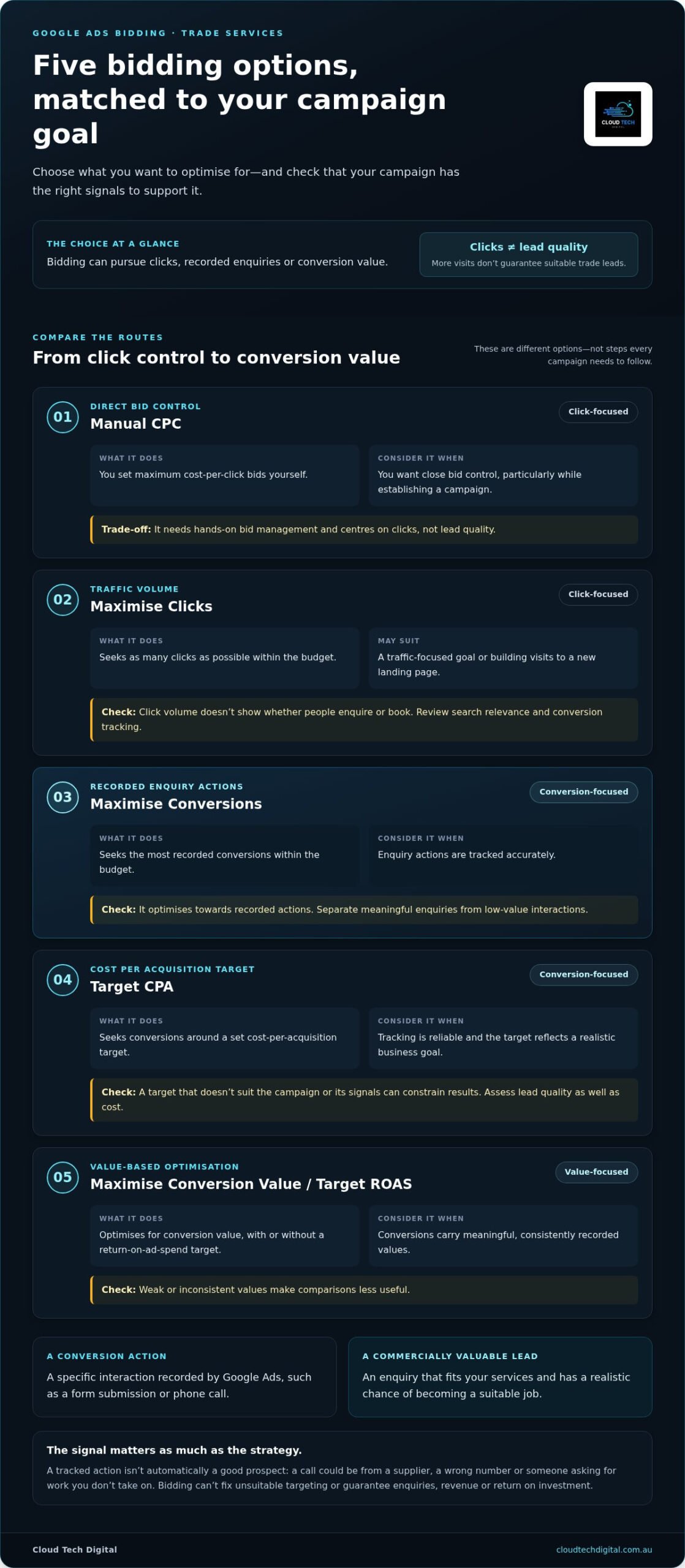
| Strategy | Goal | Suitable conditions | Trade-off and data considerations |
|---|---|---|---|
| Manual CPC | Set maximum cost-per-click bids yourself. | Useful when you want close bid control, particularly while establishing a campaign. | Requires hands-on bid management. It’s centred on clicks, not lead quality. |
| Maximise Clicks | Seek as many clicks as possible within the budget. | Can suit a traffic-focused goal or help build visits to a new landing page. | Click volume doesn’t show whether people enquire or book. Review search relevance and conversion tracking. |
| Maximise Conversions | Seek the most recorded conversions within the budget. | More relevant when enquiry actions are tracked accurately. | It optimises towards recorded actions, so distinguish meaningful enquiries from low-value interactions. |
| Target CPA | Seek conversions around a set cost per acquisition target. | Consider it when conversion tracking is reliable and the target reflects a realistic business goal. | A target that doesn’t suit the campaign or its signals can constrain results. Assess lead quality as well as cost. |
| Maximise Conversion Value and Target ROAS | Optimise for conversion value, with or without a return-on-ad-spend target. | Relevant when conversions carry meaningful, consistently recorded values. | Weak or inconsistent values make comparisons less useful. Don’t assign arbitrary values to enquiries. |
When conversion value or Target CPA may be relevant
For Google Ads bidding strategies for trade services, start with a clear definition of what counts as an enquiry. Target CPA depends on recorded conversions and a sensible acquisition-cost goal; it doesn’t judge whether each lead is worth pursuing. Value-based bidding needs reliable conversion values that represent meaningful differences, such as distinct job outcomes, rather than an assumed value assigned to every form fill.
Google Ads labels and available settings can change. Use the names shown in your account when comparing options, and consider that availability may depend on your campaign setup.
For support aligning bidding with trade enquiries and campaign goals, explore Google Ads management for tradies.
Which bidding strategy suits your trade campaign? Compare the trade-offs
Choose a strategy based on what your campaign can reliably measure, not on what sounds most advanced. A new campaign with little conversion history has different needs from an established one recording suitable enquiries. Your goal matters too: you might be gathering visits, generating more enquiries, improving lead suitability or understanding which types of work are most valuable.
Automation can adjust bids towards the signals it receives, but it can’t guarantee better leads or lower acquisition costs. If tracking counts every form submission as a success, the system may pursue more submissions without knowing which ones become genuine opportunities. Google’s Google Ads Smart Bidding explained describes how automated strategies use signals to optimise for conversions or conversion value. The quality of your inputs still matters.
A new campaign with limited conversion history
Imagine an electrician launching a campaign for switchboard upgrades. Manual CPC could provide closer control while the business checks whether search terms, ads and landing pages attract relevant traffic. Maximise Clicks may suit a traffic-first test, but visits alone won’t confirm whether people enquire or want the advertised work.
Before drawing conclusions, make sure the intended actions are recorded consistently and review whether they represent genuine enquiries. Give changes time to produce useful evidence, and avoid changing several important campaign elements at once. Early ad data can show whether the campaign attracts relevant searches. It can’t tell you whether the business quoted successfully, won the job or completed profitable work. Track those outcomes separately in your business records.
An established campaign with tracked enquiries
Once a campaign records enquiries consistently, conversion-focused bidding may be worth testing. For a plumbing business, Maximise Conversions could pursue more tracked calls or form submissions, while Target CPA adds a cost-per-acquisition goal. Neither strategy can identify a good lead from an unsuitable one unless measurement provides a useful signal. Review enquiry fit as well as conversion count and cost.
If the business can reliably connect enquiries to completed work and record meaningful differences in value, Maximise Conversion Value or Target ROAS may help align bidding with those distinctions. Don’t treat a rough estimate as precise job value. If you can’t consistently distinguish a small repair enquiry from a larger project, value-based bidding may optimise against noise rather than useful commercial differences.
For example, a plumber might assess whether campaign enquiries match the services advertised, can be served and progress to quoting. That gives a more grounded basis for comparing strategies than clicks or form fills alone. Businesses considering plumbing campaigns can also explore this Google Ads guide for plumbers in Australia for trade-specific context.
Make the decision practical: match the strategy to campaign maturity, tracking reliability and the result you want to improve. Then judge performance against the quality of actual opportunities, rather than assuming automation will fix weak signals or suit every trade account.
How to choose, test and measure a bidding strategy for trade services
A sound test starts with a business outcome, not a setting in Google Ads. Decide what you want to improve, then make sure the campaign can measure it and your team can assess what happens after an enquiry arrives.
Bidding decisions are only as dependable as the conversion actions, attribution settings, call and form records, lead-status feedback and, where relevant, conversion values informing the account. Missing, duplicated or misclassified events can make reported cost per conversion a poor guide to genuine job opportunities.
Set up measurement before judging bidding performance
Choose the enquiry actions that matter, such as a submitted form or a call, and check that each is recorded consistently. A recorded conversion confirms that a configured action occurred. It doesn’t establish whether the person needed your service, was suitable to quote or became a customer. Verify Google Ads conversion tracking and relevant account or campaign settings against current Google Ads guidance before relying on the data.
- Define the goal. Choose whether the campaign should attract relevant visits, generate enquiries or improve the quality or value of opportunities. Make the goal specific enough to judge.
- Check tracking. Confirm that the intended calls and form submissions are recorded, and that reports reflect actual enquiries rather than duplicate or irrelevant actions.
- Select a strategy. Match the bidding approach to your objective and the strength of the available signals. If conversion data is unreliable, fix measurement before asking an automated strategy to optimise towards it.
- Monitor the test. Record the strategy and any meaningful campaign changes. Change one important variable at a time, such as the bidding approach, so you can interpret what may have influenced results.
- Review lead quality. Compare platform-reported conversions with business feedback: which enquiries matched the work, progressed to a quote or became a job?
Review results without overreacting to short-term changes
Assess a meaningful period of campaign activity rather than reacting to an isolated rise or fall. Consider whether the campaign had enough opportunity to reflect the change, and account for delays between an enquiry, follow-up, quoting and a job decision. A brief fluctuation isn’t proof that a strategy has succeeded or failed.
Read platform metrics alongside what happens in the business. If recorded conversions increase but the enquiries are unsuitable, the campaign may be producing more actions without improving the outcome you care about. If qualified opportunities are progressing but the platform reports few conversions, investigate whether tracking is capturing the relevant actions. Consistent feedback on lead status gives you a clearer basis for the next adjustment.
This measurement discipline applies across decisions about tradie lead generation and helps connect paid campaign activity with wider business goals. For a conversion-focused approach with transparent lead tracking and reporting, explore Google Ads management for tradies.
How Cloud Tech Digital manages Google Ads bidding for tradies
Choosing between Google Ads bidding strategies for trade services is one part of building a campaign that supports your business. Cloud Tech Digital manages Google Ads with a tradie-focused, conversion-focused approach, centred on generating high-quality leads and making campaign activity transparent. The aim is to help you understand what your advertising is producing, not just how many clicks it attracts.
Campaign management considers your goal and the signals available, with lead tracking and reporting informing performance discussions. A bidding strategy can guide how Google Ads pursues a goal, but it can’t guarantee a particular number of enquiries, revenue or return. Clear reporting keeps decisions grounded in what the campaign records and the opportunities your business sees.
What transparent campaign management should make clear
Cloud Tech Digital tracks and reports every lead. This gives you a clearer view of campaign enquiries and a basis for discussing which ones suit your work. Reporting is more useful when lead outcomes inform the conversation too. An enquiry that matches your services is different from an irrelevant contact, and both should be understood rather than hidden behind an overall conversion count.
Lead feedback can guide campaign adjustments, including whether the bidding goal still reflects your priorities. It supports a practical conversation about lead quality without treating clicks or recorded actions as proof of booked work. Results vary, so a case study is an example, not a typical outcome or a promise.
For instance, Jabez of JT Handyman Solutionz closed an $84K job directly from Google Ads. That result describes one client’s experience; it doesn’t predict what another trade business will achieve. For a wider view of how paid search fits alongside other channels, explore marketing for Australian tradies.
What happens when you work with Cloud Tech Digital
The process is straightforward: choose a package, share campaign material and provide account access. Your photos or job shots help create campaign material that reflects your trade business.
- Invoice – Choose the package that fits your business.
- Content – Share your photos or job shots so we can create campaign material.
- Access – Give us access to your ad accounts. All leads are exclusive to you.
- Results – We launch and deliver real leads directly to your inbox. You get to work.
To discuss a Google Ads approach shaped around your trade business, talk with Cloud Tech Digital.
Make your next bidding decision with confidence
Your next step doesn’t need to be a major campaign overhaul. Choose one decision you can make more clearly: which trade enquiries are worth pursuing, what your campaign should optimise for, or what evidence you need before changing the bid strategy. That focus gives you a practical way forward without expecting an automated setting to solve every campaign challenge.
Cloud Tech Digital’s work with trade businesses is backed by more than 50 five-star Google reviews. Every business has different services, capacity and commercial priorities, so the right approach should reflect what you want from your advertising and what your campaign can reliably measure. Focus on progress you can assess, not promises about a particular result.
Start with a clear picture of the work you want more of and how you’ll judge a valuable enquiry. Talk with Cloud Tech Digital about Google Ads for your trade business and discuss an approach shaped around your goals. With a sound plan and useful measurement, you can make your Google Ads bidding strategies for trade services work towards more relevant business outcomes.
Frequently Asked Questions
Which Google Ads bidding strategy is best for trade services?
There’s no single best choice. It depends on the campaign’s goal and the reliability of its data. Google Ads bidding strategies for trade services should reflect the work you want to book, not simply the strategy name. A roofing business seeking larger replacement projects may assess success differently from one focused on smaller repairs. Decide which enquiries suit your capacity, then compare strategies against that objective.
Is automated bidding suitable for a new tradie Google Ads campaign?
It can be, provided the campaign tracks relevant actions correctly and the chosen goal makes sense. If a new campaign has little useful conversion history, automation has less evidence to learn from, so don’t assume it will immediately identify the enquiries you value. Check that test calls and forms appear accurately in reporting, then assess whether real enquiries match the advertised work before relying on the results.
Can Maximise Clicks generate quality leads for a trade business?
It can bring people to your site, but Maximise Clicks is designed to pursue visits, not assess whether each person is a suitable prospect. For example, a campaign for hot water system repairs might attract visitors researching parts or DIY fixes as well as people seeking a tradie. Review search terms and the landing page journey, then judge lead quality by the enquiries your business actually receives, not traffic volume alone.
What is the difference between Maximise Conversions and Target CPA?
Maximise Conversions seeks as many recorded conversions as possible within the campaign budget, while Target CPA adds a desired average cost per conversion as a bidding goal. Neither setting determines whether an enquiry is profitable. If your account counts quote requests and low-intent downloads alike, both strategies may respond to those actions. Make sure the conversions used for bidding represent actions that matter to the trade campaign.
How much conversion data does Google Ads need for Smart Bidding?
There isn’t one universal conversion count that guarantees Smart Bidding will perform well. The usefulness of the data depends on whether conversions are recorded consistently, relate to the campaign goal and occur often enough to provide meaningful signals. A campaign with a steady stream of correctly tracked enquiries may offer more to learn from than one with occasional, inconsistently recorded actions. Review Google’s current guidance and the campaign’s own data before changing strategy.
What happens if Google Ads tracks calls or form submissions as conversions but they are poor leads?
The bidding system may treat those actions as useful outcomes and pursue more of them, even if they rarely become suitable opportunities. Check what each conversion represents: a brief call, a duplicate form and a genuine request for a quote shouldn’t necessarily carry the same weight. Review lead records alongside campaign data, then refine which actions are used for optimisation so reporting better reflects the enquiries your business wants.
Should trade businesses use Target ROAS for Google Ads leads?
Consider Target ROAS only if the campaign can assign meaningful, consistent values to its conversions. A standard form submission doesn’t reveal the eventual value of the work, so giving every enquiry an arbitrary figure can send bidding in the wrong direction. If you can connect a lead to a reliable job value, that information may support value-based optimisation. Otherwise, a strategy focused on suitable conversion actions may be a clearer fit.
