


What makes a property manager choose one tradie over another? Often, it’s not the slickest pitch. It’s confidence that the work will be completed reliably, communication will be clear and maintenance will be easy to coordinate. That’s the practical advantage of marketing to property managers for trades: make your service and the way you work simple to assess.
If your outreach is being ignored, or you’re unsure what matters when a property manager appoints a trade, start by looking at the job from their perspective. A one-off job can lead to more work, but a good first impression alone won’t build an ongoing relationship. Property managers need to know what work you handle, how you manage a job and how you’ll keep them informed.
This guide explains how to identify relevant property managers, shape a concise trade-specific pitch and use proof, clear processes and a credible online presence to support it. You’ll also learn how to follow up thoughtfully, turn completed jobs into stronger relationships and build a repeatable marketing system for commercial enquiries.
Key Takeaways
- Focus your pitch on the property manager’s maintenance needs, not a generic list of trade services.
- Make your trade, job scope and service area easy to understand so managers can assess fit quickly.
- Use search, paid advertising, social media and referrals to reinforce one consistent message.
- Make marketing to property managers for trades repeatable with tailored outreach and measured follow-up.
- Bring SEO, Google Ads, social advertising and a conversion-focused website together to support commercial enquiries.
Marketing to property managers for trades: understand what earns the first conversation
Property managers coordinate maintenance while balancing tenant requests, owner expectations and other work. A strong first approach shows that you understand this role and can make trade work easier to organise. Focus your message on what you do, how you handle a job and how you keep the manager informed. The goal is to start a relevant conversation, not to send a long sales pitch.
Property managers oversee rental homes or buildings and arrange work needed to maintain them. Their responsibilities vary, but often involve communicating between owners, tenants and contractors. A Property management overview provides useful context on the breadth of the role. For a tradie, the key point is that the person arranging a repair is managing communication as well as the work itself.
What property managers need from trade contractors
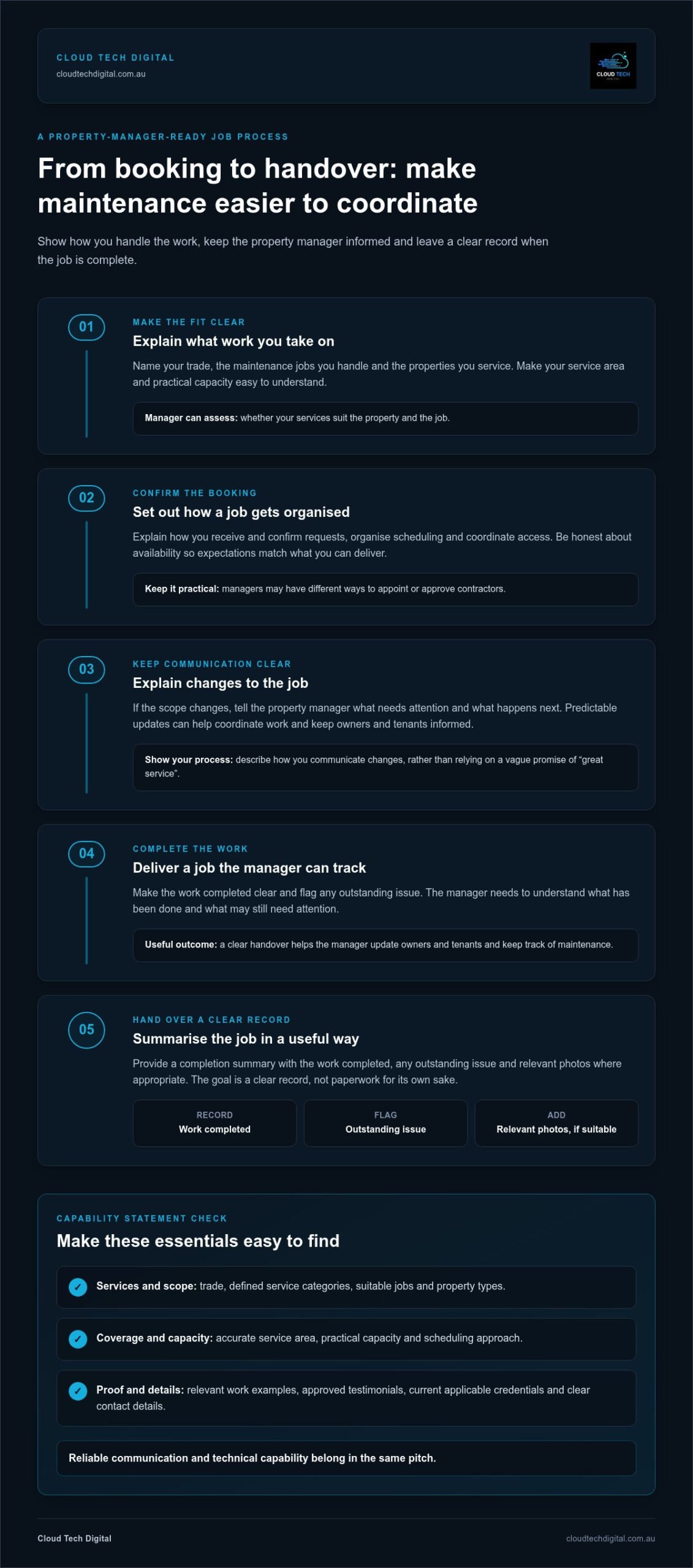
Trade skill is essential, but managers also want to know what working with you will involve. Can they understand what you’ve done, what needs attention and what happens next? A dependable contractor confirms arrangements, explains changes to the job and provides a clear record when the work is complete. That helps a manager update owners and tenants and keep track of maintenance.
Make your process concrete. Explain how you confirm a booking, communicate if the scope changes and provide a completion summary. A useful job record can note the work completed, any outstanding issue and relevant photos where appropriate. The purpose is a clear handover, not paperwork for its own sake.
Predictable communication can reduce avoidable back-and-forth and make it easier to coordinate access and updates. Managers may have different ways to appoint or approve contractors, so avoid assuming there’s one process every business follows. Make your services and the steps for engaging you easy to understand.
Why a trade business needs a distinct property-manager message
A homeowner-focused offer often centres on fixing a problem at one person’s home. A property-manager proposition should explain how your trade supports maintenance across managed properties, where that suits your business, and how you organise communication and job delivery. Instead of listing every service you offer, identify the work you want to be considered for and the practical value your process brings to a manager’s day.
Connect your work to outcomes a manager can assess: keeping a property in good order, clarifying what has been done and supporting a smoother tenant experience. For example, explain how you document completed work and flag a follow-up requirement rather than relying on a vague claim that you provide “great service”. Make promises based on processes you can consistently deliver.
Property managers assess service reliability as well as technical capability. That’s the foundation of marketing to property managers for trades. Make both clear in your pitch, and you give prospective clients a stronger reason to discuss upcoming work.
Build a trade-services pitch property managers can assess quickly
A property manager should be able to understand your fit without working through a long sales pitch. Make the essentials easy to find: your trade, the maintenance work you take on, the properties you service and how you manage a job from booking to completion. A focused capability statement gives them a quick way to assess whether your business suits their portfolio.
What to include in a property-manager capability statement
Keep the document concise and specific. Name your trade and service categories, then describe the jobs you’re set up to handle. Instead of saying “all maintenance”, a plumber could list leak repairs, blocked drains and fixture replacements if those match their actual work. Explain your practical capacity, including the kinds of jobs your team can take on and how you organise scheduling. Be honest about availability so you don’t set expectations you can’t meet.
Describe your service area accurately and explain if coverage varies by job type. Include a business contact, how you receive and confirm requests, and a brief example of completed work that shows how you manage a job. Use testimonials only when they’re approved and attributable. Include licences, insurance details and trade credentials only when they’re current and relevant.
A practical capability-pitch checklist:
- Trade and clearly defined service categories
- Suitable maintenance jobs and property types
- Accurate service-area description and practical capacity
- Job communication, scheduling and completion process
- Relevant work examples and approved testimonials
- Current, applicable credentials and clear contact details
Make your website support the pitch
Your capability statement should lead to a website that supports the same message. Create a clear trade-services page for property maintenance that explains the work you handle, the properties you serve and what happens after someone makes an enquiry. Keep contact details easy to find, and make sure the wording matches your pitch. Consistency helps property managers check your fit without encountering conflicting information.
A landing page can give a specific campaign or outreach message a focused next step. If your pitch is about ongoing maintenance for managed properties, for example, the page can explain that offer and give interested managers a clear way to enquire. This keeps the experience relevant from first contact through to your website. Strong web design for tradies can make your services, proof and enquiry process easier to understand.
For a trade business refining its online pitch, conversion-focused website and landing page design can help present the offer clearly. Keep the message grounded in what your business can deliver, and make the next step easy to find.
Choose marketing channels that help property managers find and trust your trade business
Effective marketing to property managers for trades doesn’t rely on one channel doing everything. Search can help a manager find a service when a maintenance need arises. Referrals and relevant project examples can build confidence, while advertising can put a clear offer in front of potential clients. Choose channels that reinforce the same property-manager proposition, and track whether they produce suitable enquiries rather than attention alone.
| Channel | Audience | Best use | Measurement |
|---|---|---|---|
| SEO | Managers actively searching for trade services | Build visibility for relevant maintenance searches over time | Relevant enquiries and the work they ask about |
| Google Ads | People searching with immediate service intent | Test focused messages for specific trade services | Enquiry source, suitability and follow-up outcome |
| Social advertising | Professional and local business audiences | Introduce your offer and share useful examples | Enquiries and audience response, not reach alone |
| Referrals | Managers introduced through existing relationships | Build trust through relevant recommendations | Referral source and resulting conversations |
Use search and paid advertising to capture active demand
SEO helps your business appear when property managers search for a trade or maintenance service. Build useful pages around the work you actually handle, with clear service descriptions and a direct enquiry path. Consistent work on those pages can support discovery beyond a single campaign. A focused SEO strategy for tradies can align search visibility with the jobs you want to attract.
Google Ads can test messages aimed at people actively searching, such as an offer focused on maintenance services for managed properties. Keep the ad, landing page and enquiry prompt aligned. Review search terms and the suitability of enquiries, then adjust the campaign based on what attracts relevant work, not clicks alone.
Use social proof and referrals to reinforce credibility
Social advertising can introduce your services and show how you approach a job. Share accurate project details, such as the type of work completed and the process used. Avoid implying results you can’t substantiate. Facebook ads for tradies can support visibility when the message is tailored to the audience and leads to a relevant next step.
Referrals add a personal signal of trust. Build a simple follow-up habit with satisfied clients: after a job is complete, thank them, invite honest feedback and make it easy for them to recommend your business where appropriate. Don’t pressure clients or assume every job will lead to a referral.
Track the source of enquiries across your channels. Record how each enquiry arrived, whether it came from a property manager and whether the requested work suits your business. Cloud Tech Digital helps tradies connect SEO, paid search, social advertising and conversion-focused pages through digital lead-generation strategy tailored to their growth goals.
Turn property-manager outreach into a repeatable follow-up process
Good outreach is more than a polished introduction. It’s a simple system for finding relevant property managers, starting a useful conversation and recording what happens next. A consistent process helps you follow up without sending generic messages or losing track of promising contacts. Set the pace based on the conversation rather than assuming the same contact frequency will suit every manager.
Plan a useful first contact and follow-up
Before contacting someone, check that their business manages properties suited to your trade and that you can take on the work they’re likely to need. Note a relevant detail, such as the type of portfolio they manage or a maintenance service that fits your capability. Personalisation should show you’ve considered their needs, not just added their name to a template.
- Research the prospect. Record their business, portfolio type, relevant contact details and why your service may be useful.
- Choose a relevant point of contact. Use the recipient’s preferred channel where it’s known, and follow applicable marketing requirements.
- Send a concise introduction. State your trade, the maintenance work you handle and why it may suit their properties. Offer one clear next step, such as a brief conversation or permission to send a capability statement.
- Follow up with something useful. If appropriate, share a relevant service-page link or a short example of similar work. Add context instead of simply asking whether they saw your first message.
- Record the response and next action. Note the date, channel, reply, stated preferences and any agreed follow-up. If they decline or ask you not to contact them again, record that and respect it.
Keep each message brief enough to scan. A useful introduction might explain that you handle a particular type of maintenance for rental properties, then link to a page describing your services. Only use a trade or job example that accurately reflects your business. A specific, relevant detail gives the manager a reason to respond; a broad claim about being “the best” does not.
Measure progress beyond the number of enquiries
Track more than initial replies. Record qualified conversations, requests for information, opportunities that match your capacity and work that progresses to an ongoing relationship. Note the source of each introduction too, whether it came from search, advertising, a referral or direct outreach. This makes it easier to see which activities start worthwhile discussions.
Separate first-time enquiries from repeat jobs and referrals in your records. A channel that produces fewer enquiries may still be valuable if those conversations are a better fit or lead to repeat maintenance work. Review your notes regularly and adjust your message, prospect list or next step based on what you learn. The 2026 Tradie Growth Guide offers further context for building a considered lead-generation approach.
Connect your outreach with a tailored marketing strategy for your trade business so your digital channels support the same offer.
Scale marketing to property managers with a clear digital lead-generation system
Once your pitch and follow-up process are clear, connect them to a digital system that helps property managers find and assess your business. A focused offer gives each channel a shared purpose: attract relevant commercial enquiries, establish credibility and make the next step straightforward. That’s the practical foundation of marketing to property managers for trades.
Each channel can play a different role. SEO helps your trade business appear in relevant searches over time. Google Ads can put a specific service offer in front of people actively searching, while social advertising can build awareness and showcase useful examples of your work. A conversion-focused website or landing page gives interested managers a place to understand your services and enquire. When the message carries through from search or ad to page, the experience feels joined up.
Keep the system focused. Choose the trade services and property-maintenance opportunities you want to attract, support your offer with accurate proof and explain what happens next on your website. Track where enquiries come from and whether they suit your work. Use that information to refine campaign targeting, page content and messages. Clicks show that people noticed an ad, but enquiry relevance and qualified conversations offer better context for business decisions.
When a trade business may need ongoing marketing support
Ongoing support may be useful if enquiries are inconsistent, campaign results are hard to interpret or you’re struggling to find time to review and improve your marketing. A managed process can bring campaign monitoring, lead tracking and strategy adjustments together, helping you make decisions based on performance against your goals.
Marketing supports how you present and promote your business. It doesn’t replace dependable trade delivery, clear communication or the relationships that help turn a first job into repeat work. Your online message should reflect the service clients experience.
Choose a next step that matches your growth priorities
Start by defining the property-manager opportunities you want to pursue. Which maintenance services do you want to promote? What kind of portfolio suits your capacity? What would make an enquiry a good fit? Clear answers help shape a digital strategy, whether the priority is search visibility, paid advertising, a stronger landing page or a coordinated mix.
Cloud Tech Digital helps Australian tradies connect SEO, Google Ads, social advertising and conversion-focused websites to their business goals. The right approach depends on what you want to grow and how you want to attract suitable enquiries. A considered strategy can bring those channels together around your priorities.
Make your next growth step a deliberate one
Building a stronger pipeline starts with choosing the property-management work your business is ready to pursue. Set a clear priority, then make sure your marketing gives the right people a credible reason to take the next step. With marketing to property managers for trades, progress comes from connecting what you promote with the work you can deliver and learning from the enquiries you attract.
Cloud Tech Digital is an Australian-owned agency founded in 2020, supporting trade businesses with SEO, Google Ads, social-media advertising, lead tracking and conversion-focused websites. A tailored approach brings those elements together around your growth priorities, while keeping the service and relationships that underpin repeat work in focus.
Talk to Cloud Tech Digital about a lead-generation strategy for your trade business and take a practical next step towards attracting suitable property-manager enquiries. With a focused plan and consistent follow-through, you can build momentum at a pace that makes sense for your business.
Frequently Asked Questions
How do tradies get work from property managers?
Tradies can win property-management work by making it easy for managers to understand where their services fit and how to engage them. Start with a relevant introduction, then build familiarity through useful, professional interactions rather than expecting one message to secure ongoing work. A manager who needs a particular maintenance job may keep your details for a future request if your trade, service scope and contact pathway are clear. That consistency supports marketing to property managers for trades.
What do property managers look for in a trade contractor?
Property managers typically need confidence that a contractor can complete suitable work and make coordination straightforward. They may consider whether your team can handle the job, communicate changes clearly, follow site access arrangements and provide a useful completion record. A brief example of how you handled a change in scope can be more informative than a broad claim about quality. Be accurate about your capacity so expectations match what your business can deliver.
Do property managers use preferred trade contractors?
Some property managers may use established or preferred contractors, while others may select trades based on the property, job or their own processes. Don’t assume every business maintains a formal approved list. If it’s appropriate in the conversation, ask whether there’s a supplier registration or information process. If a manager already has regular contractors, explain the specific work your business handles and leave your details for situations that match your services.
How should a tradie introduce their business to a property manager?
Keep the introduction personal, brief and focused on a relevant service. For example: “I’m Sam, an electrician handling electrical maintenance for rental properties, including fault repairs and fixture replacements. If this suits your portfolio, I can send through our service details.” Adapt the example to your real trade, work and service area. Use the manager’s preferred contact method where known, and avoid attaching a large bundle of material before they’ve shown interest.
Can a small trade business win property-management work?
Yes. A smaller business can be a suitable fit if it clearly describes the jobs it can take on and communicates its practical capacity honestly. Focus on a manageable service scope rather than implying you can cover every property or request. For instance, outline the maintenance work your team handles and explain how you’ll keep the manager updated if a job falls outside that scope. Clear boundaries help build confidence and avoid overcommitting.
How often should a tradie follow up with a property manager?
There’s no single follow-up interval that suits every contact. Base your next step on the conversation, any agreed timing and the recipient’s communication preferences. If they ask you to send information, allow reasonable time for them to review it before following up. If they decline or ask you not to make further contact, respect that. Each follow-up should add context, such as a relevant service detail, rather than simply repeating “just checking in”.
What should a trade business track in its property-manager marketing?
Track each contact’s source, the service they enquired about, the conversation status and the agreed next action. Record whether an opportunity suits your trade and capacity, then distinguish new work from repeat jobs and referrals. This shows more than enquiry volume: it helps identify which messages and channels lead to relevant discussions. Review the records regularly and use patterns to refine your targeting, marketing message and follow-up process.
