


A builder can be looking for a subcontractor like you and still pass you by if your capability is hard to assess. Marketing to builders for subcontractors isn’t about replacing referrals or turning every spare hour into promotion. It’s about making your experience, reliability and fit for a project clear before the first conversation.
Existing relationships and word of mouth matter, but relying on them alone can make builder enquiries unpredictable. When quoting, site work and delivery already fill the week, marketing can feel like another job. A practical, repeatable system can support your relationships and help the right builders find and understand your business.
This guide shows you how to present your trade, relevant project experience and communication standards so builders can assess your capability. You’ll also learn how a focused website, search visibility and paid advertising can help generate relevant enquiries, and how lead tracking can separate genuine opportunities from general attention. The goal is to make it easier for builders to notice, trust and engage your subcontracting business.
Key Takeaways
- Define the builder work you want so your marketing speaks to the right projects, not a broad consumer audience.
- Make it easy for builders to assess your fit with clear service details, relevant project examples and accessible contact information.
- Use marketing to builders for subcontractors to support referrals and direct relationships, not replace them or dependable project delivery.
- Build a repeatable plan: define target work, prepare proof, improve discovery, follow up and review which enquiries progress.
- Coordinate SEO, paid campaigns and a conversion-focused website, then use lead tracking to focus on enquiries that match your work.
Marketing to builders for subcontractors: why a trade business needs a clear position
Builders need to identify the right trade partner for a specific scope of work, often before speaking with the subcontractor. Make that first assessment easier. Instead of promoting your business to everyone, show builders what you do, which projects suit your capability and what evidence supports your claims.
Subcontractor-to-builder marketing makes a trade business’s relevant capability, reliability and project fit visible before a builder enquires. It differs from general construction-company marketing, which may promote a wider range of services or seek work directly from property owners. A subcontractor’s message is more focused: help a builder quickly see where your trade fits into a project and why it’s worth starting a conversation.
The Subcontractor entry provides background on the role within a contract. For marketing, the practical question is narrower: can a builder quickly tell whether your business suits the work they need done? A clear trade specialisation helps answer that. For example, a painting subcontractor can specify the project types and work scope they take on, rather than relying on a broad claim such as “all painting services”.
What builders need to understand about a subcontractor
Make three things easy to find: your trade scope, the project types you’re suited to and the work you can take on. Describe what is included in your service, along with any relevant boundaries. Be specific about capacity using terms you can stand behind, such as the size or type of project you’re equipped to deliver. This helps builders screen for fit without having to interpret vague promotional language.
Support your positioning with concise, verifiable evidence. A project example can state the project type, your role, the scope you completed and any relevant outcome you can substantiate. Separate evidence from opinion: “completed the flooring scope across the project” describes work, while “the most reliable team in the industry” is an unsupported claim. Clear facts help builders judge relevance and decide what to ask next.
Why referrals alone can limit business development
Referrals are valuable, but an enquiry pipeline that relies on a small group of contacts can be vulnerable when relationships go quiet or project needs change. A visible online presence gives builders another way to discover your business and assess your fit, including when they haven’t met you through an existing contact. It supports relationship-building; it doesn’t replace staying in touch, communicating well or delivering on site.
A focused website and useful search presence give builders a consistent reference point when they check your business after receiving a referral. They can also help your capability reach beyond your immediate network. The Australian lead generation guide explores how trade businesses can take a more deliberate approach to attracting enquiries. For subcontractors, start with a clear position builders can understand and verify.
How builders assess subcontractors: make capability and reliability easy to see
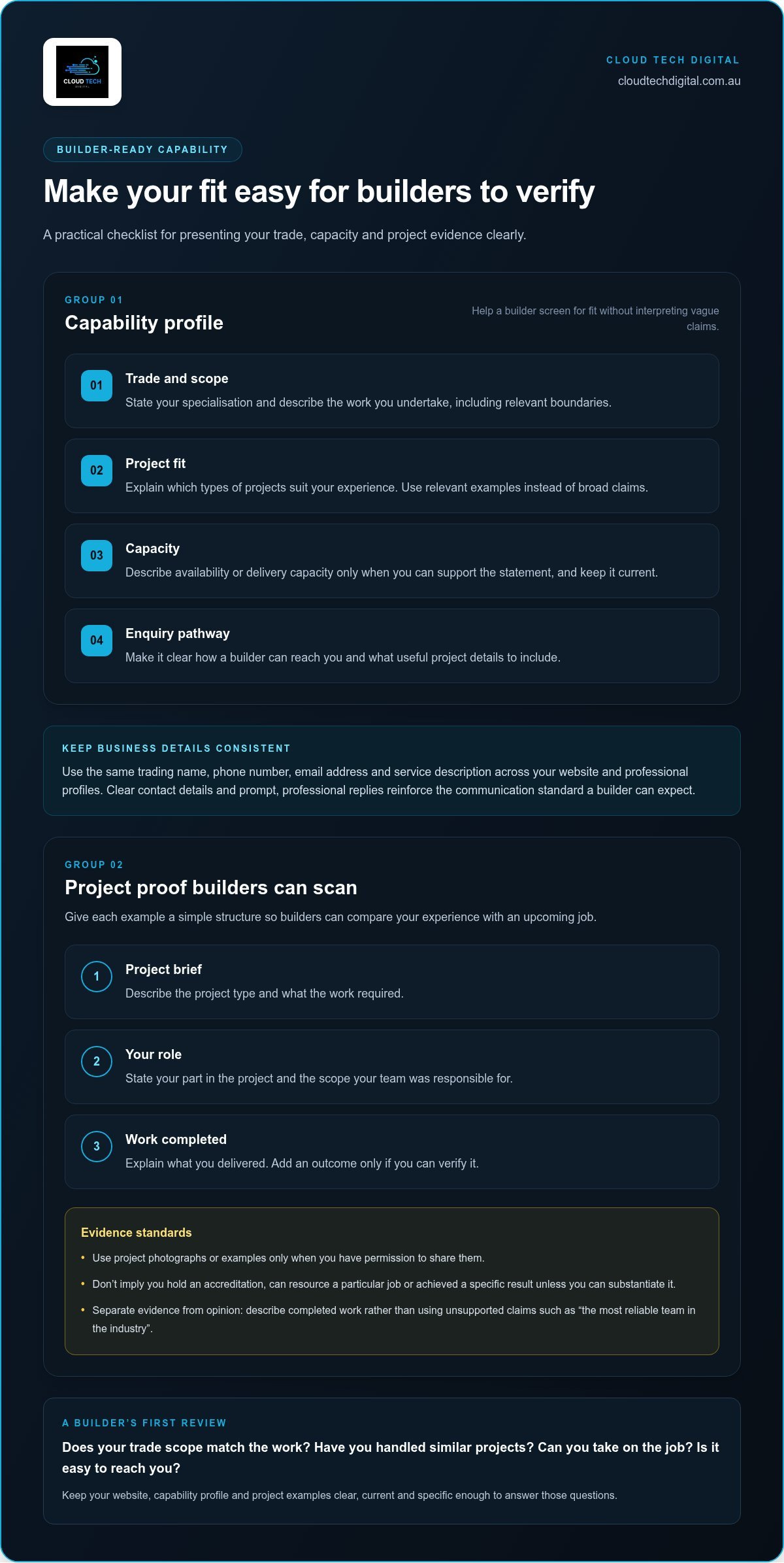
A builder’s first review is practical: does your trade scope match the work, have you handled similar projects, can you take on the job, and is it easy to reach you? Your website, capability profile and project examples should answer these questions without relying on broad claims or outdated information.
Keep your business details consistent across your website and other professional profiles. Use the same trading name, phone number, email address and service description. Clear contact details and a straightforward enquiry pathway help a builder take the next step. Prompt, professional replies also reinforce the communication standard they can expect.
Build a builder-ready capability profile
Organise your profile around the information a builder needs to screen for fit:
- Trade and scope: State your specialisation and describe the work you undertake, including any relevant boundaries.
- Project fit: Explain the types of projects your experience suits, using examples rather than vague claims.
- Capacity: Describe availability or delivery capacity only when you can support the statement, and keep it current.
- Enquiry pathway: Make it clear how a builder can get in touch and what useful project details to include.
Use project photographs or examples only when you have permission to share them. Don’t imply that you hold an accreditation, can resource a particular job or achieved a specific result unless you can substantiate it. Evidence should help a builder assess fit, not make unsupported promises about quality, reliability or outcomes.
Turn completed work into proof builders can scan
Give each project example a simple structure: the project brief, your role and the work completed. Add an outcome only if you can verify it. For instance, explain which part of the scope your team delivered and what the project required, rather than claiming the work was “exceptional”. This format helps a builder compare your experience with an upcoming job.
Choose examples that reflect the work you want more of, not just the projects that look impressive. The Australian building activity statistics provide broader context on construction activity, while your own project records show the work you’ve completed. Use testimonials only with permission, and retain the reviewer’s original meaning when editing for length.
A well-organised website makes this evidence easier to find and review. Practical web design for tradies can structure service information, project proof and contact options around what a prospective builder needs to see. If you’re improving your online presentation, Cloud Tech Digital’s website and landing page services can create a clearer path from discovery to enquiry.
Relationship marketing or digital marketing? Choose the right mix for builder enquiries
Builder enquiries rarely come from one channel alone. A trusted introduction may prompt a builder to search for your business, while a useful website can give a referral the confidence to take the next step. For marketing to builders for subcontractors, choose channels based on the trade work you want, the projects you suit and the time you can consistently commit.
Each channel has a different job. Use this comparison to decide where to focus and what to monitor:
| Channel | Role | Suitable use | Practical measurement signal |
|---|---|---|---|
| Direct relationships | Build familiarity and trust | Developing connections with relevant builders and decision-makers | Useful conversations and agreed next steps |
| Referrals | Turn existing trust into introductions | Reaching builders through clients, suppliers or professional contacts | Relevant introductions and resulting discussions |
| Organic search | Support discovery and credibility | Helping builders find your trade and project information while researching | Relevant website visits and suitable enquiries |
| Paid campaigns | Test focused visibility | Promoting a defined service or project fit to a selected audience | Enquiry relevance and progression, considered alongside campaign spend |
When relationship-led marketing should lead
For subcontractors whose work comes through established professional networks, relationships remain central. Make introductions specific: explain your trade scope, the project types you’re seeking and the work you can take on. A concise project example gives the conversation substance. After a useful discussion, record who you spoke with, what was relevant and an appropriate next step, then follow up thoughtfully. It’s a simple habit, not a call-centre operation.
Referrals are more effective when your contacts know what kind of builder opportunity suits you. Instead of asking broadly for “more work”, describe the project fit you’re pursuing. That gives people a clearer basis for connecting you with a relevant decision-maker.
Where search and paid campaigns can support visibility
Search engine optimisation (SEO) helps your business appear when builders research relevant trade services. A focused service page should connect the search to practical details about your scope and experience. For guidance on building that search presence, SEO for tradies explains how organic visibility fits into a trade business’s marketing.
Paid search can test demand for a clearly defined service, but clicks alone aren’t proof of progress. Track whether enquiries match your trade, target project and capacity, then review campaign spend against the quality and progression of those conversations. The Australian government marketing guide for businesses offers a practical starting point for setting target markets and planning activity.
Let your available time shape the mix. If site work leaves little room for regular outreach, keep relationship follow-up manageable and use digital channels to support ongoing discovery. If builders already know your business, strengthen the website and project information they see when checking your details. Digital marketing can improve visibility and credibility, but dependable communication and delivery still earn lasting trust. Cloud Tech Digital coordinates trade-focused search and paid campaigns through digital marketing support for trade businesses.
Build a practical builder-marketing plan and measure what moves enquiries forward
A useful marketing plan should fit around quoting, site work and project delivery, not compete with them. Keep it simple: decide which builder work you want, prepare evidence that supports your fit, make the business easier to find, follow up on enquiries and review what happened. This gives marketing to builders for subcontractors a clear purpose and helps you spend limited time on actions that can lead to a relevant conversation.
Work through the steps in order, then repeat them as your target work or capacity changes:
- Define the target: Specify the trade work, project types and builder opportunities that suit your business.
- Prepare proof: Select project examples and supporting details that demonstrate relevant experience.
- Improve discovery: Align your website and service information with the work builders may search for.
- Follow up: Record each suitable enquiry and take the next agreed step.
- Review: Check which activity prompted relevant enquiries and where those conversations progressed.
Set up the essentials before promoting the business
Write a concise offer for the builder projects you want to attract. Use the same description across your website, service pages and marketing to keep the message consistent. Then choose a simple way to record each enquiry, such as a spreadsheet or customer relationship management tool. Include fields for source, project fit, date received and follow-up status. A basic system you maintain is more useful than a complex one that gets ignored.
Keep the record practical. Note whether the enquiry matches your trade and intended project type, whether you had a conversation and what action is due. Don’t treat every website visit or initial message as a qualified opportunity. Assessing fit gives you more useful insight than counting traffic alone.
Review signals and improve the plan
Make a brief weekly note of new enquiries and follow-ups, then set aside a regular monthly review to look for patterns. Compare channels by relevance: did the builder’s project suit your work, did the enquiry progress to a conversation, and did the contact come through a referral, search or paid campaign? A channel can attract attention without producing the right opportunities, so assess quality alongside volume.
Track whether your marketing creates relevant conversations, not just attention. Lead tracking shows where enquiries originated and can help guide campaign adjustments, but it can’t guarantee a particular result. If enquiries don’t match your target, refine the service description, audience or campaign focus, then observe what changes. The 2026 tradie marketing blueprint offers further ideas for structuring ongoing activity.
For support aligning your website, search activity and paid campaigns with this review process, explore digital marketing support for trade businesses.
Turn builder-focused marketing into a steady growth system with Cloud Tech Digital
Builder-focused marketing works best when every channel points to a clear next step. Search engine optimisation (SEO) can help builders discover your trade services while they’re researching. Paid campaigns can put a specific offer in front of a relevant audience, while social advertising can build visibility and familiarity. A conversion-focused website or landing page gives prospective builders a clear place to assess your business and make an enquiry.
Cloud Tech Digital brings these activities together for trade businesses across Australia. As an Australian-owned digital marketing agency working with trades since 2020, the team coordinates search, paid advertising, social campaigns and website pathways around the work you want to attract. The aim is to make your capability easier to find and assess, while keeping your existing builder relationships and reliable project delivery at the centre of business development.
What an ongoing marketing partnership can help manage
Marketing needs attention after launch, too. Cloud Tech Digital manages performance monitoring and lead tracking, then uses what the activity shows to inform campaign and strategy adjustments. Tracking can help distinguish relevant builder enquiries from general attention, giving you a clearer view of which channels contribute useful opportunities and where your approach may need refining.
Client testimonials have reported measurable sales increases and rapid lead turnover. Those reports aren’t a promise of future performance. Marketing can support your business development, but it can’t guarantee builder contracts. Builders still make decisions based on project fit, capacity, communication and delivery. A practical marketing partner strengthens your visibility and enquiry process; it doesn’t replace the work that earns trust on site.
For subcontractors, the right mix depends on your trade, target projects and current enquiry sources. A focused plan might prioritise search visibility for a defined service, use paid campaigns to test demand, and improve the website so builders can understand your offer quickly. Performance monitoring keeps those activities connected rather than treating each channel as a separate task.
Take the next step with a focused growth conversation
Before discussing a plan, note the builder work you want more of, how enquiries currently reach you and what’s holding growth back. It could be limited visibility, an unclear enquiry pathway or uncertainty about which marketing activity is producing suitable conversations. These details help shape a discussion around priorities, tracking and campaign fit, without assuming every channel suits every subcontractor.
Cloud Tech Digital’s work with Australian trade businesses combines marketing expertise with performance monitoring and ongoing adjustments. The goal is an approach that supports your capacity and business objectives, not a one-size-fits-all campaign. If you’re ready to explore what could work for your subcontracting business, start a conversation about your builder-marketing goals.
Make your next builder opportunity easier to win
Strong marketing to builders for subcontractors is an ongoing business habit, not a one-off campaign. Choose one practical improvement that fits your current workload: sharpen the project work you want to attract, make your enquiry pathway clearer or review which sources are starting useful conversations. Focused changes can give builders a clearer reason to consider your business.
A considered plan should reflect your trade, capacity and growth priorities. It should also leave room to adjust as you learn which activity brings the right opportunities. Cloud Tech Digital can help map those priorities into a digital marketing approach, connect relevant channels and track what’s happening without promising contract wins.
Talk with Cloud Tech Digital about a practical growth plan for your subcontracting business. Set a clear direction, keep the process manageable and take the next step with confidence.
Frequently Asked Questions
How do subcontractors get work from builders?
Subcontractors get builder work through introductions, tender and procurement networks, and a professional online presence. Register on relevant platforms where suitable, and introduce your business to estimators or project managers whose projects match your trade. Follow up with a concise capability statement and current business documents. Keep in touch between projects, not only when you’re looking for your next job.
What should a subcontractor include in a capability statement for builders?
Include your business and ABN details, trade scope, relevant experience, service capacity and contact information. Builders may also request evidence such as current insurance details, licences relevant to your trade and safety documentation. Keep the statement brief and easy to scan, and make sure every claim is accurate. Tailor the examples to the work the builder is considering rather than sending the same generic document to everyone.
Can subcontractors use digital marketing to find builder clients?
Yes. Digital marketing can help builders discover and assess your business while researching a trade or checking a referral. A clear website, search engine optimisation and carefully targeted paid advertising can support that discovery. For marketing to builders for subcontractors, make sure online content speaks to builder needs rather than general homeowner enquiries. Review the quality of enquiries, since online visibility alone doesn’t guarantee suitable projects or contracts.
How can a subcontractor stand out to builders without competing on price?
Show why your business is a sound fit for the work, not simply the cheapest option. Give builders evidence of relevant experience, clear scope boundaries and the way you manage communication, coordination and project handovers. For example, explain how you keep a project contact updated when sequencing changes. Specific, verifiable details help builders compare the practical value you bring without relying on broad claims or discounting your work.
Is social media useful for marketing a subcontracting business to builders?
Social media can help keep your business visible and provide context around completed work, particularly if the builders and industry contacts you want to reach use the platforms you choose. Share project updates, explain your role and show work only when you have permission. Keep posts professional and relevant to your trade. If you use paid social advertising, assess whether it reaches suitable business audiences and leads to meaningful enquiries, not just reactions.
How do subcontractors measure whether their marketing is working?
Track enquiries from first contact through to a useful conversation and next step. Record where each enquiry came from, whether the project matched your trade and capacity, and whether it led to a quote, meeting or future opportunity. This simple pipeline helps separate relevant builder interest from casual website visits. Review patterns over time and adjust your effort towards sources that bring suitable enquiries, rather than judging success by traffic alone.
How often should a subcontractor update their website and project examples?
Update your website whenever important details change, such as your service scope, contact information or the types of projects you can take on. Add a project example after completing work that demonstrates the opportunities you want to attract, once you have permission to share it. A quick quarterly review can help catch outdated details and identify gaps. Keep project descriptions accurate, and remove claims or examples that no longer reflect your business.
