


Being visible on Google isn’t enough to win the job. For tradies, local SEO needs to put your business in front of relevant searchers and help them understand what you do, trust your work and make an enquiry. Your Google Business Profile, website and reviews all shape how customers find and assess you, so local SEO for tradies works best when these pieces support the same clear message.
You need practical actions, not rankings that look good but don’t lead to useful work. This guide covers the essentials, from accurate business details and useful service pages to genuine reviews and clear ways to get in touch. You’ll also find a manageable action plan and ways to assess whether local visibility is contributing to relevant calls and enquiries.
Key Takeaways
- Learn how local SEO for tradies can help your business appear in map results and organic listings for relevant searches.
- Keep your Google Business Profile and business details accurate, and describe only the services you actually provide.
- Make service pages more useful by explaining the work you do, who it suits and how customers can enquire.
- Follow a manageable action plan, then compare local visibility with relevant calls and enquiries.
- See how Cloud Tech Digital connects SEO, conversion-focused website work and transparent lead tracking for tradies.
What Is Local SEO for Tradies, and How Does It Help Customers Find You?
Local SEO for tradies helps a trade business appear when people search online for relevant services in a particular area. It brings together information about your services, business and location so search engines can match your business with relevant searches. General SEO can target a broader range of searches, while local SEO focuses on discovery with a local context. The Local search engine optimization overview explains how local search differs from broader search optimisation.
Visibility is only the first step. A potential customer needs enough information to judge whether your business suits the job, and a clear way to get in touch. Local SEO can support that journey, but it doesn’t guarantee a particular ranking, phone call or booked job.
How local searches connect customers with trade businesses
A search engine considers both the service someone needs and the local context of their search. A person searching for “local plumbing service”, for example, is signalling the type of work they need and that nearby options matter. Their location, search wording and the information available about businesses can all influence what appears.
Results may include a map section with business profiles, website pages in local organic results, and other standard organic listings. Map results show profile information; organic results link to website pages. The layout varies, so there’s no guaranteed position in the results.
The customer journey is simple: they need a trade service, search for an option, assess the information and decide whether to call or submit an enquiry. Clear service details help them work out whether you handle the job before they get in touch.
What local SEO can, and cannot, do for a tradie
Local SEO can improve discoverability by helping search engines understand what services you offer and where your business is relevant. That can help potential customers find you, but appearing in a search doesn’t mean every resulting enquiry will be suitable. A person may need a different service, be outside your operating area or be comparing several businesses.
Visibility creates an opportunity to be considered, not a promise of leads or booked work. Search positions can change, and no SEO approach can guarantee a particular ranking. What you can control is how accurately your online presence describes your work and how easy it is for a potential customer to take the next step.
Useful service information gives people a clearer basis for deciding. Explain the job you handle, who it suits and how to enquire, so prospective customers can decide whether your business fits their needs. Local SEO works best when relevant visibility leads to useful information and an easy enquiry. That’s the difference between simply being seen and helping the right customer move forward.
The Local SEO Foundations Tradies Need: Profiles, Services and Consistent Details
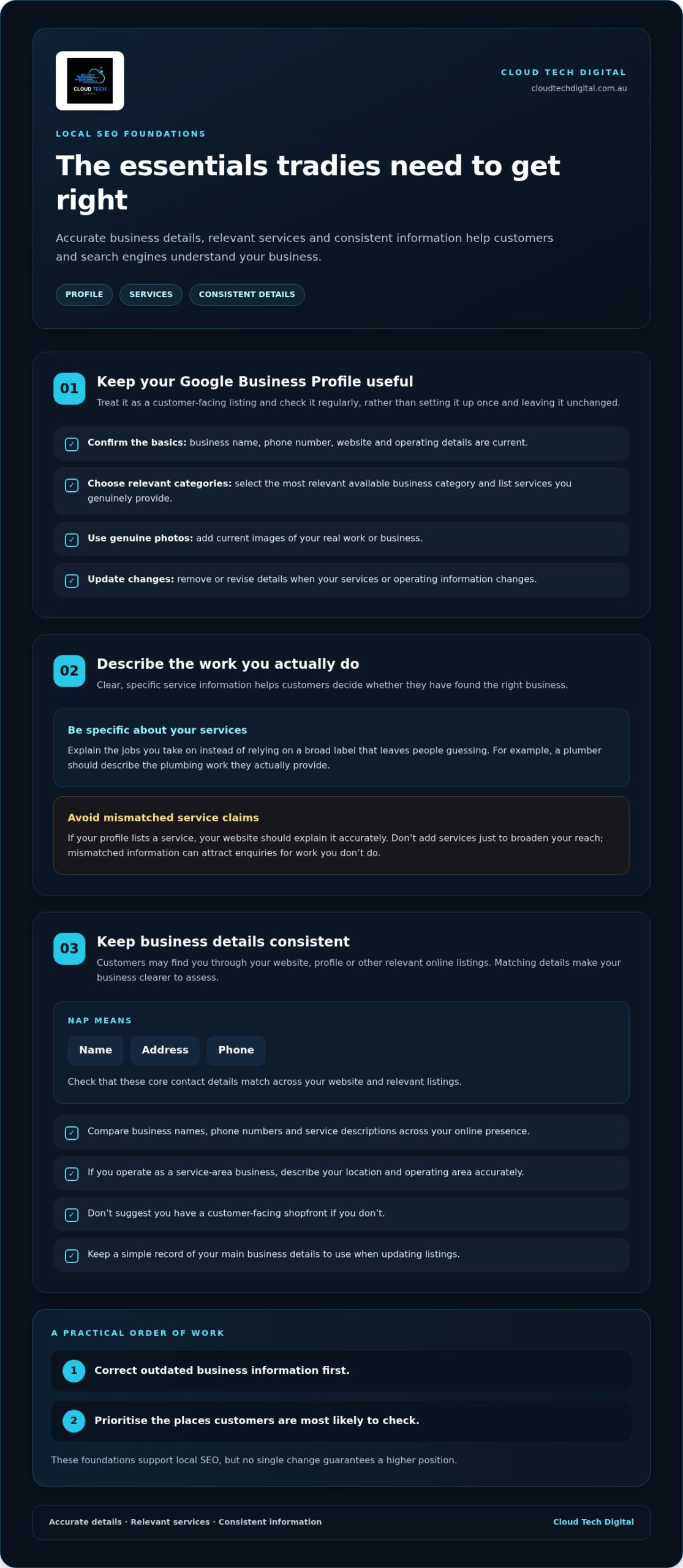
Accurate business details, a useful Google Business Profile and service information that reflects your work are the foundations of local SEO. They help search engines and potential customers understand your business. No single change guarantees a higher position, so start by getting the basics right and using clear, consistent information wherever customers might find you.
Set up a useful Google Business Profile
Your Google Business Profile is a customer-facing listing where people can learn what you do and how to reach you. Check it regularly rather than treating it as a set-and-forget task. Confirm that your business name, phone number, website and operating details are current. Choose the most relevant available business category, then add services that reflect the jobs you genuinely take on.
Be specific enough to help customers decide whether they’ve found the right business. A plumber, for example, should describe the plumbing work they actually provide rather than rely on a broad label that leaves people guessing. Keep the profile aligned with your website, add genuine photos of your work or business, and update details when your services or operating information changes.
Use this quick profile check:
- Confirm your business name and contact details are correct.
- Review the main category and listed services for accuracy.
- Use current photos that represent your real work and business.
- Remove or update details that no longer reflect how you operate.
Make website and business details consistent
Customers may find your business through your website, profile or other relevant online listings. If those sources show different phone numbers, business names or service descriptions, people may be unsure which details to trust. Consistent information gives customers and search engines a clearer picture of your business.
SEO shorthand calls core contact details NAP: name, address and phone. Check that these details match across your website and relevant listings. If you operate as a service-area business, describe your location and operating area accurately instead of suggesting you have a customer-facing shopfront when you don’t.
Compare service descriptions as well. If your profile says you handle a particular job, your website should explain that service clearly and accurately. Don’t add services just to broaden your reach; mismatched information can attract enquiries for work you don’t do. Keep a simple record of your main business details to use when updating listings, including industry directories and networks like Constructology 101. Correct outdated information first, then prioritise the places customers are most likely to check.
In short, accurate profile details, relevant service information, genuine business photos and consistent NAP details form the local SEO foundation. Cloud Tech Digital provides SEO for trade businesses alongside website work to help connect these essentials.
From Local Search Result to Enquiry: What Builds Relevance and Trust?
A local search result can earn attention, but the page a customer visits needs to answer the next questions: is this the right service, does this business seem credible, and how do I get in touch? A useful service page connects the search with work you actually do, then makes the next step clear. That matters in local SEO for tradies because a relevant visit is more valuable than a click from someone looking for a different job.
Visibility signals help people find your business; conversion signals help them decide whether to enquire. Relevant service and location information support discovery. Clear explanations, genuine proof and easy contact options support the decision. Neither guarantees a booking, but together they make the customer journey easier to follow.
Build pages around real services and customer questions
Give each important service a focused page that answers practical questions: what work you provide, who it suits, what a customer can expect and how to enquire. Add useful detail instead of repeating search terms. Where relevant, include genuine examples of completed work or explain your process. Link to related services or helpful information when it gives visitors a sensible next step.
Compare the difference:
| Vague service page | Clear, specific service page |
|---|---|
| “We do plumbing. Contact us for all your needs.” | Names the plumbing work offered, explains who it’s suited to and tells customers how to enquire. |
| Broad claims with little detail about the job. | Sets realistic expectations and answers common questions using accurate business information. |
| One generic page for unrelated services. | Separate, well-organised information helps visitors find the service relevant to their needs. |
Use the comparison as an editing test. Can a customer tell whether you handle their type of job? Can they find the contact option without hunting? If not, fill those gaps before adding more keywords.
Use reviews and clear next steps to support confidence
Reviews help prospective customers understand other people’s experiences. Create an honest, repeatable process for inviting customers to share genuine feedback, and ask for honest opinions rather than a particular rating. Don’t create reviews, offer incentives or ask only customers you expect to be happy. Respond professionally and keep the focus on the customer’s experience.
Make it simple to get in touch on desktop and mobile. Put a clear phone or enquiry option where it’s easy to find, label forms plainly and ask only for information you need to respond. Check that buttons work on a phone and contact details are readable without zooming. A page that answers questions and offers a clear next step can reduce hesitation, though the customer still decides whether to enquire.
Review the whole journey: does the search result accurately represent your service, does the page answer the customer’s main questions, and is the next action obvious? That’s how local visibility can lead to a more informed enquiry, without confusing higher rankings with better-fit work.
A Practical Local SEO Action Plan for a Busy Trade Business
Local SEO for tradies doesn’t need to become another full-time job. Work through the essentials in order: first fix information that could confuse a customer, then improve the pages that help them decide. A short, regular check-in is more useful than making a stack of changes without knowing what needs attention.
Prioritise the work without trying to do everything at once
Start with the basics, then build on them. This sequence connects your business details, profile and website while keeping the workload manageable:
- Check your details. Review your business name, phone number, address or service-area details, website and core services wherever customers may find them. Correct outdated or inconsistent information first.
- Improve your profile. Make sure your Google Business Profile reflects your actual business and current services. Complete the relevant fields, use genuine photos and remove information that no longer applies.
- Strengthen service pages. Choose an important service based on your business priorities and the questions customers commonly ask. Make the page specific, useful and easy to act on rather than trying to rewrite your whole website at once.
- Review the results. Check available profile and website reporting, then compare activity with the enquiries you receive. Use what you learn to decide which detail or page deserves attention next.
Keep a simple record of changes, such as correcting a phone number or adding detail to a service page. This helps you connect later shifts in activity with work you’ve actually completed. Set a recurring review that fits your workload, and revisit details whenever your services or operations change. Accuracy comes first; adding listings or content won’t help if the information customers already see is wrong.
Measure useful progress, not vanity metrics alone
Impressions show that your business or pages appeared in search. Clicks and profile interactions, such as website visits or calls, show that someone took another step. Neither tells you whether that person needed a service you provide or became a suitable enquiry.
Use the reporting available to your business. Google Business Profile can show profile activity, while website analytics and search reporting can help you understand visits and search traffic. Compare these signals with actual calls and enquiry submissions, using lead tracking where available. Note whether enquiries relate to services you want to grow, not just how many came in.
Read trends in context. A change in enquiries may relate to the type of work customers need, your capacity, seasonal demand or updates to your online presence. Avoid drawing conclusions from one data point or expecting a fixed result by a particular date. Rankings, traffic and enquiries can shift, and SEO can’t guarantee a position or lead count.
For a trade-focused approach that connects local visibility with clear reporting and enquiry-ready website content, explore SEO for trade businesses with Cloud Tech Digital.
How Cloud Tech Digital Helps Tradies Turn Local SEO Into a Lead Strategy
Local SEO works harder when discovery leads to a website that explains your services and makes it straightforward to enquire. Cloud Tech Digital brings SEO together with conversion-focused website work and lead generation, building a joined-up approach around how tradies attract and assess potential jobs. The focus is on relevant enquiries and useful performance information, not rankings or traffic figures in isolation.
A tradie-focused approach that connects visibility with enquiries
Trade businesses have different services, priorities and customer questions. Your strategy should reflect those differences rather than rely on a generic checklist. SEO can support local discovery, while clear service pages give prospective customers the information they need to decide whether your business suits their job. Lead-generation work and website improvements can support the next step, helping turn relevant visits into opportunities to get in touch.
Transparent lead reporting helps you see recorded enquiries and understand campaign activity alongside website performance. This gives you a more practical view than impressions or clicks alone. You can assess whether enquiries relate to the work you want and use that insight to guide future marketing decisions. No approach can promise a particular ranking, volume of leads or amount of booked work, but clear reporting keeps attention on outcomes that matter to your business.
Cloud Tech Digital is an Australian-owned agency helping tradies succeed since 2020. Its trade-focused SEO, lead generation and conversion-focused websites are designed to work together, connecting online visibility with the customer’s next step.
What getting started looks like
The process is set out in four steps:
- Invoice – Choose the package that fits your business.
- Content – Share your photos or job shots so we can create campaign material.
- Access – Give us access to your ad accounts. All leads are exclusive to you.
- Results – We launch and deliver real leads directly to your inbox. You get to work.
This process gives the work a clear starting point, from choosing a package to sharing campaign material and tracking lead activity. Performance can then be reviewed using lead and campaign information, keeping the conversation grounded in what’s happening rather than unsupported promises. Choose a package that aligns with your business priorities and the enquiries you want to attract.
If you’re ready to connect local visibility with a practical lead strategy, discuss a suitable package with Cloud Tech Digital.
Take the Next Step Towards Better-Fit Enquiries
Make local SEO for tradies a manageable business priority, not another item on an endless marketing list. Choose one area where stronger visibility could support the work you want more of, then decide what evidence would show whether your effort is helping. This keeps your marketing connected to the jobs your business is equipped to take on.
Refine your approach as you learn. Customer needs shift, and the services you want to prioritise can change too. Review what’s attracting attention and whether it’s bringing the right kind of enquiry. A practical strategy gives you room to make informed adjustments without chasing every new SEO tactic.
Cloud Tech Digital can help you plan a trade-focused approach that connects local visibility with meaningful lead tracking. Talk to Cloud Tech Digital about a local SEO strategy built for tradies.
Frequently Asked Questions
What is local SEO for tradies?
Local SEO for tradies helps search engines connect trade services with people searching in a relevant location. It includes information about your business, the services you provide and the places you genuinely serve. For example, a roofer can make clear which roofing jobs they take on and where they work, helping potential customers assess whether the business fits their needs before getting in touch.
Does a tradie need a Google Business Profile for local SEO?
A Google Business Profile is a useful way to present your business in Google Search and Maps, but it isn’t the only part of local SEO. A website still matters, particularly when customers need details about specific services. Keep your profile accurate and representative of your real operations. It won’t replace clear website information or guarantee your business appears for every relevant search.
Can local SEO work for a trade business that travels to customers?
Yes. A trade business can serve customers at their properties rather than from a shopfront and still build a useful local online presence. Make your service area and contact details clear, and ensure your website describes the work you travel to do. For instance, mobile trade specialists like Two Keys Mobile structure their service area details around on-site automotive, residential and commercial call-outs. Don’t imply that you have a customer-facing address if you don’t. Accurate information helps customers decide whether your business operates where they need service.
How do reviews help local SEO for tradies?
Reviews can help potential customers judge a trade business’s reputation before making contact. They may also provide practical context, such as how a customer describes the work or communication. Invite customers to leave honest feedback as part of a consistent follow-up process, without offering rewards or asking only people likely to leave positive comments. Respond calmly and professionally, including when feedback is critical.
How long does local SEO take to work for a tradie?
There’s no fixed timeframe for local SEO to produce noticeable changes. Results depend on factors such as your starting point, competition, the accuracy of your information and how consistently you improve your online presence. Track changes over time rather than judging the work by a single week or search. Treat early movement in profile activity or website visits as useful information, not proof that enquiries or bookings will follow.
Can I do local SEO for my trade business myself?
Yes. You can handle practical basics yourself, such as checking business information, keeping service descriptions current, adding genuine work photos and asking customers for honest reviews. Set aside time to check that website contact details and profile information still match. More complex website or reporting work may take extra skills, but you can start by fixing clear gaps and making improvements that reflect your actual services.
What should a tradie track to measure local SEO?
Track more than search positions. Check profile activity, website visits from organic search, calls and enquiry form submissions, then note which enquiries relate to services you want to grow. Google Business Profile reporting can show interactions, while website analytics and Search Console can help you assess visits and search activity. Compare periods consistently and record relevant changes, such as service updates or shifts in job demand.
