


Calculating cost per lead for a trade business means dividing campaign spend by the number of new leads it generates. Fewer enquiries raise the cost per lead; more enquiries lower it. The calculation is simple, but the result is only useful if you count leads consistently.
It’s tempting to focus on the cost of an enquiry, especially when marketing competes with wages, materials and other running costs. But a low cost per lead doesn’t automatically mean a campaign is paying off: some enquiries become booked jobs, while others don’t.
This guide explains what cost per lead measures, how to calculate it across marketing channels and how to estimate the break-even cost your business can afford. It also explains why lead quality, close rate and job value matter when deciding whether a campaign brings in work at a sustainable cost.
Key Takeaways
- Work out what each enquiry costs by comparing campaign spend with the new leads it generates.
- Set a break-even ceiling using your average job value and the proportion of genuine enquiries that become customers.
- Compare channels by booked jobs and closed revenue, not just by which one produces the cheapest enquiries.
- Track lead sources and follow-up outcomes consistently to see where marketing spend is working hardest.
What is Cost Per Lead?
Cost per lead (CPL) is campaign spend divided by the new leads generated during the same period. It measures how much marketing costs to bring each potential customer into your lead pipeline.
Online advertising CPL examples
CPL shows the average cost of each enquiry from an online advertising campaign. It helps tradies assess what each campaign delivers, rather than focusing on clicks alone.
There’s no single average by trade, and SEO or social media CPL depends on campaign spend and lead volume. Compare channels over the same period.
Attribute calls, forms and ad enquiries by recording their sources in a tracking system or lead log. Note the campaign details for each enquiry, then match leads to their outcomes.
Assessing and optimising campaigns with CPL
Review campaign performance over a consistent period. If the lead mix misses your target, adjust targeting, keywords, ad copy or landing pages. Timing matters too: allow for the time between an enquiry, follow-up and booked job before assessing results.
Lead-nurturing automation can organise follow-up for form enquiries. Record missed calls as missed, not as completed conversations. Exclude unqualified enquiries from qualified-lead reporting, but include them in total CPL if they came through the campaign. Track repeat customers separately from new leads.
CPL versus cost per customer
CPL measures the cost of generating an enquiry; cost per customer measures the marketing cost of acquiring a paying customer. The distinction matters because not every lead books a job.
Break-even cost per lead
Your break-even cost per lead is the most you can spend to acquire an enquiry without losing money on the work it generates. Base it on gross profit from jobs, not the invoice total: materials, labour and overheads all reduce the amount available for marketing.
Apply the same conversion rate to gross profit per job to find a realistic ceiling.
Then compare the cost of acquiring a booked job with its margin. A small Australian trade business can review or drop channels costing more than 10 to 15% of that margin. A Google Ads campaign may deliver plenty of qualified enquiries, but the booked-job cost and job profit show whether those leads make commercial sense.
Your charge-out rate helps establish the profit available to cover marketing. Calculate the break-even hourly rate by dividing total annual costs by annual billable hours.
Use your own costs and billable hours to understand each job’s margin. Then set a marketing ceiling based on the gross profit those jobs can realistically deliver.
Cost per lead formula
The cost per lead formula is campaign spend divided by the number of new leads generated in the same period. Write it as: CPL = total campaign spend ÷ number of new leads. The result is an average, not the amount you pay for every individual enquiry.
Keep the spend period and lead period aligned so you can make useful month-to-month comparisons.
Decide what counts as “campaign spend” before calculating. For paid advertising, use the associated advertising spend. To measure broader marketing, include the costs you consistently attribute to that activity. The formula stays the same, but changing the inputs changes the metric, so record your method for finance reviews.
Count new enquiries generated by the campaign, not clicks, website visits or existing customers. In a PPC campaign, a click becomes a lead only when someone takes an enquiry action, such as submitting a form or calling. Click-through rate measures a different step and can’t replace the number of leads in the CPL formula.
If your business advertises on Google Ads and Facebook, calculate CPL for each channel separately before working out an overall figure. This shows whether one channel is raising or lowering the combined average. Use the same period and lead definition for both, and don’t count one person twice if they submit a form and later call.
Use CPL to compare campaign performance, not to judge profitability on its own. Pair the calculation with lead quality and booked-job results to make a sound decision.
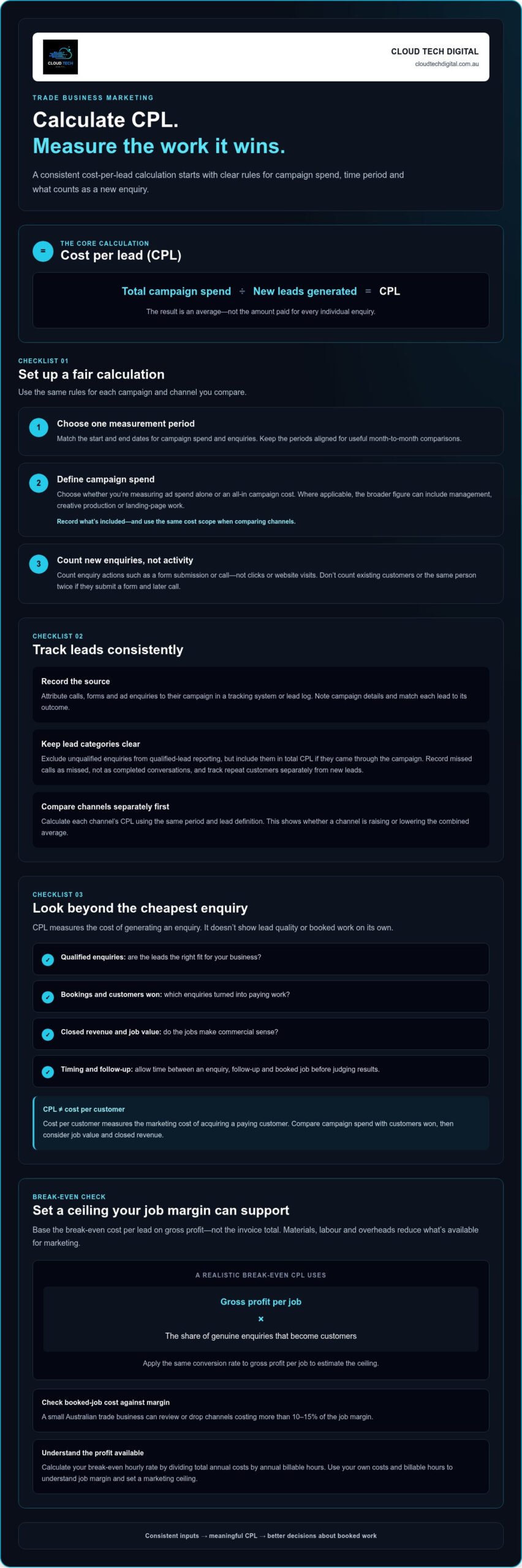
How to calculate cost per lead
Use a consistent period, cost scope and lead definition. That makes channel comparisons meaningful instead of combining different campaign inputs.
Steps for calculating CPL
Calculating cost per lead for a trade business means dividing the campaign’s total cost by the new leads it generated. Apply the same steps to Google Ads, social media and other channels to compare performance fairly.
- Choose a period: use the same start and end dates for spend and enquiries.
- Set the lead rule: count new enquiries, not clicks, repeat customers or duplicate calls and forms.
- Divide: total campaign cost by the number of leads that meet your rule.
Review CPL alongside qualified-lead and booked-job results to see whether enquiries are turning into work.
Costs included in the calculation
Include the costs directly attributable to the campaign you’re measuring. For an all-in figure, add advertising spend and related campaign costs, such as management, creative production or landing-page work, where applicable.
State what’s included in your total cost before comparing channels. An ad-spend-only Google Ads figure won’t match an all-in social media CPL if the latter includes campaign management. Neither method is automatically wrong; consistent accounting makes the comparison useful.
Keep general business expenses separate unless you’re deliberately calculating a broader marketing cost. Record each cost in the same Australian-dollar period as its leads, then divide. This gives you a repeatable measure of campaign performance, rather than a misleadingly low figure that leaves out relevant spending.
Improve your lead-generation measurement by aligning campaign costs with enquiries and booked work.
Cloud Tech Digital: Lead Generation Agency in Australia
Cloud Tech Digital helps Australian trade businesses attract and convert enquiries through digital marketing. If your CPL figures show that campaigns generate leads but too few turn into suitable job opportunities, a more focused lead-generation approach can help address the gap.
Cloud Tech Digital’s Google Ads (PPC) service supports businesses using paid search, while Meta Ads (Facebook and Instagram) can help assess social advertising performance. Web design matters too: a clear, conversion-focused website can help prospective customers understand your services and enquire. The right combination depends on your channels, audience and campaign goals.
For a practical next step, bring your lead sources and campaign results together, then identify where targeted marketing support could improve measurement or lead quality. Contact Cloud Tech Digital to discuss lead generation for your trade business.
Turn your lead data into a smarter next move
Make your next marketing decision with a clear view of the work you want more of. A disciplined approach to calculating cost per lead for a trade business can help you identify which enquiries match your services, capacity and commercial goals. Use that insight to refine campaign priorities instead of chasing lead volume for its own sake.
If you want support putting those priorities into practice, Cloud Tech Digital provides lead generation, Google Ads (PPC) and Meta Ads for Australian trade businesses. These services can shape campaigns around the customers and jobs you want to attract, with performance measured against your business objectives.
Contact Cloud Tech Digital today to discuss a practical next step for your marketing. A clearer plan can help you move forward with focus.
Frequently Asked Questions
Does the calculator include GST?
The charge-out calculator’s rates and inputs are shown excluding GST. If your business is GST-registered, add GST when quoting customers. For CPL reporting, use a consistent basis for campaign costs and leads across every channel. Consistent GST treatment makes comparisons clearer, especially when reviewing advertising spend alongside job revenue and business costs.
How do you calculate cost per lead for a trade business?
Divide the marketing costs assigned to a campaign by the unique new enquiries it generated during the same period. Record each lead’s source, such as an ad, website form or phone call, and remove duplicate enquiries from the count. This gives you a comparable figure across campaigns without confusing customer enquiries with clicks or repeat bookings.
How do you calculate a target cost per lead from job value, profit margin, and conversion rate?
Multiply the average job value by your gross profit margin, then multiply that result by the proportion of leads that become paying customers. This gives the break-even lead cost before any extra profit target. Use the value of a typical job, the profit left after job costs and your actual lead-to-customer conversion rate. Base the figures on your own records.
How can a trade business reduce cost per lead without lowering lead quality?
Refine targeting around searches that clearly match your trade and services, rather than chasing high-volume traffic alone. Make the ad and landing page specific about the work you take on so enquiries are better aligned. Track which sources produce qualified jobs and follow up with new enquiries promptly. Review search terms and exclude irrelevant ones before increasing campaign spend.
What is the average cost per lead for Australian tradies by trade and marketing channel?
There’s no single average by trade.
