


Outsourcing isn’t automatically a deal-breaker. What matters is knowing which work is outsourced, who oversees it and how updates reach you. Among the questions to ask a digital marketing agency, ask whether campaign work is handled by its own team or an external partner, and who remains accountable for the result. A clear answer helps you assess the effect on communication and continuity.
Look beyond a polished pitch. You need to understand how the relationship will work once the campaign is under way, who you’ll speak with and whether the agency’s approach fits your business priorities.
This guide covers practical questions to reveal an agency’s communication, asset ownership, relevant experience, strategy, flexibility and value. You’ll also learn what to listen for in the answers, so you can compare proposals on what matters to your business, not just the presentation.
Key Takeaways
- Clarify who will manage your work, how often you’ll communicate and how disagreements or scope changes will be handled.
- Agree who owns campaign accounts, content and other assets, including how they’ll be transferred if the relationship ends.
- Look for relevant experience backed by examples that connect marketing activity to sales outcomes.
- Compare agencies on how they tailor strategy, adapt campaigns and measure value against your business goals.
1. Handling disagreement and client relationships
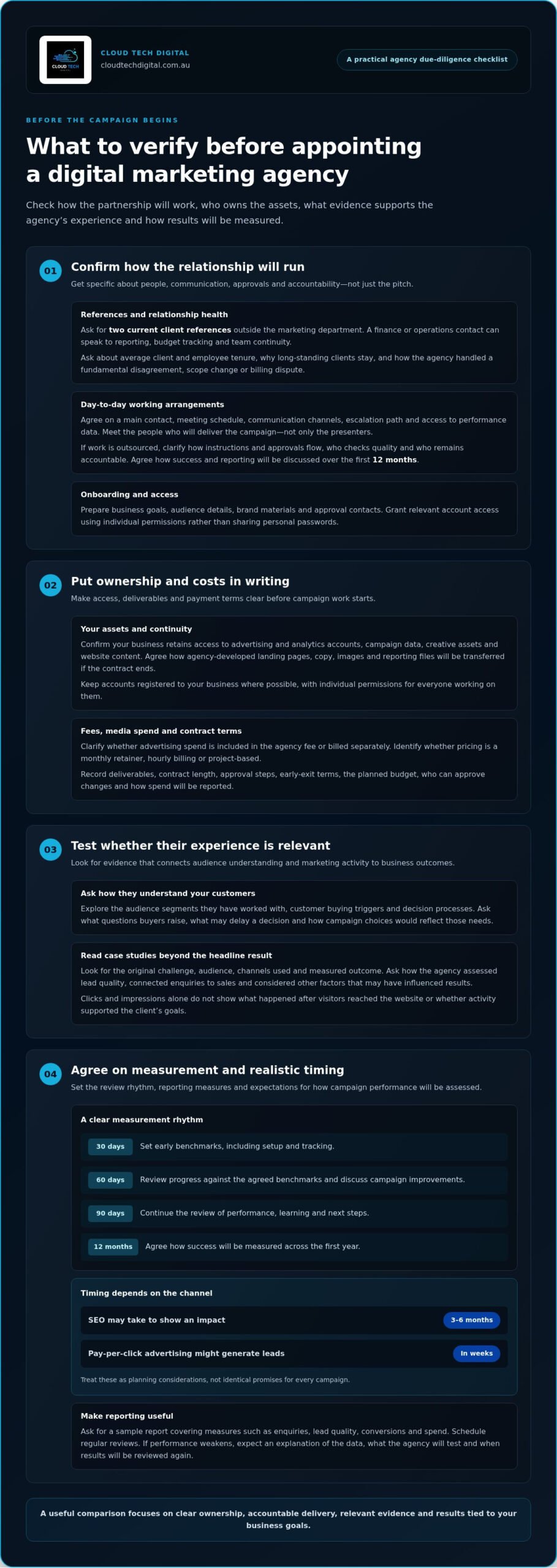
Ask for two current client references outside the marketing department. Ask each contact how work is planned, changes are approved and concerns are escalated. A reference from finance or operations can explain whether reporting follows the agreed process, budgets are tracked and the same team stays involved. Then ask about average client and employee tenure, and why the agency’s longest-standing clients stay. Short client stories can add context that polished case studies may leave out.
Ask the agency to describe a fundamental disagreement with a client. Listen for a specific example: how the team explained its recommendation, considered the client’s priorities and reached a decision without losing sight of outcomes. Ask how it handles scope changes and billing disputes, too. If the answer is general, ask what happened, who made the decision and how the relationship continued. Client and staff turnover can also offer clues about team stability and the health of the partnership.
Clarify the day-to-day process before work begins. Agree on a main contact, meeting schedule, communication channels, escalation path and access to performance data. Ask to meet the people who’ll deliver the campaign, not just the team presenting it. If social media is part of the work, clarify whether you can discuss strategy directly with the social lead or through an account manager. For onboarding, provide business goals, audience details, brand materials and approval contacts, then grant the access needed to relevant advertising, analytics or website accounts. Use account permissions instead of sharing personal passwords.
Ask whether work is outsourced and whether instructions and approvals pass through the agency or go directly to an external partner. Clarify who checks quality and remains accountable for delivery. Agree how success will be measured over the first 12 months, including the reporting rhythm and how results will be discussed. These questions reveal whether the agency’s process, tools and client interaction suit your internal capacity, decision-making style and expectations for a practical working relationship.
2. Ownership of content, accounts and campaign assets
Put ownership in writing before the campaign starts. Confirm that your business retains access to its advertising and analytics accounts, campaign data, creative assets and website content. Agree how agency-developed material will be transferred if the contract ends, including landing pages, copy, images and reporting files. Keep accounts registered to your business where possible, with individual permissions for everyone working on them. This supports continuity if staff or suppliers change.
Define the commercial terms alongside asset ownership. Record the campaign deliverables, contract length, approval steps and what happens if you end the agreement early. Clarify whether advertising spend is included in the agency fee or billed separately, and whether the work uses a monthly retainer, hourly billing or project-based pricing. Ask for the planned budget, who can approve changes and how spend will be reported. These details distinguish agency fees from media costs and clarify what each payment covers.
Set benchmarks for the first 30, 60 and 90 days, then agree how success will be measured over the first 12 months. Early benchmarks should cover setup and tracking, while later reviews can assess campaign performance and improvements. Timelines depend on the channel: SEO can take 3 to 6 months to show an impact, while pay-per-click advertising might generate leads in weeks. Treat these as planning considerations, not identical promises for every campaign.
Ask for a sample report and identify the metrics it will show, such as enquiries, lead quality, conversions and spend. Schedule regular reviews to compare results with agreed goals, discuss underperforming areas and set next steps. If performance weakens, expect a clear explanation of what the data shows, what the agency will test and when results will be reviewed again. Case studies can illustrate previous work, but your reporting should connect activity to your business objectives. Clear ownership, budget controls and benchmarks make campaign decisions easier to assess.
3. Track record with similar businesses and industries
Ask to see case studies that trace marketing activity to sales impact. Look for the original business challenge, the audience, the channels used and the outcome measured. Analytics should show more than clicks or impressions. Ask how the agency assessed lead quality, connected enquiries to sales and separated campaign influence from other factors. If a case study focuses only on traffic, ask what happened after visitors reached the website and whether those visits supported the client’s business goals.
Test how well the agency understands your customer segments. Ask what questions buyers raise before choosing a provider, what might delay a decision and which messages address those concerns. If social media is part of the proposed approach, ask how content will reflect your audience rather than repeat generic industry posts. A useful answer gives a clear example, such as tailoring creative to different customer needs or matching a landing page to a specific campaign message.
Ask which emerging trends could affect your market and how the agency decides whether to act on them. The answer should explain how it distinguishes a relevant change in customer behaviour from passing industry noise. Then ask what it would test first, what analytics would guide the test and how the result could shape your growth plan. These questions reveal whether an agency can apply past success thoughtfully, learn the details of your business and turn industry knowledge into practical decisions.
4. Comparing agencies on strategy, flexibility and value
Ask each agency to restate your business problem and identify the biggest assumption behind its proposed strategy. A useful answer connects your priorities, audience and sales process to specific channels, deliverables and measures. Ask what it would test first, which result would change the plan, and how it will protect longer-term growth while adapting to performance.
An agency’s own marketing can show how it communicates its expertise, but it doesn’t prove the same approach suits your business. Ask for real campaign data and an explanation of the context, audience and objective. Compare the evidence with relevant case studies and your growth goals. When assessing the agency, listen for curiosity about your business, clear reasoning and a willingness to explain what it would change if results fall short.
In Australia, privacy, spam and advertising requirements affect how campaigns handle personal information, commercial messages and promotional claims. Ask who manages consent, data access, unsubscribe processes and advertising-claim approvals, and how these checks fit into campaign delivery.
Warning signs include guaranteed first-page Google rankings in less than a month, vague metrics disconnected from business outcomes, or a cookie-cutter strategy with no testing plan. Be cautious if an agency can’t explain its assumptions, ignores your priorities or presents activity without a way to measure value. A sound partnership makes responsibilities, decisions and delivery clear before work begins.
For a strategy focused on measurable business outcomes, discuss your lead generation goals.
Cloud Tech Digital: Lead Generation Agency in Australia
Cloud Tech Digital helps trade businesses build a stronger pipeline of enquiries through lead generation, pay-per-click advertising, Facebook Ad Management and web design. Turn to the team when you want marketing activity tied to practical business goals, such as reaching potential customers or improving the path from an advert to an enquiry.
The right mix depends on your audience, current website and growth priorities. A paid campaign can support a focused acquisition goal, while a well-planned website can give prospective customers a clearer route to get in touch. Discuss your objectives and the channels you’re considering with Cloud Tech Digital to explore an approach that fits your business.
Contact Cloud Tech Digital to discuss your digital marketing needs.
Choose a partnership built for the next stage
Turn your priorities into a clear decision. Before committing, identify the business outcome that matters most, the time your team can contribute and the changes you’re prepared to make. Then use your questions to ask a digital marketing agency whether its proposed approach fits those realities, not just whether its presentation sounds impressive.
Look for a working relationship where responsibilities are understood, recommendations have a clear rationale and progress can be discussed openly. The right fit should make it easier to act and learn from campaign results, even when the first approach needs adjusting. You’re choosing how to move your business forward, so weigh the partnership as carefully as the strategy.
If you’re ready to discuss a practical digital marketing approach for your business, contact Cloud Tech Digital. Take the next step with a clear view of what you want to achieve.
Frequently Asked Questions
Do you outsource?
Outsourcing isn’t automatically a problem. The key is knowing who controls quality and remains responsible for delivery. Separate administrative support from core campaign work, such as strategy, advertising and optimisation. Clarify how external contributors receive instructions, access information and have their work reviewed. Focus on accountability and continuity, not simply whether every task happens under one roof.
How do you communicate with your clients?
Effective agency communication gives you a clear way to raise issues, approve decisions and understand campaign progress. A practical arrangement names your main contact, sets out suitable communication channels and explains how urgent problems are escalated. Ask to see how a performance update turns results into next steps. For example, a report should help you understand whether to adjust targeting, creative or the landing page.
What are your client and staff churn rate?
Client turnover and staff turnover are separate measures, so assess them independently and ask what period each covers. Find out how the agency calculates departures and whether it can explain common reasons for clients leaving or staff moving on. The context matters: a rate without a timeframe or explanation says little about account continuity. Ask how the agency maintains knowledge and campaign momentum when a team member changes.
What questions should you ask a digital marketing agency before hiring?
The most useful questions to ask a digital marketing agency before hiring connect its proposal to your business priorities. Ask what outcome the work targets, what your team must contribute and how progress will inform decisions. Clarify deliverables, approval responsibilities and exit arrangements before signing. These answers help you judge whether the proposed partnership fits your capacity, sales process and appetite for change.
How do you evaluate an agency’s digital marketing experience and case studies?
Evaluate case studies by comparing the featured business with yours, including its customer type, sales cycle and buying considerations. Look for a clear explanation of the original challenge, the work performed and the result attributed to that work. Ask what other factors influenced the outcome, such as seasonality or changes to the sales process. This helps distinguish relevant expertise from impressive-looking but unrelated results.
What digital marketing services and channels should an agency provide?
Choose services according to the job each channel must do, rather than expecting every agency to provide every option. Search engine optimisation supports visibility in organic search, while pay-per-click campaigns target paid search demand. Facebook advertising can reach social audiences, and web design or landing pages support the visitor’s next step. Cloud Tech Digital provides these options alongside lead generation, so businesses can explore a mix that fits their goals.
