


What if your next commercial opportunity came from a buyer who found your business while researching providers, not just from a referral? Digital marketing for commercial trades can help you reach those buyers, but it works best when your website, search visibility and advertising attract the right enquiries and make it easy to take the next step.
Relying on referrals can make the flow of work hard to predict. When marketing runs across several channels, it can also be difficult to tell which activity led to a qualified enquiry or booked job. With limited time to manage campaigns and follow up, spending on enquiries that don’t fit your services is not a practical growth plan.
This guide shows you how to connect your online presence into a measurable marketing system for a commercial trade business in Australia. Learn how to turn relevant website visits into enquiries, build visibility where commercial buyers are searching and track advertising through to lead quality. You’ll also find practical steps for organising and reviewing those channels over time.
Key Takeaways
- Digital marketing for commercial trades works best when channels attract and convert relevant business opportunities, not just generate more enquiries.
- Give each channel a clear role, then use its results and limitations to decide how it contributes to visibility and lead generation.
- Track the path from campaign to enquiry, qualification and sales follow-up to see what is helping and what needs adjustment.
- Set a business goal, define the opportunities you want and check your capacity before auditing your website or adding campaigns.
- Coordinate SEO, Google Ads, social advertising and focused web pages around business goals to build a connected marketing system.
What digital marketing for commercial trades needs to achieve
For a commercial trade business, marketing needs to do more than make the business visible. It should help relevant buyers find your capabilities, understand whether your services fit their project and take a useful next step. Digital marketing is a component of marketing that uses digital technologies such as desktop computers, mobile phones, and other digital media platforms to promote products and services. The practical challenge is making each channel contribute to opportunities your business can deliver.
Commercial work often involves a considered buying process rather than a quick search followed by an immediate booking. A buyer may compare providers, clarify the scope, assess technical fit and seek internal approval. A project manager, procurement team or business owner may each influence the decision. Your marketing should support that journey with clear, relevant information that helps each person understand why your business may suit the work.
How commercial buyers find and assess trade businesses
Buyers may search for a particular trade, capability or project requirement, then review a business’s website and other available information before getting in touch. They want to see whether the provider understands the work, can meet the scope and is a credible fit. A useful service page explains what work you take on, who it is for and what the prospective client should do next.
Specificity helps buyers assess fit. A page that only lists a broad trade can leave them unsure whether you handle their type of project. Describe the relevant service in plain language, explain the capabilities that matter to the work and make the enquiry path easy to find. This gives prospective clients a clearer basis for deciding whether to contact you, while helping your business attract enquiries that better match its services.
What a useful marketing outcome looks like
An enquiry is a first expression of interest, not automatically a sales opportunity. It becomes more useful when the work matches your services, the buyer’s requirements are relevant and your business has capacity to respond and deliver. A high enquiry count can still conceal a mismatch, such as requests outside your scope or opportunities that don’t fit your current workload.
A qualified marketing opportunity is an enquiry from a buyer whose project fits your services, requirements and available business capacity.
That distinction changes how you assess performance. Website visits, search visibility and advertising impressions can show whether people are seeing your marketing, but they don’t prove that it is creating viable work. Follow the enquiry beyond the first contact: does the opportunity fit, does it progress to a meaningful sales conversation, and can your team follow it up? Those outcomes offer more practical insight than traffic alone.
The right channel mix depends on your trade, offer, buyers’ research and approval process, and the time available to manage enquiries. A specialist service with a longer sales cycle may need detailed pages that support careful evaluation. A targeted campaign may instead need a direct route to a focused landing page. You don’t need every channel. Choose the activity most likely to attract suitable buyers and help you learn which opportunities are worth pursuing.
How digital marketing channels work together for commercial trades
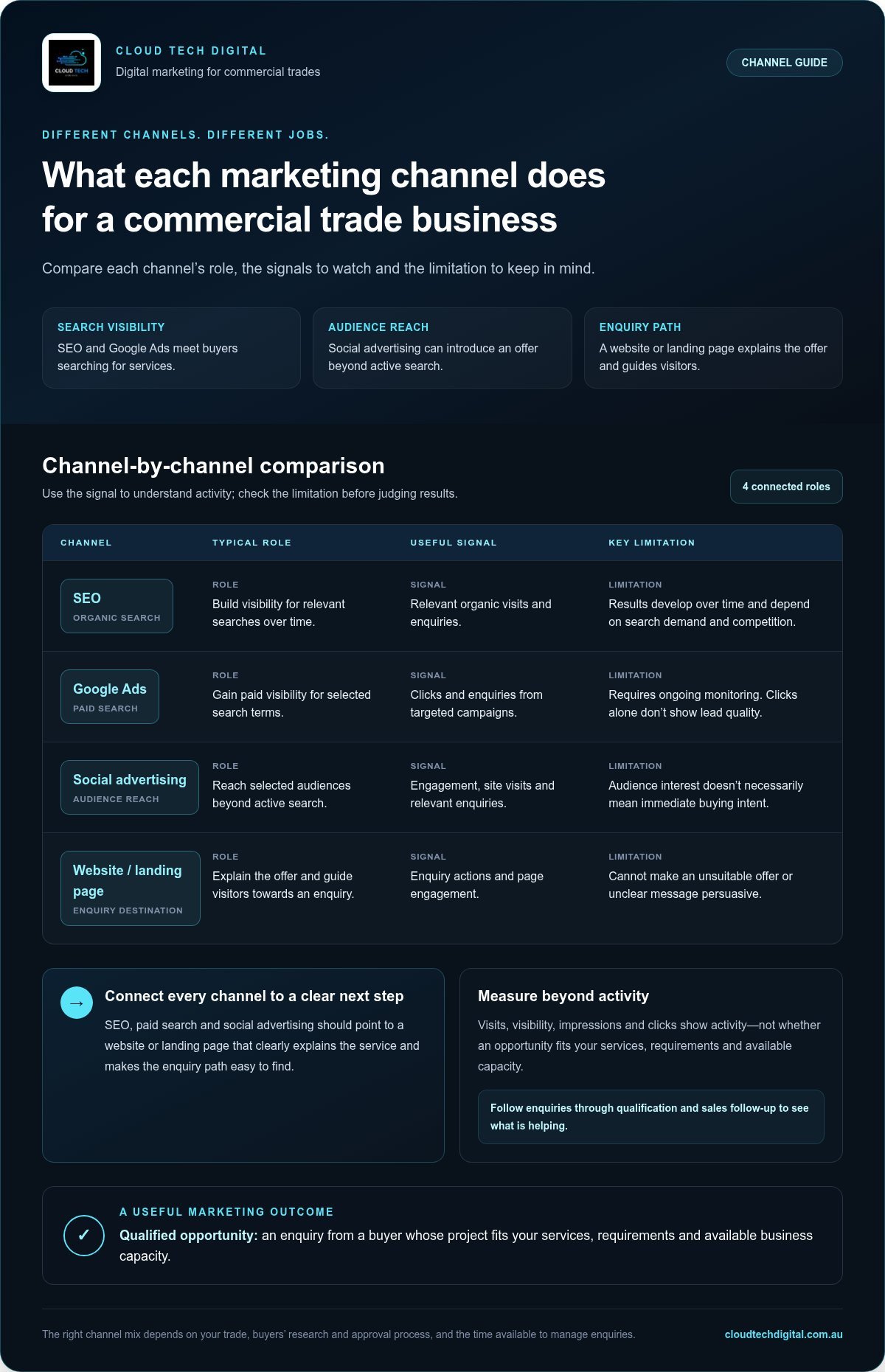
Each channel has a different role. Search engine optimisation (SEO) helps buyers find relevant information over time. Paid search places your business in front of people searching for selected services. Social advertising can introduce your offer to audiences who aren’t actively searching. The right mix depends on what you do, how buyers assess the work and what your business can manage. Digital marketing for commercial trades works best when each channel points to a website or landing page that clearly explains the service and next step.
| Channel | Typical role | Useful signal | Key limitation |
|---|---|---|---|
| SEO | Build visibility for relevant searches over time | Relevant organic visits and enquiries | Results develop over time and depend on search demand and competition |
| Google Ads | Gain paid visibility for selected search terms | Clicks and enquiries from targeted campaigns | Requires ongoing monitoring, and clicks alone don’t show lead quality |
| Social advertising | Reach selected audiences beyond active search | Engagement, site visits and relevant enquiries | Audience interest doesn’t necessarily mean immediate buying intent |
| Website or landing page | Explain the offer and guide visitors towards an enquiry | Enquiry actions and page engagement | Cannot make an unsuitable offer or unclear message persuasive |
Match search, paid advertising and social to the job
SEO can help buyers discover your business when they research a particular capability or service. It relies on useful, relevant website content and is a longer-term visibility effort, not a promise of a particular ranking or lead volume. Google Ads can target selected searches, making it useful for putting a specific service in front of people already looking for it. Monitor the search terms, ad message and resulting enquiries to check whether the campaign remains relevant.
Social advertising serves a different purpose. It can introduce a service to people who may not yet be searching, but attention is not the same as intent. Use it when the offer benefits from explanation or awareness, and assess the quality of responses as well as engagement. You don’t need every channel. Choose based on buyer awareness, service type, enquiry goal and your capacity to follow up.
Make the website do its share of the work
A campaign can bring the right person to your site, but the page still needs to answer their questions. Use service-specific copy to describe the work you take on, the type of project the page addresses and what information a buyer should provide. A clear call to action, such as requesting a project discussion or submitting an enquiry, gives visitors a straightforward next step.
Keep the message consistent from the search result or advert to the page. If an ad promotes a particular commercial service, send visitors to a page about that service rather than a broad homepage. Thoughtful web design for tradies connects clear service information with a practical enquiry path. Cloud Tech Digital’s lead generation support brings website, search and advertising activity together around business goals.
How to measure digital marketing results and address wasted-spend concerns
Marketing activity without clear measurement is difficult to evaluate. If you can’t see how a campaign connects to enquiries and sales follow-up, it’s hard to tell whether it is attracting suitable work or just generating attention. For digital marketing for commercial trades, measurement should follow the opportunity through the whole journey, not stop at a click or form submission.
Map the journey in clear stages: record the channel and campaign, note when an enquiry arrives, assess whether it fits your services and capacity, then track what happens during sales follow-up. This shows where enquiries are coming from and where opportunities fall away. Agree on what counts as a suitable enquiry before reviewing performance so everyone uses the same definition.
Which signals help explain performance
Review signals in sequence. Relevant website visits show whether the people reaching your pages may match the service. Enquiry actions indicate whether visitors take the next step. Lead-source records show how they found you, while qualification status reveals whether the work fits. Impressions and clicks show that an advert was seen or engaged with, but don’t establish commercial value on their own.
Keep lead-source recording simple and consistent. For each enquiry, capture the source where known, the service requested, whether it meets your fit criteria and its follow-up status. Classify enquiries as suitable, unsuitable or still being assessed, and add a short reason. Attribution won’t always be exact: a buyer may see your business through one channel and return through another. Treat the data as useful evidence, not a perfect account of every influence.
How feedback can improve campaign decisions
Marketing data needs context from the people handling sales conversations. Ask the team to note which enquiries matched the required scope, which lacked key information and which progressed to a meaningful discussion. If a campaign generates enquiries but few are a good fit, review its targeting, message and landing page rather than assuming more volume means better performance. Regular campaign monitoring and strategy adjustments help turn that feedback into practical changes.
Enquiry volume shows how much interest arrived; enquiry quality shows whether that interest can become relevant work, so assess both together. Reviewing both helps prevent spending decisions based only on surface-level activity and reveals which services and messages attract the right opportunities. Cloud Tech Digital’s lead generation for Australian tradies connects campaign activity with lead tracking, giving you a clearer view of the enquiries coming through.
Review the same core signals regularly, compare changes against lead fit and sales follow-up, and investigate weak points. Keep what is contributing to suitable opportunities. Where practical, adjust one part of a campaign at a time so you can better understand the effect. Cloud Tech Digital’s lead generation support connects marketing activity with business outcomes and keeps the focus on the opportunities your team wants to win.
How to build a practical digital marketing plan for a trade business
A useful plan starts with the work you want to win, not a long list of channels. For digital marketing for commercial trades, each activity should support a clear business priority and fit your team’s capacity to respond to new opportunities. Use this sequence to build a sound foundation before expanding your campaigns.
- Set a business goal. Decide what marketing should help the business achieve, such as building awareness of a particular service or generating more relevant project enquiries. Choose an outcome you can monitor rather than assuming a campaign will deliver a fixed number of leads or sales.
- Define the best-fit opportunity. Identify the services, project types and customer segments you want to prioritise. Note what makes an enquiry suitable, including the work requested and whether it fits your delivery capability. This gives marketing a clear focus and helps the team assess incoming opportunities consistently.
- Check capacity. Consider who will respond to enquiries and whether your team can deliver the work if demand increases. A campaign should support the business you can take on, not create a queue of unsuitable or unattended leads. Include the time needed for sales follow-up as well as project delivery.
- Audit your website and current channels. Check whether key service pages explain what you do and make the next step clear. Review the accuracy of existing business information, the enquiry process and any current campaign activity. Address gaps in these foundations before adding channels or increasing advertising.
- Set up tracking and choose a manageable mix. Record where enquiries come from and agree on what counts as qualified. Select channels that suit buyer behaviour and your current foundations. Set a regular review to assess enquiry sources, fit and follow-up, then make deliberate adjustments before expanding activity.
Start with business goals and operational capacity
Set specific priorities without relying on an unsupported target. For example, a trade business might focus on promoting one commercial service to a defined customer segment, then assess whether relevant enquiries come through and progress to sales conversations. Keep the goal, qualification criteria and capacity in view together. A strong response is only useful if the opportunity fits the work your business can deliver.
Prioritise channels and establish a review rhythm
Start with what buyers are doing and what your website can support. If relevant service information is hard to find, address that before adding campaign activity. If buyers search for a defined service, SEO may support discoverability over time; SEO for tradies can be part of that foundation. Review results consistently, record what changed and why, then use the evidence to guide your next step.
A plan should be clear enough to act on and flexible enough to improve as you learn. Work with Cloud Tech Digital on a practical marketing plan that connects your business priorities with measurable campaign activity.
How Cloud Tech Digital connects marketing activity with trade-business growth
Cloud Tech Digital is an Australian-owned agency specialising in lead generation for trade businesses. Since 2020, it has provided ongoing SEO, Google Ads and social-media advertising management to help trade businesses pursue relevant opportunities. The focus is practical: connect online visibility with a clear path to enquiry, then use lead tracking and campaign monitoring to understand how the activity is contributing.
Channels work together rather than in isolation. Search activity can help buyers discover a service, advertising can put that offer in front of selected audiences, and a well-structured website or landing page can make the next step clear. Together, these elements support a more measurable approach to digital marketing for commercial trades, without treating impressions or clicks as the end goal.
What an ongoing marketing partnership can cover
Ongoing management can coordinate SEO, Google Ads and social-media advertising with your business priorities. Campaigns are monitored, leads tracked and strategy adjusted as evidence develops. This keeps attention on whether activity is attracting relevant enquiries, not simply whether a channel is active.
Your website plays a key role, too. Bespoke website and landing-page projects bring technical setup, copywriting and UI/UX design together to make service information easier to understand and the enquiry path easier to follow. For example, a dedicated page can explain a specific commercial service and guide interested buyers towards a relevant enquiry action.
Client testimonials describe measurable sales increases and rapid lead turnover. These experiences illustrate why it is useful to track results against your own business goals and lead quality rather than assume that channel activity alone represents progress.
Take the next step with a clear growth conversation
A productive starting point is to outline the trade services you want to prioritise, the business goals behind that focus and the types of opportunities you’re equipped to pursue. This gives the discussion a practical foundation: what needs attention, which marketing activity may support it and how to assess whether enquiries are a good fit.
Cloud Tech Digital connects marketing activity with lead generation and ongoing improvement. Talk to Cloud Tech Digital about your trade-business marketing and discuss an approach shaped around your business priorities.
Turn your next marketing decision into a clear first step
Growth doesn’t require a complicated plan from day one. Start with a decision you can act on: which commercial opportunity matters most, what your business needs to pursue it and what evidence would help you judge progress. That focus keeps digital marketing for commercial trades connected to the work you want, rather than activity for activity’s sake.
Choose a practical starting point, such as sharpening one service message or improving the path from a relevant search to an enquiry. Then refine your approach as you learn which opportunities suit your business. You don’t need to solve every marketing challenge at once. A clear priority makes it easier to decide what comes next.
Discuss a marketing approach for your trade business with Cloud Tech Digital, and take the next step towards attracting opportunities that fit. Your growth plan can start with one focused decision.
Frequently Asked Questions
Is digital marketing worth it for a small commercial trade business?
It can be worthwhile if it helps your business reach buyers for work you’re equipped to take on. Start by choosing one service or project type to prioritise, then consider whether your team can handle the enquiries and delivery workload if interest grows. For example, a specialist contractor might focus its website content on a commercial capability it wants to expand, then assess whether enquiries match that work.
How long does SEO take to generate enquiries for a trade business?
There’s no dependable universal timeframe for SEO to produce enquiries. Progress depends on factors such as your website’s current condition, competing pages and the searches relevant to your services. Instead of judging the whole site by one overall traffic figure, track which service pages attract relevant search visits and whether those visitors take an enquiry action. This page-level view can help identify where content needs attention.
Can Google Ads and SEO work together for commercial trades?
Yes. Google Ads can target selected searches while SEO supports organic discovery, and each channel can inform the other. For example, search terms that produce suitable enquiries through an advertising campaign may point to topics worth covering in service-page content. Keep reporting clear enough to understand each channel’s contribution, then consider their combined role in the buyer’s research journey. Neither channel guarantees a sale, so include sales follow-up when assessing value.
What should a trade business track in digital marketing?
Track the source of each enquiry, the service requested and whether it progresses to a useful sales conversation. A simple spreadsheet or customer-management system can record these details alongside the enquiry date and follow-up status. Note repeat or duplicate enquiries so they don’t inflate your lead count. Website visits and advertising clicks add context, but the record is more useful when it shows which opportunities suit the work you want.
Do social media ads work for commercial trade businesses?
They can, particularly when a service benefits from visual explanation or buyers may not be actively searching yet. A campaign might show the type of commercial work you handle or explain a specialist capability, then direct interested viewers to a relevant service page. Treat responses as an early signal, not proof of buying intent. Review whether enquiries match your target work and progress after follow-up before deciding to change the campaign.
How often should a trade business review its digital marketing?
Review it regularly, with timing suited to your campaign activity and the time needed for sales follow-up. Check whether enquiries have been assessed and acted on, not just whether clicks or impressions changed. Revisit the plan sooner if your priority service, capacity or offer changes, as existing campaign settings may no longer fit. Avoid reacting to a short-lived fluctuation; look for evidence that supports a considered adjustment.
