


A polished website can still leave your phone quiet. If visitors can’t quickly work out what you do, why they should trust you or how to enquire, they may move on before you get the chance to quote. A high converting tradie website does more than look professional: it makes your services, credibility and next step clear from the first visit.
It’s frustrating when a site feels like a big investment but brings in few genuine enquiries. When you’re busy running a trade business, it’s not always obvious which changes will make the biggest difference. You don’t need to guess or rebuild everything at once. Start by finding where visitors get stuck, then prioritise practical fixes that make the site easier to use.
This guide shows you how to build a trade business website that communicates your value, earns trust and gives suitable visitors a clear path to get in touch. You’ll learn how to improve service pages, choose useful proof points, check the mobile experience, simplify enquiries and assess performance.
Key Takeaways
- Make your services, ideal customers and next step clear so visitors can quickly decide whether you’re the right fit.
- Build a high converting tradie website around specific, supportable reasons to trust your business, not vague claims.
- Use genuine reviews, relevant project photos and accurate credentials to answer the concerns that can hold customers back.
- Audit the enquiry journey, record a performance baseline, then prioritise and review changes instead of guessing what to fix.
- See how bespoke website design can work alongside SEO and paid campaigns to guide relevant visitors to useful pages.
What makes a high-converting tradie website work for customers?
A website works harder when it helps the right customer take a confident next step. For a tradie, that might mean a qualified phone enquiry or a completed job request from someone seeking work the business actually provides. A page view or casual click offers context, but it isn’t the same as a suitable lead.
The customer journey is straightforward: find the relevant service, decide whether the business feels credible and suitable, then choose how to enquire. At each step, the website should answer a question or make an action easier. This is the practical focus of Conversion Rate Optimization (CRO): improving a website so more of the right visitors take a useful action.
A high converting tradie website makes service fit, trust and the next action clear. Its design should reduce uncertainty and effort, not just look polished. Visitors shouldn’t have to hunt through menus to work out whether you do the job, where you work or how to get a quote.
What should a potential customer understand straight away?
Make the essentials easy to find and understand. State your trade, prioritise the services you want enquiries for and describe who those services suit. Replace broad wording such as “quality solutions” with the actual work you do, such as hot water system repairs or kitchen renovations, where relevant.
Be just as clear about your service area. Name only the places or regions your business genuinely covers, so customers can judge whether they’re within reach. Then make the next step visible and consistent with how you handle enquiries. If customers can call or submit a job request, label those options clearly and use them consistently on relevant pages.
Which website conversion counts as a useful result?
Not every enquiry is a qualified enquiry. Someone asking about work outside your services or service area may submit a form, but that contact may not be a suitable job lead. Define a useful result around fit: the customer needs a service you offer, is in an area you cover and has taken a practical step towards discussing the work.
Track relevant calls and completed forms rather than relying on page views alone. A page can attract attention without prompting a suitable customer to get in touch. Look at both the number of enquiries and their quality: are they about the work you want, and are they from customers you can serve? That distinction helps you assess whether the website attracts the right people, not simply more visitors.
How to build a clear tradie brand and message into your website
A clear brand is more than a logo and a colour palette. It answers three customer questions consistently: Is this business right for my job? What makes its approach suitable? What should I do next? When those answers carry across your homepage, service pages and enquiry prompts, customers can understand your offer without piecing it together themselves.
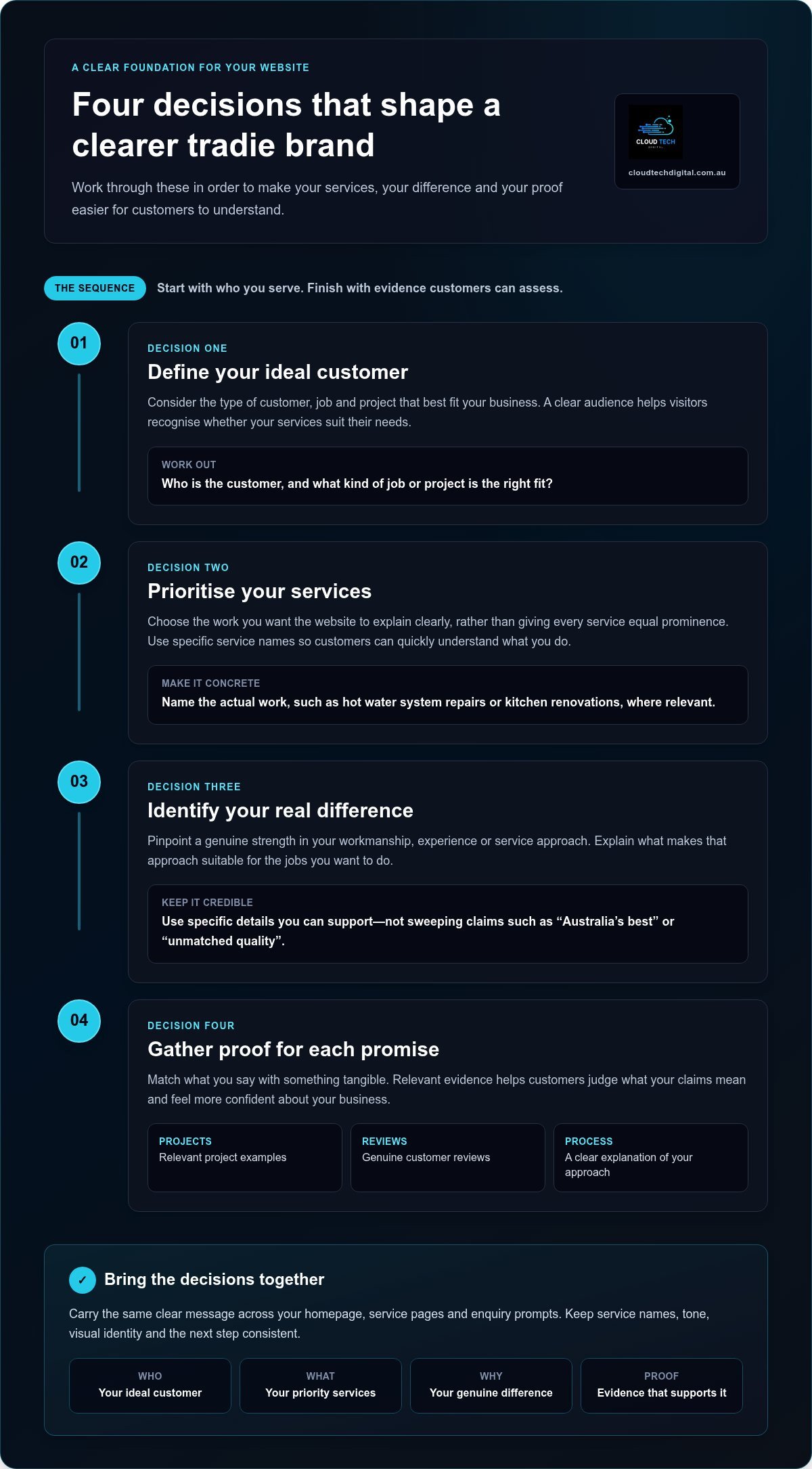
Before writing page copy, work through these four decisions:
- Define your ideal customer. Consider the type of customer, job and project that best fit your business.
- Prioritise your services. Choose the work you want the website to explain clearly, rather than giving every service equal prominence.
- Identify your difference. Pinpoint a real strength in your workmanship, experience or service approach that you can demonstrate.
- Gather supporting evidence. Match each promise to something tangible, such as relevant project examples, genuine reviews or a clear explanation of your process.
These decisions give your website a practical foundation. A high converting tradie website doesn’t rely on sweeping claims such as “Australia’s best” or “unmatched quality”. It gives customers specific reasons to believe what the business says.
How do you write a clear homepage message?
Lead with the trade service and the customer problem it solves. Then explain your approach or point of difference in a line or two. For example, an electrician might name the residential electrical work offered, then explain how the business guides customers through the job. Finish with a direct call to action, such as “Request a quote”, and briefly explain what happens after the customer submits the form or calls.
Keep the message easy to scan. A clever tagline can support your brand, but it shouldn’t make people guess what you do. State your service area accurately, and avoid naming places you don’t cover. Each service page can then expand on one part of the homepage promise with relevant details and evidence.
How can your brand sound credible without overclaiming?
Use language you can back up. If you describe your team as experienced, explain the kind of work that experience covers. If you emphasise careful workmanship, show relevant examples or outline the steps you take. Avoid unsupported guarantees, absolute claims and vague phrases such as “the ultimate solution”. Specific details sound more credible because customers can assess what they mean.
Consistency matters, too. Use the same service names, tone, visual identity and core call to action across your homepage, service pages and enquiry prompts. If one page invites customers to request a quote while another asks them to book an inspection, explain the difference so the process feels joined up.
For broader design context, explore Cloud Tech Digital’s tradie website design and how clear messaging can be built into a bespoke website. Apply the same brand decisions across the site, then add proof points that help customers feel confident about making contact.
Which website elements help tradies earn trust and reduce enquiry friction?
Customers look for different proof depending on their concerns. Someone comparing workmanship may want to see completed projects, while a customer deciding whether to invite a tradesperson into their home may value genuine feedback and clear business details. Choose trust cues that answer real questions, then place them near the relevant service information or enquiry prompt. A collection of badges and praise won’t help if visitors can’t tell what any of it means.
Use this evidence-to-concern check when reviewing a page:
- “Have they done this kind of job?” Show relevant, genuine project photos with an accurate description of the work.
- “What are past customers saying?” Include authentic reviews with permission and appropriate attribution.
- “Are they suitably qualified for this work?” Display applicable credentials accurately, without suggesting the business holds qualifications it doesn’t have.
- “What happens if I get in touch?” Explain the enquiry process plainly, including what information the customer should provide.
Clear, relevant proof gives customers fewer unknowns to weigh, making it easier to decide whether to enquire. The goal isn’t to promise a particular result. It’s to replace broad claims with evidence that addresses the customer’s concern.
Which trust signals suit a trade business website?
Keep evidence authentic and useful. Ask permission before publishing customer feedback, preserve its meaning and attribute it appropriately. Choose project photos that show work relevant to the page, and describe them accurately rather than implying every image represents the same service. If you display credentials, keep their wording and status precise. These checks help customers assess your business without being misled by inflated or ambiguous claims.
How can a mobile website make enquiries easier?
Check the site on a real mobile phone, not only in a desktop preview. Make phone and enquiry actions easy to spot and tap, use readable text, and keep navigation simple enough that visitors can reach the right service page without unnecessary effort. Check how pages load on mobile connections and whether important content appears in a sensible order.
Forms should ask only for details needed to respond. A customer may need to share their name, contact details and a short description of the job, but avoid fields that don’t help you understand or follow up the request. Use clear labels and helpful prompts to reduce guesswork. An error message should explain what needs fixing rather than leaving someone stuck.
Review the journey from landing on a service page to making contact. Can a customer find the relevant information, understand the proof and reach a contact option without backtracking? A high converting tradie website makes that journey straightforward on a small screen as well as a desktop. Fix practical barriers first, such as a hard-to-tap phone number, crowded text or a form that asks for unnecessary detail.
How to test and improve a tradie website’s conversion journey
A website audit is most useful when it leads to a clear next action, not a long list of minor tweaks. Work through the customer journey, record what’s happening now, fix the biggest barriers and check whether the change helped. This gives you a repeatable way to improve a high converting tradie website without relying on guesswork.
What should you check in a website conversion audit?
Test the main journey on mobile and desktop, starting from a service page and trying every enquiry route. Tap the phone number, submit each form and check that any confirmation message appears as expected. Compare key pages for consistent service descriptions, trust evidence and contact details. Note each issue before deciding what to tackle first.
Keep the audit practical. Record problems that could stop or confuse a customer, such as a broken form, a contact option that’s difficult to find, unclear service information or a page that’s hard to read on a phone. Prioritise issues that block an enquiry or affect several important pages over small visual details with little impact.
How can you tell whether a website change helped?
Set a baseline before making changes. Record relevant phone enquiries, form submissions and, where possible, how many enquiries fit the work your business offers. Keep the period and definitions consistent so you can compare like with like. If you change the main call to action, note what it said before, what it says now and when the update went live.
Google Analytics 4 can report activity such as page views and events when tracking is configured. Use it to measure actions such as form submissions or clicks on a phone link, but remember that a click doesn’t necessarily mean a call took place. Google Search Console serves a different purpose: its performance report shows how your site appears in Google Search, including clicks, impressions, queries and pages. It doesn’t show whether a search visitor became a qualified lead.
Use those tools alongside a simple record of actual enquiries and their fit. Collect only the information you need to respond, and handle customer details in line with applicable privacy obligations. Avoid treating a short-term change as proof of success: traffic volumes and sources can shift, affecting the result.
Where practical, change one meaningful element at a time, such as a form label or the placement of a phone option. Review results over a suitable period, compare enquiry quality as well as quantity, and note any changes in traffic sources. If several things change at once, it’s harder to tell what influenced the outcome.
For a broader view of how website enquiries fit into an acquisition plan, explore this lead generation strategy. A measured audit helps you make website improvements with purpose and connect them to the leads your business actually wants.
How Cloud Tech Digital can help put a high-converting tradie website into action
Applying these principles takes more than a fresh colour palette. Your website needs to reflect the work you want, make your offer easy to understand and give each prospective customer a clear route forward. Cloud Tech Digital is an Australian-owned digital marketing agency that has worked with trade businesses nationally since 2020, bringing bespoke website design and digital marketing together around practical business goals.
What does a conversion-focused website project address?
A tailored website project starts with your services, ideal customers and priorities. Those decisions shape the page structure and messaging, so visitors can move from relevant service information to an appropriate enquiry action. Clear copy, considered design and user experience should work together, rather than being treated as separate finishing touches.
The same thinking applies to development and landing pages. A landing page can focus on a particular service or campaign, carry its message through consistently and make the intended next step easy to find. It still needs to give visitors enough context to understand what the business offers and whether it fits their needs.
How does the website fit into ongoing digital marketing?
A well-structured website gives marketing activity a useful destination. Search engine optimisation can help relevant service pages appear in search results, while Google Ads and social advertising can direct visitors to a focused page that matches the campaign message. The page then needs to carry that promise through with clear information and an enquiry path. This alignment makes it easier to assess how the website and campaigns work together, without promising a particular volume of leads.
Measure the journey beyond the click. Reviewing which pages attract enquiries, which actions visitors take and whether the resulting contacts suit the work you offer can help identify where to refine the website or campaign. This creates a practical feedback loop: attract relevant visitors, give them a useful page, then use observed activity to guide the next improvement.
Cloud Tech Digital testimonials describe measurable sales increases and rapid lead turnover. These are client-reported experiences, not a guarantee of a particular outcome. The right website structure and marketing approach depend on each trade business’s services and goals, so the focus is on building a considered foundation and improving it with relevant evidence.
To put these ideas into practice, explore Cloud Tech Digital’s website services and how bespoke design and lead-generation marketing can support your next steps.
Make your next website improvement count
Your website doesn’t need another round of changes for change’s sake. Choose one practical improvement that will make it easier for a suitable customer to take the next step, then check whether it’s helping. That might mean sharpening a key service page, making an enquiry action clearer or improving how a campaign page carries its message through to contact.
Keep the focus on the outcome your business needs. A high converting tradie website is built through clear decisions, relevant evidence and steady refinement, not a single design trend or clever headline. Start with the part of the customer journey that feels hardest to follow, and make that your next priority.
Ready to improve your website and generate more relevant enquiries? Explore Cloud Tech Digital’s website and lead-generation services to discuss a focused next step for your trade business.
Frequently Asked Questions
What is a good conversion rate for a tradie website?
There isn’t one conversion rate that’s good for every trade business. The result depends on what you count as a conversion, where visitors come from and whether the enquiries suit your services. Define the action first, such as a completed job request, then compare the same measure over time. A lower rate can still bring valuable work if enquiries are well matched, while a higher rate may include unsuitable requests.
Can a one-page website generate tradie leads?
Yes, a one-page website can generate enquiries if it explains the business clearly and makes contacting it straightforward. It can suit a business with a focused offer and a small amount of essential information. If you provide several distinct services, one page may leave customers short on detail or make relevant information harder to find. Build out separate pages as your services and content needs grow.
How often should a tradie website be updated?
Update your website whenever key business information changes, such as services, service coverage, contact details or the way customers can enquire. Also review it periodically for outdated project examples, broken forms and pages that no longer reflect the work you want. You don’t need to change the design constantly. A planned check, plus updates when something changes in the business, keeps the site accurate and useful.
What happens if my tradie website gets visitors but no enquiries?
First, check whether the visitors are a good match for your services. Search terms or campaign targeting may be attracting people looking for different work. Then test the website’s enquiry routes yourself and review whether visitors reach the right service information. Check tracking too: if calls or form submissions aren’t recorded correctly, the data may hide activity. Use what you find to choose one issue to investigate, rather than redesigning everything at once.
Do I need separate pages for each trade service?
Not necessarily for every small variation, but distinct services often benefit from their own pages when customers need different information to make a decision. A plumbing business, for example, could separate hot water work from bathroom renovations if the jobs, questions and proof differ. Give each page genuinely useful details. Avoid creating multiple near-identical pages that merely swap a service name, as they offer little extra help to customers.
Is website design enough to generate consistent tradie enquiries?
No. A well-designed site gives visitors a useful place to learn about your business and enquire, but it needs relevant visitors to reach it. Search engine optimisation can support discovery through search, while Google Ads and social advertising can put specific pages in front of relevant audiences. Ongoing measurement helps you see whether traffic and enquiries fit your goals, then adjust the site or campaigns as needed.
Should I put customer reviews on my tradie website?
Yes, genuine customer reviews can help prospective customers understand other people’s experience of your business. Use feedback with permission, attribute it appropriately and keep the wording faithful to what the customer said. Place relevant reviews near the service they relate to, rather than relying on a generic block of praise. Don’t edit feedback in a way that changes its meaning or present a review as evidence for work it doesn’t discuss.
