


The Google Map Pack captures up to 44% of all local search clicks, yet many Australian contractors watch those lucrative domestic and emergency jobs funnel straight to competitors. If you are searching for how to get on the Google map pack for tradies without drowning in technical jargon, you aren’t alone. Chasing inconsistent lead flow and wasting valuable hours on shared quote directories is a frustrating, expensive way to run a trade business.
You already know that locking in a top-three spot on Google Maps is the most reliable way to get high-intent clients calling you directly. Achieving that visibility isn’t about guesswork; it requires synchronising your Google Business Profile, organic website authority, and review velocity into a reliable lead asset. In this guide, you’ll discover the exact step-by-step framework Australian trade businesses use to dominate Google Map Pack rankings and generate high-intent inbound calls. Here is your practical 2026 blueprint to outrank competitors and turn map views into booked work.
Key Takeaways
- Mastering how to get on the Google map pack for tradies allows your business to capture high-intent inbound calls before competitors even see the lead.
- Configure your Google Business Profile correctly as a Service Area Business to protect your private residential address while expanding your operational footprint.
- Build steady review velocity and genuine client feedback to outrank static profiles and cement long-term prominence.
- Anchor your map listing with targeted website architecture and high-converting landing pages that reinforce your local search authority.
- Protect your top-three visibility by auditing competitor violations and pairing local SEO with strategic paid advertising campaigns.
What Is the Google Map Pack and Why Does It Drive Tradie Leads?
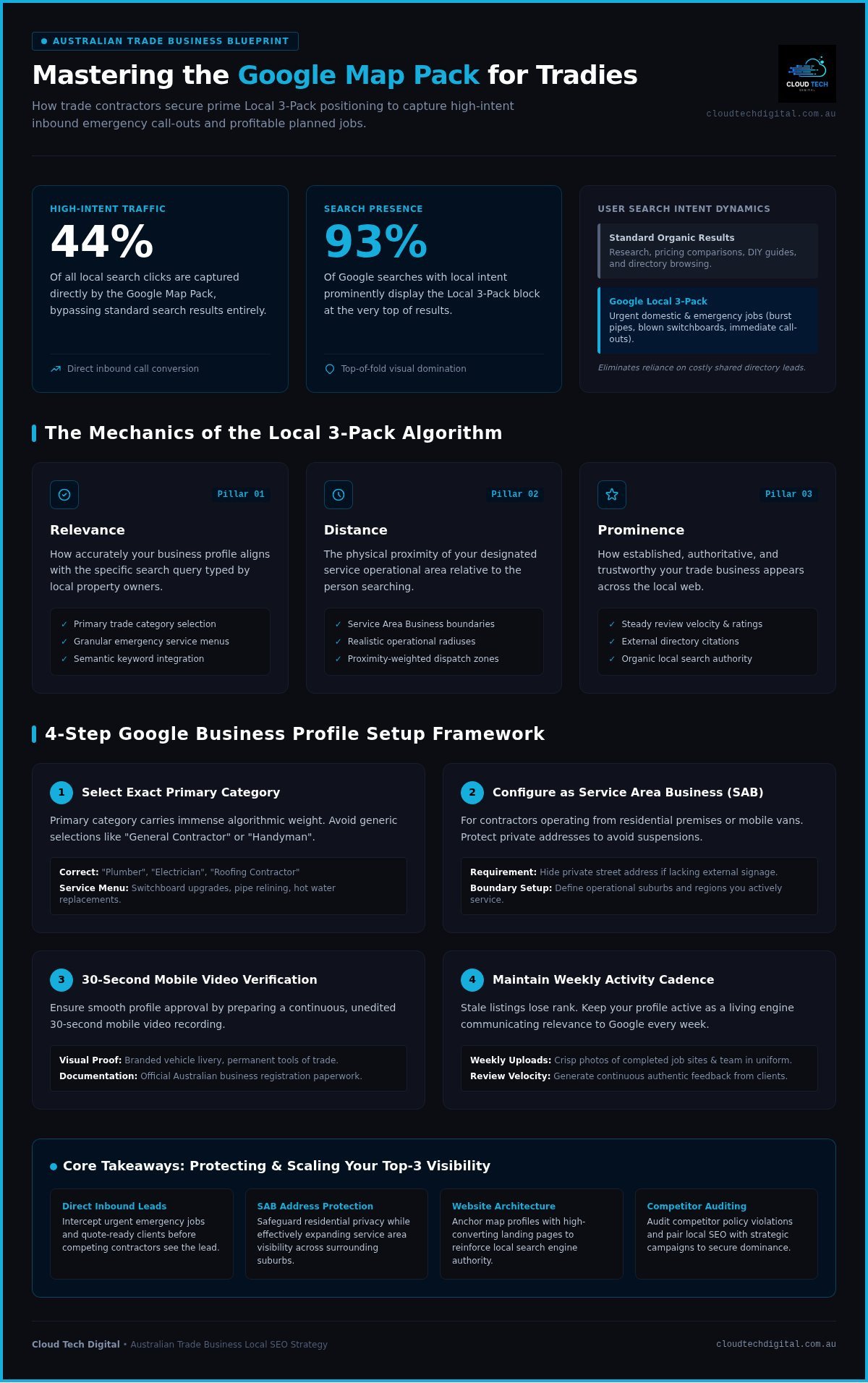
The Google Map Pack, commonly called the Local 3-Pack, is the prominent block of three local business listings displayed directly below the map at the top of Google search results. For trade businesses, this feature represents the single most valuable digital footprint available. When a domestic or commercial client faces a burst pipe or blown switchboard, they don’t scroll past the map to read long-form blog articles. Instead, mobile users rely on instant click-to-call buttons embedded in the listing to summon an immediate on-site solution.
Understanding how to get on the Google map pack for tradies requires recognising how user intent differs between organic listings and map results. Standard organic search results generally serve users looking for research, pricing comparisons, or DIY guides. The Map Pack captures urgent, high-intent searches where immediate service delivery is non-negotiable. Because Google displays this visual block in roughly 93% of searches with local intent, claiming one of these top three positions ensures your phone rings before potential clients ever consider scrolling further down the page.
The Mechanics of the Local 3-Pack Algorithm
Google relies on three core evaluation pillars to decide which businesses secure top-tier map visibility:
- Relevance: How accurately your business profile aligns with the user’s specific query. Google analyses your primary business category, service offerings, and semantic keywords to confirm you perform the exact trade requested.
- Distance: The physical proximity of your designated service area to the person searching. Google balances practical service boundaries against user location to provide workable local options.
- Prominence: How well-established and trustworthy your trade business appears across the web. This incorporates review volume, external signals, and broader local search engine optimisation principles that validate your authority.
Commercial Value of Prime Map Real Estate
Capturing a top-three placement transforms your business economics. Map Pack listings secure direct inbound calls without forcing you to buy shared leads from third-party directories where five other contractors compete for the same job. Trade businesses that dominate map rankings consistently build a self-sustaining pipeline of emergency call-outs and profitable planned jobs, drastically lowering customer acquisition costs and creating long-term commercial stability.
Step-by-Step Google Business Profile Setup for Trade Businesses
Treating your Google Business Profile (GBP) as a set-and-forget digital phonebook is the fastest way to get buried by competing contractors. When evaluating how to get on the Google map pack for tradies, view your profile as an active, living engine that communicates operational relevance directly to Google’s ranking filters every single week.
Primary Categories and Service Menus
Your primary category carries more algorithmic weight than almost any other setting on your profile. Avoid generic selections like “General Contractor” or “Handyman” if your primary revenue comes from specialised call-outs. Select your exact core trade, such as “Plumber”, “Electrician”, or “Roofing Contractor”, and use secondary categories only for legitimate adjacent capabilities. Populate your service menu with granular items that mirror what homeowners type during an urgent breakdown, such as switchboard upgrades, emergency pipe relining, or hot water replacements. For broader search strategy, explore our complete blueprint on SEO for tradies to align your web architecture with these category targets.
Service Area Businesses vs Physical Addresses
Contractors operating out of a residential home or dispatching directly from mobile vans must configure their profile as a Service Area Business (SAB). Displaying a private residential street address without permanent external commercial signage invites swift profile suspension. You must hide your street address and define realistic operational boundaries using service regions you can promptly attend. During standard live mobile video verification, prepare a continuous 30-second recording showing your branded vehicle, tools of trade, and business registration paperwork to ensure prompt approval without administrative delays.
Visual Proof and Regular Profile Updates
Stale profiles slip down the rankings. Maintain a weekly cadence of uploading crisp photos showcasing completed projects, liveried trade vehicles, and staff in branded uniforms. Regular visual proof confirms your real-world activity while establishing immediate trust with domestic clients. Use Google update posts to highlight seasonal maintenance checks or urgent call-out availability. Pairing consistent photo uploads with official guidelines for managing online customer reviews keeps your profile active and compliant. If maintaining this ongoing activity pulls you away from billable work, partnering with a dedicated lead generation agency in Australia can protect your ranking momentum while you focus on the tools.
Building Prominence Through High-Impact Reviews and Citations
Securing a prominent position on Google Maps requires more than a clean profile setup. Prominence reflects how well known and validated your business is within your market. For trade contractors determining how to get on the Google map pack for tradies, steady review velocity and rock-solid citation consistency form the foundation of your algorithmic authority.
The In-Field Review Generation Playbook
Star rating volume alone won’t move the needle if your profile remains inactive for months. Google prioritises recency, velocity, and semantic content. When a client leaves a review describing how you replaced a hot water system or repaired an electrical sub-board, Google extracts those trade-specific terms to reinforce your search relevance. Have your technicians prompt happy homeowners in the driveway right after testing the installation and presenting the invoice. Send an automated SMS containing a direct Google short-link while the positive experience is fresh, or provide a scan-to-review QR code on printed paperwork. Steady review drip feeds outperform sudden, artificial review blasts every single time.
Strategic Review Responses and Reputation Management
Responding to feedback is not optional admin; it actively feeds Google’s prominence calculations. Industry benchmarks for optimizing local search signals and business profiles emphasise that active engagement directly supports local discovery. Reply to every review within 48 hours. Integrate natural trade keywords when thanking clients, confirming the exact service provided without sounding robotic. If an unhappy customer leaves a negative review, stay calm and professional. Acknowledge the dispute politely, offer an offline phone discussion, and demonstrate to future clients that your business operates with accountability.
Australian Trade Directory Citations
Google cross-references your core business information against trusted independent websites across Australia to verify operational legitimacy. Your business Name, Address, and Phone number (NAP) must match perfectly everywhere it appears online. Inconsistent contact details confuse search crawlers and dilute your ranking power. Prioritise verified listings on established Australian platforms:
- National Directories: Maintain accurate entries on Yellow Pages, True Local, and major trade portals.
- Accredited Registries: Secure profile listings with recognised national trade associations, master builder registries, and trade safety bodies.
- Map Data Aggregators: Ensure uniform contact data across secondary map directories, such as Apple Maps and Bing Places.
Systematic clean-up of conflicting legacy phone numbers or outdated trading names eliminates algorithmic friction, cementing your Map Pack prominence across every designated service zone.
Aligning Your Website Architecture to Dominate Local Search
Your website serves as the organic anchor that stabilises your Google Maps visibility. Google does not rank map profiles in isolation; its algorithm continuously crawls your linked domain to verify that your business possesses genuine authority. If your site is a generic one-page template, your map rankings will stall against competitors with deeper technical infrastructure. Mastering how to get on the Google map pack for tradies requires engineering a website that validates your listed services through authoritative site architecture.
Dedicated Trade Service Landing Pages
Lumping every trade skill onto a single overview page cripples your topical relevance. Google needs distinct URLs for each high-margin offering, whether that covers commercial switchboard upgrades, emergency drain clearing, or residential heat pump installations. Build individual landing pages equipped with direct benefit headlines, detailed project scopes, and upfront value propositions. To see how purposeful layout turns search visits into qualified phone calls, explore our guide on web design for tradies.
Technical On-Page Signals and Structured Data
Structured data acts as an explicit interpreter between your code and Google’s local search index. Embed LocalBusiness JSON-LD schema markup across your primary templates, defining your trade categories, licensing credentials, and exact operational parameters. Align your page headings, meta descriptions, and introductory copy with the services configured in your business profile. Crucially, your website header and footer must feature the exact telephone number and operational hours displayed on your map listing, confirming unshakeable entity consistency.
Mobile Performance and Conversion Elements
When an emergency occurs, customers won’t wait for a sluggish mobile page to load. Mobile rendering delays drive up bounce rates, which sends negative behavioural signals back to Google’s ranking algorithm. Strip away bloated video banners and heavy scripts to guarantee rapid mobile page rendering. Place click-to-call phone buttons and quick enquiry forms above the mobile screen fold so visitors can connect without friction. Understanding these conversion mechanics is central to comprehensive marketing for tradies. If your current site isn’t generating measurable inbound calls, partner with an experienced web design agency in Australia to rebuild your digital platform into a high-performance lead generator.
Advanced Tactics to Protect and Scale Your Map Pack Rankings
Reaching the top three is only half the battle; defending that position requires ongoing vigilance. Once competing businesses notice your territory dominance, they will adapt their own digital presence to challenge your rankings. Ambitious trade business owners learning how to get on the Google map pack for tradies must implement proactive defence strategies and multi-channel marketing to maintain consistent lead volume year-round.
Combating Spam and Unethical Competitor Tactics
Unscrupulous operators often attempt to manipulate map rankings by stuffing their business titles with extra keywords or setting up ghost profiles at unmanned locations. Google’s guidelines explicitly prohibit adding promotional phrases or fake addresses to profile names. When competitors leap ahead using illegitimate names, submit a Google Business Redressal complaint with evidence to remove policy-violating profiles. Keep your official trade registration, contractor licences, and utility bills organised in accessible digital storage. If Google triggers a surprise verification review, having verified paperwork ready prevents costly downtime.
Synergising Google Ads with Map Dominance
Organic local rankings perform even better when reinforced by targeted paid advertising. Running Google Local Search ads allows your business to appear as a sponsored listing above the organic 3-Pack, giving your trade brand double visibility for competitive commercial terms. This layered approach captures emergency searches during seasonal surges or outside standard hours without exhausting your team. To understand how paid campaigns integrate with local SEO to maximise job flow, read our guide on choosing a Lead Generation Agency in Australia: The 2026 Tradie Growth Guide.
Tracking Key Performance Indicators That Drive Revenue
Vanity metrics do not grow trade enterprises; paying jobs do. Review your Google Business Profile performance dashboard monthly to evaluate commercial key performance indicators:
- Direct Call Volume: Track phone calls originating straight from your map listing to measure true conversion output.
- Customer Search Queries: Uncover the exact search terms homeowners use to find your services, revealing high-demand maintenance jobs.
- Peak Engagement Hours: Monitor when potential clients interact with your listing to calibrate technician rosters and fleet readiness.
Ready to turn Google Maps into a predictable inbound job pipeline? Speak with the performance team at Cloud Tech Digital.
Take Control of Your Territory and Win More High-Intent Work
Securing prime visibility on Google Maps isn’t an overnight trick; it’s a measurable commercial asset. When you master how to get on the Google map pack for tradies, you stop burning cash on shared quote directories and take command of your operational footprint. By pairing a properly structured Service Area Profile with steady review acquisition and an authoritative website, you transform everyday map views into a dependable pipeline of booked jobs.
Dominating local territory requires consistent execution and zero guesswork. Delivering specialised tradie digital marketing systems across Australia since 2020, Cloud Tech Digital builds multi-channel strategies designed to turn searches into qualified inbound phone calls. As an Australian-owned and operated agency led by industry specialists, we cut through technical jargon to deliver real revenue outcomes. Ready to cement your position in the top three and keep your crews booked solid? Partner with Cloud Tech Digital to scale your inbound trade leads today.
Frequently Asked Questions
How long does it take for a trade business to rank on the Google Map Pack?
Most trade businesses see initial ranking movement within 60 to 90 days of completing proper profile configuration and establishing regular review generation. Securing and holding a consistent top-three placement in competitive trade sectors typically takes three to six months. The timeline depends heavily on local competitor saturation, existing website authority, and how quickly your team secures steady, high-quality customer reviews. Disciplined weekly profile management yields the most sustainable ranking outcomes.
Can I get on the Google Map Pack if I run a mobile trade business without a commercial workshop?
Yes, mobile trade contractors can successfully secure top map rankings without a physical workshop or commercial storefront. When learning how to get on the Google map pack for tradies as a mobile operator, register your Google Business Profile as a Service Area Business. This setting allows you to hide your private residential address completely while defining the territories you actively service, keeping your business fully compliant with Google policies and eligible for 3-Pack placement.
Why did my trade business suddenly drop out of the Google Map Pack rankings?
Sudden ranking drops usually happen because of algorithmic updates, unaddressed competitor edits, or conflicting contact information across Australian business registries. A sudden drop can also stem from an unverified address change, algorithmic filtering of sudden review spikes, or an unlinked website error. To recover lost positioning, audit your profile dashboard for verification warnings, correct any citation discrepancies, and ensure your website’s linked landing pages remain fast, mobile-friendly, and technically sound.
How many Google reviews do I need before my business starts appearing in the top 3?
There is no fixed review number that guarantees entry into the top three, though top-performing trade profiles maintain a steady volume alongside recent activity. Google prioritises consistent review velocity and rich semantic feedback over a static count. Earning two to three authentic reviews each week that mention specific trade jobs will elevate your visibility much faster than sitting on a high review total that hasn’t received fresh feedback for several months.
What should I do if a competitor is stuffing extra trade keywords into their business name?
Submit a formal Google Business Redressal complaint through Google’s business support portal with photographic evidence of their legal trading name. Google’s strict guidelines state that business names must match real-world branding shown on service vehicles, trade licences, and registered business documents. While artificial keyword stuffing can temporarily boost a competitor’s ranking, Google routinely penalises or suspends offending listings once formal redressal evidence confirms intentional manipulation of the map algorithm.
Does paying for Google Ads improve my organic position in the Google Map Pack?
Paying for Google Ads does not directly boost your organic ranking in the Google Map Pack. The organic map algorithm and Google’s paid advertising auction operate on entirely independent systems. Running paid search or local ads places your listing in a sponsored slot directly above the 3-Pack, giving your trade business immediate double visibility while your long-term search engine optimisation strategy gains traction across your core service footprint.
Is it better to set my service area by broad regions or specific postcodes?
Setting specific postcodes and defined operational sectors produces far stronger relevance than selecting broad state boundaries. Understanding how to get on the Google map pack for tradies involves demonstrating genuine local capability. Designating precise postcodes that your vans can attend within practical dispatch windows signals clear geographic relevance to Google, preventing your profile from getting diluted across unrealistic territories that your crews cannot efficiently service.
