


A forty-page monthly report packed with impressions and click-through rates is usually just an expensive smokescreen for flatlining sales. If you run a growing business, you already know the sinking feeling of sitting through agency review calls where account managers celebrate record digital reach while your phone stays quiet. You shouldn’t have to decipher confusing technical jargon just to determine what should a marketing agency report on to prove real commercial value.
You deserve absolute clarity regarding your cost per qualified lead, attribution accuracy, and whether inbound enquiries actually translate into profitable booked jobs. This guide cuts straight to the core commercial metrics, pipeline data, and channel KPIs your agency must measure to demonstrate true return on investment. Ahead, you’ll get a ruthless 2026 performance checklist designed to audit your monthly reporting packet, strip out vanity metrics, and hold your marketing partners accountable to genuine cash flow.
Key Takeaways
- Discover what should a marketing agency report on to prove tangible commercial return rather than hiding behind vanity metrics.
- Learn how to evaluate genuine lead quality and calculate true Cost Per Acquisition across your paid and organic channels.
- Understand the channel-specific operational KPIs required for paid search, SEO, and social campaigns to support your bottom line.
- Spot common reporting red flags and deceptive data practices during monthly agency performance reviews.
- Use our ruthless audit framework to turn backward-looking reports into aggressive, forward-looking commercial growth strategies.
The Anatomy of a Results-Driven Marketing Agency Report
Most monthly marketing packs fail because they function as raw data dumps instead of strategic commercial audits. Automated platform exports might save an agency hours of manual compilation, but they leave business owners staring at isolated figures stripped of real-world meaning. When considering what should a marketing agency report on, the baseline standard must always be commercial impact. Digital activity only matters if it feeds pipeline growth and profitable business acquisition.
Foundational disciplines like web analytics exist to translate online visitor behaviour into actionable commercial intelligence, not simply to generate colourful charts. When your agency presents its monthly figures, every slide should directly tie spend back to commercial outcomes rather than hiding behind platform noise.
Vanity Metrics vs Commercial Outcomes
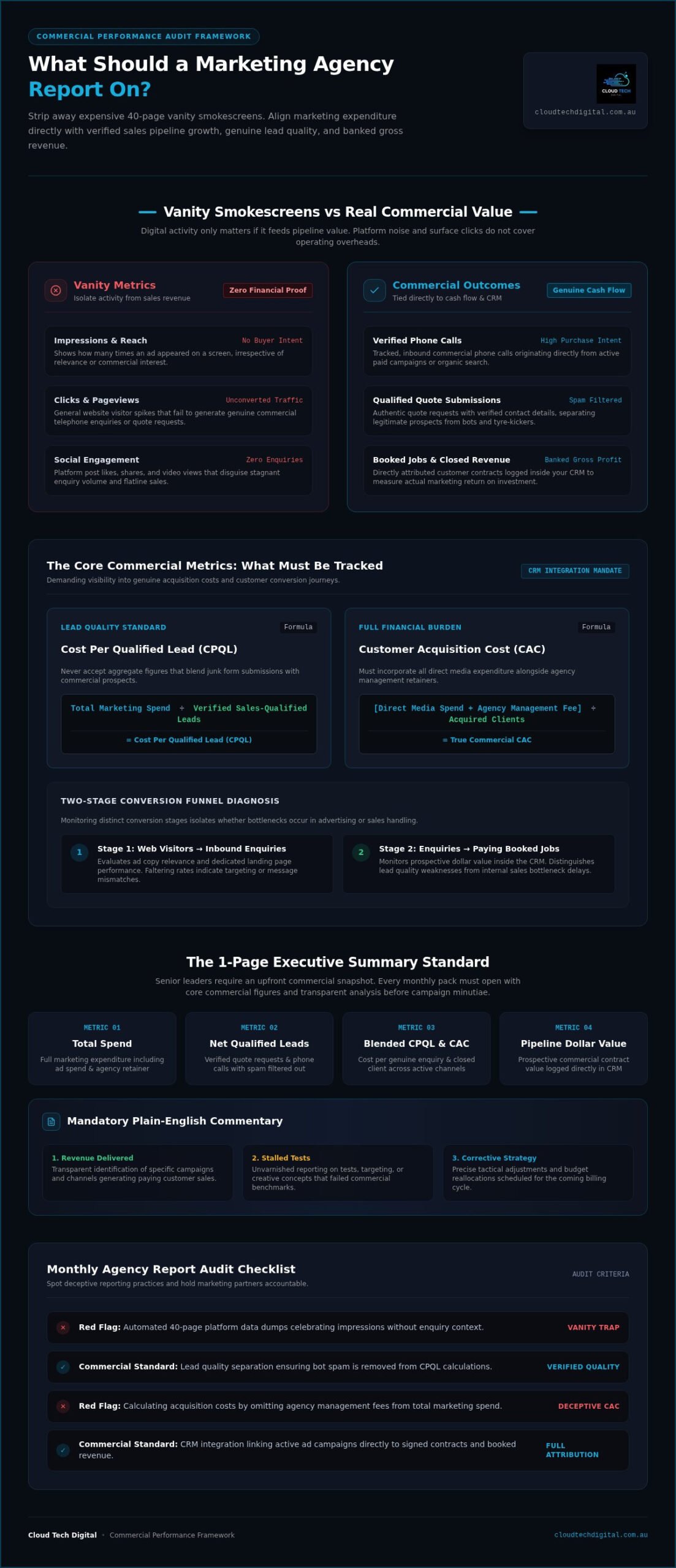
Commercial marketing reporting is the systematic tracking of qualified pipeline value, cost per acquisition, and closed customer revenue generated from marketing expenditure, distinguishing true commercial return from top-of-funnel web interactions.
Vanity metrics look impressive on paper, but they won’t pay your operating overheads. Common vanity indicators include:
- Impressions and reach: How many times an ad appeared on a screen, regardless of user intent.
- Clicks and pageviews: General site traffic that often fails to convert into real buyer conversations.
- Social engagement: Post likes, shares, or video views that generate zero commercial enquiries.
Struggling agencies routinely highlight surging site traffic to disguise stagnant enquiry numbers. In contrast, genuine commercial reporting prioritises bottom-line metrics: verified phone calls, qualified quote submissions, booked consultations, and signed contracts. Traffic increases mean very little if your sales pipeline remains bone dry.
The Essential Executive Summary Component
Senior leaders don’t have time to wade through forty pages of campaign minutiae to determine if marketing is working. A professional report always leads with a concise, one-page executive summary delivering an immediate commercial snapshot. This upfront briefing must clearly display total marketing spend, net qualified leads generated, and blended cost per acquisition across active channels.
Equally critical is plain-English commentary explaining the figures. Knowing what should a marketing agency report on means demanding transparent, honest analysis: an unvarnished summary of which campaigns delivered revenue, which tests stalled, and the exact corrective steps planned for the coming billing cycle.
Core Commercial Metrics: What Your Agency Must Track
Tracking raw enquiry volume tells you almost nothing about financial health. If an agency delivers fifty form submissions but forty are spam bots or tyre-kickers, your sales team burns hours chasing zero revenue. Rigorous application of marketing analytics requires connecting campaigns directly to your customer relationship management software. This integration traces every dollar of ad spend through to verified sales pipeline value and banked gross profit.
Knowing what should a marketing agency report on starts with demanding visibility into the entire customer acquisition journey. It means separating surface activity from commercial reality.
Lead Volume, Lead Quality, and Cost Per Lead (CPL)
Never accept a combined lead total that treats automated spam the same as a high-intent quote request. Your agency must separate qualified leads from raw form fills. Calculate your true Cost Per Qualified Lead (CPQL) using this simple formula:
Total Marketing Spend ÷ Verified Sales-Qualified Leads = Cost Per Qualified Lead
Whether you’re scaling an enterprise firm or reviewing hands-on marketing for tradies, this formula ensures you only fund channels that produce real prospects.
Conversion Rates and Pipeline Value
Your monthly audit needs to monitor two distinct conversion stages: the rate at which web visitors become enquiries, and the rate at which enquiries convert into paying jobs. Measuring prospective dollar value inside your CRM reveals whether a shortfall stems from weak ad targeting or an internal sales bottleneck. If conversion rates falter at the initial click stage, pairing tailored ad copy with dedicated landing pages quickly restores campaign traction.
Customer Acquisition Cost (CAC) and Lifetime Return
Customer Acquisition Cost must factor in all expenses: total direct media spend plus your agency management fee divided by acquired clients. Comparing this blended CAC against Customer Lifetime Value (LTV) confirms whether your business model remains solvent over multi-year horizons. Tactical ad spend should systematically build lasting commercial equity rather than acting as a temporary cash drain.
Channel-by-Channel Reporting Standards for Digital Campaigns
Each marketing channel serves a distinct role inside your customer acquisition system. Blanket summaries that mix all marketing streams into one figure obscure which platforms deliver profit and which ones drain capital. Determining what should a marketing agency report on requires establishing precise, channel-specific operational standards across paid media, search engines, and your website.
Paid Search and Pay-Per-Click (PPC) Campaign Reporting
Search ads capture active, high-intent commercial demand. A reputable Lead Generation Agency in Australia must report on search impression share, impression share lost to budget, and high-intent keyword conversions. Crucially, your PPC dashboard must show an ongoing log of negative keyword additions. This proves your account manager proactively eliminates irrelevant search queries and protects your ad spend from click waste.
Organic Search (SEO) and Local Visibility Tracking
Ranking improvements mean nothing if organic visitors never contact your office. Effective reporting links organic search performance directly to verified inbound calls, quote forms, and local map interactions. Implementing transparent tracking frameworks like SEO for tradies ensures rankings translate into tangible customer enquiries. In addition, link-building reports should focus strictly on referring domain authority and commercial relevance rather than arbitrary backlink counts that skew metrics.
Website Performance, Landing Pages, and Paid Social Metrics
High bounce rates and sluggish page speeds strangle conversions before campaigns even gain momentum. A complete agency audit evaluates mobile conversion paths, layout friction, and page engagement across all destination URLs. Pairing these diagnostics with conversion-first design principles found in web design for tradies keeps user friction low. For paid social advertising, reports must track creative fatigue, ad frequency, and cost per booked lead to ensure audiences aren’t over-saturated with repeated messaging.
When defining what should a marketing agency report on, require operational metrics that tie directly back to conversion efficiency. If a channel report fails to prove how site visitors become qualified pipeline leads, it isn’t serving your business.
The Monthly Agency Report Audit Checklist: How to Spot Red Flags
Opening your monthly marketing pack shouldn’t feel like deciphering a tax audit. Too many service providers use complex dashboards to obscure poor campaign delivery rather than highlighting clear commercial progress. If you want to know what should a marketing agency report on, start by auditing the integrity of their data presentation. Transparent agencies never hide behind shifting metrics or blended costs.
Critical Red Flags in Agency Reporting
Watch out for deliberate accounting smoke and mirrors designed to inflate campaign success. Common warning signs include:
- Omitted Cost Per Acquisition: Hiding commercial acquisition figures while showcasing rising impressions or click totals.
- Blended ad spend and fees: Rolling media costs and management retainers into a single figure, obscuring how much budget actually reaches active ad auctions.
- Shifting date baselines: Comparing a 30-day window against an arbitrary 21-day period from the previous month to manufacture false percentage gains.
- Automated data dumps: Exporting raw platform summaries with zero written analysis or strategic recommendations.
The 7-Point Monthly Verification Checklist
- Executive Commercial Summary: Does page one clearly display total capital invested versus pipeline revenue generated?
- Explicit Cost Breakdown: Are direct platform ad spend and agency service fees completely separated?
- Lead Data Verification: Can you cross-match reported phone calls and forms against your internal sales records to confirm they were genuine prospects?
- Channel-by-Channel CPA: Does the pack provide an unblended Cost Per Acquisition for each active channel?
- Consistent Reporting Periods: Are all month-on-month comparisons using identical date ranges and baseline parameters?
- Active Campaign Optimisation: Does the report detail tangible technical adjustments, such as negative keyword updates and creative split tests?
- Forward Strategy: Does the document outline concrete, commercial action items for the upcoming billing cycle?
If your current monthly review fails more than two of these checks, you’re paying for digital vanity rather than commercial accountability. Take control of your pipeline growth and partner with a results-focused performance team that prioritises verified return over digital noise.
Turning Monthly Reports into Strategic Growth: The Next Steps
Historical reporting without strategic action is just an expensive archive. Looking back at last month’s numbers only matters if those figures actively dictate where you allocate your budget next week. A high-performing marketing report should serve as a practical launchpad for commercial expansion, revealing exactly where to pull back on weak campaigns and where to double down on high-margin revenue streams.
When asking what should a marketing agency report on, remember that true commercial partners never stop at retrospective summaries. They present clear commercial hypotheses and strategic roadmaps for the quarter ahead.
From Historical Data to Forward-Looking Strategy
Every monthly review must dissect which services drove the strongest profit margins, not just which ones drove the most volume. If high-intent search terms generated thirty booked jobs for a flagship service while social campaigns yielded low-value enquiries, your strategist should recommend reallocating spend immediately. Each reporting cycle needs an active testing roadmap outlining upcoming ad creative tests, landing page adjustments, and refreshed audience targeting based on real seasonal trends.
Establishing Real Accountability with Your Marketing Partner
Commercial trust thrives on radical transparency. When an agency proactively flags an underperforming campaign, explains why conversion costs spiked, and presents an immediate tactical fix, you know you have an aligned partner. Conversely, if monthly reviews consistently produce defensive excuses, missing conversion figures, or superficial vanity metrics, it’s time to re-evaluate your arrangement.
You shouldn’t have to guess whether your marketing spend generates a healthy commercial return. Experience absolute transparency, verified pipeline attribution, and aggressive revenue growth across Australia with Cloud Tech Digital.
Take Control of Your Agency Reporting and Pipeline Growth
Dumping dozens of pages of impressions and clicks onto your desk does nothing to grow your bottom line. Understanding exactly what should a marketing agency report on empowers you to eliminate vanity noise, demand unblended cost breakdowns, and hold your marketing partners accountable to real revenue. When your monthly audits track qualified enquiries, actual pipeline value, and transparent customer acquisition costs, marketing ceases to be an unpredictable gamble and becomes a scalable growth engine.
At Cloud Tech Digital, we manage your entire digital ecosystem across SEO, PPC, paid social, and conversion-focused web design with zero fluff. Every campaign connects directly to bespoke tracking frameworks that verify incoming phone calls and quote submissions in real time. If you’re ready to ditch confusing agency jargon and secure absolute clarity over your cost per qualified lead, partner with an Australian agency focused on transparent commercial leads. Take charge of your commercial trajectory today.
Frequently Asked Questions
How often should my digital marketing agency send me performance reports?
Your agency should provide comprehensive performance reports on a monthly basis, backed by real-time dashboard access. Weekly updates or automated snapshots are helpful for tracking fast-moving ad spend, but monthly cycles offer enough data to evaluate meaningful commercial trends. Quarterly reviews should then focus on high-level strategic alignment, conversion performance, and budget reallocation rather than routine operational adjustments.
What is the difference between vanity metrics and actionable commercial metrics?
Vanity metrics measure surface online activity like ad impressions, social media likes, and pageviews without proving financial return. In contrast, actionable commercial metrics track verified phone calls, qualified quote forms, customer acquisition cost, and pipeline value. Knowing what should a marketing agency report on means demanding data that ties marketing expenditure directly to bankable business revenue rather than superficial platform engagement.
Should my marketing agency report on phone calls or just website form fills?
Your agency must track and report on inbound phone calls alongside web form submissions. For trade and commercial service businesses across Australia, incoming phone calls often represent the highest-intent sales leads. Dedicated call tracking frameworks record call duration, caller identity, and the exact marketing channel, ensuring you don’t overlook your most valuable conversion pipeline during monthly reviews.
Why is my agency reporting high website traffic when my sales have not increased?
High website traffic without sales growth typically points to poor audience targeting, irrelevant search queries, or conversion friction on your landing pages. If visitors bounce immediately or submit spam enquiries, your agency is likely targeting low-intent traffic rather than commercial buyers. Traffic is purely an operational indicator; without qualified pipeline enquiries and booked jobs, increased visitor numbers offer zero commercial value.
How should an agency report advertising spend versus management fees?
An agency must completely separate direct media spend from ongoing management fees on every invoice and monthly report. Rolling these figures into a single blended total obscures how much capital actually enters ad auctions versus agency retainers. Clear itemisation lets you calculate genuine customer acquisition costs and ensures your marketing partner remains accountable for true campaign efficiency.
What are the biggest red flags to watch out for in an agency marketing report?
Major red flags include reports dominated by vanity metrics, shifting comparison date ranges, hidden ad spend breakdowns, and a total absence of qualified lead data. If your provider cannot explain what should a marketing agency report on to prove return on investment, or hands over automated software exports without plain-English commercial commentary, they are likely disguising stagnant campaign results.
Can an agency report accurately on actual closed revenue and profit margins?
Yes, an agency can report accurately on closed revenue if their tracking connects seamlessly with your customer relationship management software or job booking system. By matching incoming calls and qualified forms to your closed sales data, your marketing team can trace gross profit back to specific ad campaigns and keywords. This end-to-end integration eliminates guesswork and proves genuine commercial profitability.
