

Word-of-mouth is a fantastic way to start a business, but it’s a dangerous way to scale one in the 2026 Australian market. If you’re tired of the feast-or-famine cycle or fighting for scraps on public tender boards, you’re likely wondering how to get commercial construction leads that actually move the needle. It’s frustrating to watch larger competitors with better digital presence secure high-value contracts while you’re stuck wasting time on low-quality residential enquiries that don’t fit your business model.
We know you want a predictable pipeline and direct relationships with the project managers who matter. This guide provides the exact multi-channel blueprint to move beyond “hope-based marketing” and establish your firm as a dominant force. We’ll explore how to leverage high-performance SEO and the latest 2026 regulatory shifts, such as the NCC 2025 energy efficiency requirements, to build authority and ensure a steady flow of high-value tender invitations directly to your inbox.
Key Takeaways
- Stop relying solely on word-of-mouth and learn how to position your brand as a top-tier choice for developers and project managers.
- Discover how to get commercial construction leads by building dedicated landing pages that speak the language of commercial estimators rather than residential homeowners.
- Use high-intent Google Ads to bypass crowded public tender boards and get in front of decision-makers the moment they search for specific site solutions.
- Build long-term authority by ranking for technical, solution-based queries that prove your expertise in complex commercial projects.
- Transition from a reactive mindset to a proactive commercial partner by leveraging a managed, multi-channel lead generation strategy designed for the Australian market.
Understanding the Commercial Lead Ecosystem in Australia
Commercial construction leads aren’t just names on a list; they’re high-value B2B opportunities that can sustain your business for years. In the Australian market, the process of lead generation has evolved beyond the local pub or the “old boys” club. While relationships still matter, the 2026 landscape is dominated by digital vetting. Before a project manager even picks up the phone, they’ve already checked your safety record, your recent projects, and your capacity to handle the job. This is the new reality of how to get commercial construction leads in a competitive market.
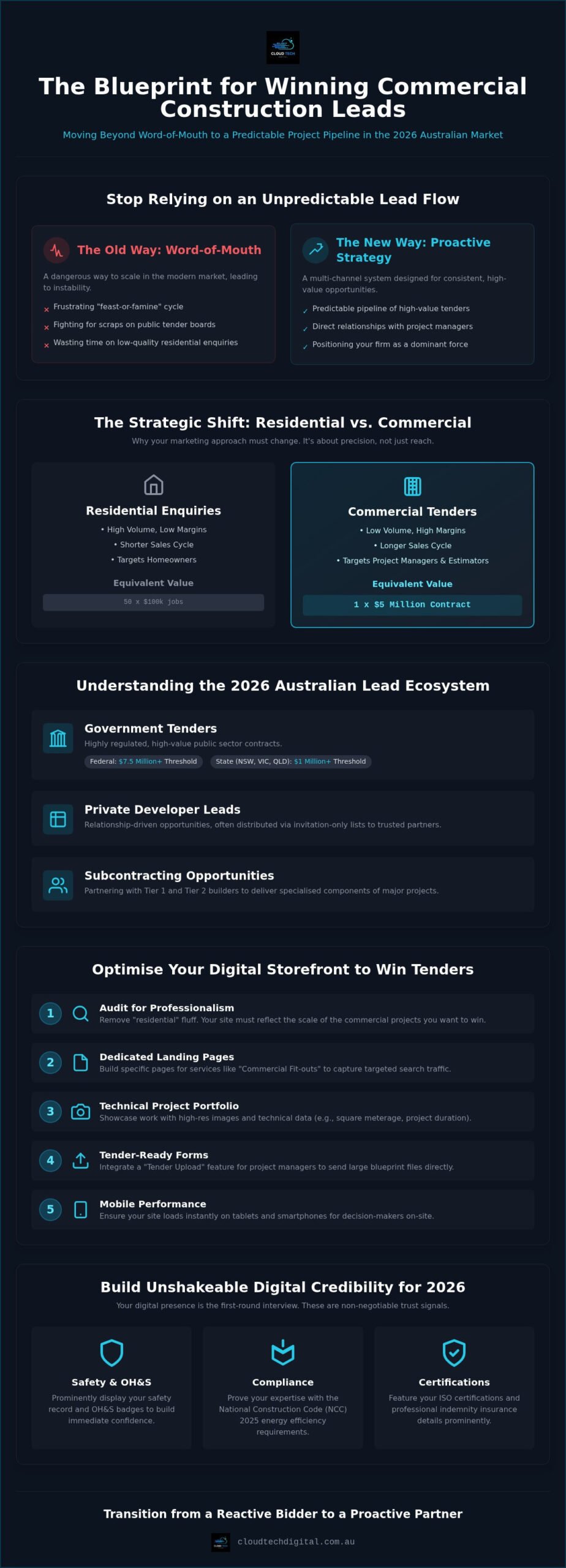
The ecosystem is divided into three main streams. First, you have government tenders. For federal construction services, an open tender is required for contracts valued at $7.5 million or more. In states like New South Wales, Victoria, and Queensland, that threshold drops to $1 million. Second, there are private developer leads, which often rely on invitation-only lists. Third, subcontracting opportunities allow you to partner with Tier 1 and Tier 2 builders. To win in any of these areas, you need a “Lead Machine” that combines aggressive SEO, targeted PPC, and active networking.
Residential vs. Commercial: Why the Strategy Must Change
The sales cycle for a commercial project is significantly longer than a residential renovation. You’re dealing with multiple stakeholders, from architects to quantity surveyors. Volume is less important than project profit margins. One $5 million contract is often more profitable and less stressful than managing fifty $100k residential jobs. Your strategy must reflect this by targeting professional decision-makers rather than general homeowners. It’s about precision, not reach.
The Role of Digital Credibility in 2026
In 2026, your website is your digital storefront. Project managers use it to vet your compliance with the National Construction Code (NCC) 2025, which introduced stricter energy efficiency requirements and mandatory on-site solar for certain building classes. If your site looks outdated, you’re losing “silent” leads. These are people who visited your site, didn’t see proof of your expertise or safety records, and moved on to a competitor without ever leaving a message. High-quality case studies and clear safety certifications are no longer optional; they’re the entry price for high-value tenders.
Optimising Your Digital Storefront to Win Commercial Tenders
Your website is often the first and only chance you get to impress a head contractor or developer. In the commercial sector, decision-makers aren’t looking for “friendly service”; they’re looking for capacity, compliance, and a track record of reliability. According to Australia’s construction market overview, the sector remains a massive contributor to the national economy, but capturing that value requires a digital presence that looks as professional as your on-site operations. If you’re serious about how to get commercial construction leads, you must stop treating your website like an optional extra and start treating it like a high-performance sales tool.
Winning a commercial bid starts with a rigorous audit of your current site. You need to move beyond generic “About Us” pages and build a platform that serves the specific needs of estimators and project managers. This involves five critical steps:
- Audit for Professionalism: Remove any “residential” fluff. Ensure your site reflects the scale of the projects you want to win.
- Dedicated Landing Pages: Build specific pages for services like “Commercial Fit-outs” or “Industrial Civil Works” to capture targeted search traffic.
- Technical Project Portfolio: Showcase your work with high-resolution imagery paired with technical specifications, such as square meterage and project duration.
- Tender-Ready Forms: Integrate a “Tender Upload” feature so project managers can easily send over large blueprint files and specifications directly.
- Mobile Performance: Site managers and developers are often checking subbies while on-site. Your site must load instantly and look perfect on a tablet or smartphone.
The Anatomy of a High-Converting Commercial Landing Page
A commercial landing page needs to establish trust immediately. This means prominently displaying your ISO certifications, professional indemnity insurance details, and OH&S badges. Your project gallery should move beyond aesthetic shots to highlight the scale of the build, the complexity of the engineering, and your ability to hit deadlines on live sites. Including logos from Master Builders Australia or relevant industry bodies provides a psychological “green light” to potential partners. Investing in specialised web design for tradies ensures your site isn’t just a brochure, but a conversion engine.
Converting Traffic into Tender Invitations
Traffic is useless if it doesn’t lead to a conversation. Use “Lead Magnets” like a downloadable capability statement to capture contact details from prospects who aren’t ready to bid yet but are researching partners. Automated follow-ups can then keep your business top-of-mind for general contractors during their next procurement cycle. Speed is also a non-negotiable factor. If your site takes more than three seconds to load, a busy estimator will simply click the next result. If your current site isn’t pulling its weight, a professional Web Design Agency in Australia can help you overhaul your digital presence to meet these commercial standards and show you how to get commercial construction leads consistently.
Active Hunting: Using Google Ads and Social for Fast Commercial Wins
Waiting for the phone to ring is a strategy for hobbyists, not for commercial contractors looking to scale. While organic growth is essential, paid advertising is the most direct answer to how to get commercial construction leads when you need to fill your pipeline immediately. In 2026, the average cost per click for trade-related services in Australia sits around $9.25. With stakes this high, you can’t afford to spray and pray. You need a surgical approach that puts your brand in front of developers and project managers at the exact moment they’re ready to award a contract.
Google Ads serves as your frontline for capturing high-intent search traffic. When an estimator searches for “commercial roofing contractors” or “industrial civil works Sydney,” they aren’t looking for a quote for their backyard. They’re looking for a partner who can handle a specific scale of work. By bidding on these “high-intent” keywords, you bypass the noise and position your firm as the immediate solution. LinkedIn and Facebook then act as your secondary layers, reaching decision-makers who might not be searching today but will be procurement-ready tomorrow.
Google Ads: Dominating Commercial Search Intent
Precision is the difference between a profitable campaign and a burnt budget. To win at Google Ads, you must aggressively use negative keywords to filter out residential “tyre-kickers.” Terms like “DIY,” “cheap,” “residential,” and “home repair” should be blocked to ensure your ads only appear for professional queries. Geographic targeting is also critical. If you’re chasing the $3.8 billion Suburban Rail Loop East projects in Victoria, your ads should be laser-focused on that region. Your ad copy must move beyond generic promises. Focus on “on-time delivery,” “NCC 2025 compliance,” and “proven Tier 1 subcontracting experience” to resonate with professional estimators.
Social Media for B2B Construction Leads
LinkedIn is the undisputed heavyweight for B2B networking in the Australian construction sector. It allows you to target project managers, developers, and quantity surveyors by their specific job titles and company names. This isn’t about posting photos of your lunch; it’s about sharing technical case studies and safety milestones that prove your capability. Facebook, while often seen as a residential tool, is incredibly effective for retargeting. If a developer visits your tender page but doesn’t submit a bid, you can use Facebook ads for tradies to stay top-of-mind with professional imagery of your live sites. This multi-channel approach ensures that once a lead discovers you, they see your authority everywhere they look, which is a key component of how to get commercial construction leads that actually convert into signed contracts.
The Authority Play: SEO and the Long-Term Commercial Pipeline
Paid ads are the fuel that gets your engine started, but Search Engine Optimisation (SEO) is the engine itself. While Google Ads provides immediate visibility, a robust SEO strategy is the most cost-effective way to generate a consistent flow of high-value enquiries over the long term. In the competitive Australian market, organic search authority acts as a permanent asset that works for you 24/7. When you master how to get commercial construction leads through organic search, you stop paying for every click and start owning the digital territory your competitors are neglecting.
Commercial decision-makers often start their procurement process by researching solutions to complex technical challenges. Instead of just searching for “builders,” they might look for “how to waterproof commercial basements” or “fire-rated cladding requirements for NSW carparks.” Ranking for these “Solution-Based” queries positions your firm as the subject matter expert before the formal tender process even begins. To support this, you need a backlink profile built from reputable Australian industry associations, such as Master Builders Australia or local construction news outlets. These links signal to Google that your business is a trusted authority within the national trade ecosystem.
Content Marketing for Commercial Authority
Project managers don’t want to read generic marketing fluff; they want to see how you’ve handled complexity on live sites. Your blog and case studies should detail specific challenges, such as meeting the latest NCC 2025 energy efficiency standards or managing tight logistics in a CBD fit-out. A specialised, SEO-optimised “Capability Statement” on your website ensures that when an estimator searches for your specific trade niche, your business appears at the top of the list. If you want to stop wasting money on broad terms that only attract residential homeowners, investing in SEO for tradies is the most logical step to secure your future pipeline.
Local SEO: Winning the Regional Commercial Market
The “Google Map Pack” isn’t just for emergency repairs; it’s a vital tool for developers looking for local subbies for regional infrastructure projects. Optimising your Google Business Profile for commercial-specific categories ensures you appear in local searches for industrial and commercial works. Consistency is vital. Your Name, Address, and Phone (NAP) data must be identical across every directory and industry listing to maintain your ranking. Encourage your professional partners, such as architects or quantity surveyors, to leave detailed B2B reviews. These testimonials carry significant weight with estimators who are looking for a reliable partner for their next multi-million dollar build. To start building your long-term organic authority, partner with a dedicated Search Engine Optimization team that understands the Australian construction market.
Scaling Your Pipeline: Partnering with a Lead Gen Specialist
Running a commercial construction firm is a full-time commitment. It leaves zero room for moonlighting as a digital marketer. Most business owners fall into the “Time vs. Growth” trap. They try to manage their own SEO or ads after a ten-hour day on-site, only to see inconsistent results and wasted spend. If you are serious about how to get commercial construction leads that actually convert, you must move beyond DIY efforts. A specialised Lead Generation Agency in Australia doesn’t just buy ads. We identify the invisible gaps in your sales funnel, from slow-loading landing pages to poorly targeted keywords that attract residential homeowners instead of project managers.
Cloud Tech Digital specialises in a managed, multi-channel approach. We integrate high-performance web design, surgical Google Ads, and long-term SEO authority into one cohesive engine. This transition moves your business from manual hunting to automated growth. Instead of chasing every lead, you build a system that delivers a predictable flow of tender invitations while you focus on project delivery and site management. We’ve seen how a structured digital presence can transform a “subbie” into a preferred partner for Tier 1 builders.
What to Look for in a Construction Marketing Agency
Don’t settle for a generic agency that doesn’t know a subbie from a head contractor. You need a partner with deep industry-specific knowledge who understands the Australian procurement cycle and the nuances of the local market. Transparency is equally vital. Avoid firms that brag about “impressions” or “clicks.” In the commercial sector, the only metric that matters is the number of qualified tender invitations you receive. Look for a proven track record with Australian trade businesses and a clear reporting structure that shows exactly where your investment is going.
Getting Started with Cloud Tech Digital
We pride ourselves on being straight-shooters. We don’t waste your time with marketing fluff or vague promises. Our team organises your digital presence to attract high-value commercial contracts by positioning you as the most reliable and professional option in your niche. We understand the local market and use that context to sharpen your competitive edge. Discovering how to get commercial construction leads shouldn’t be a mystery; it should be a calculated result of expert management and persistent optimization. Book a strategy session with Cloud Tech Digital today and let’s build your 2026 growth blueprint.
Build Your Future Pipeline Today
The shift toward digital vetting in the Australian commercial sector is permanent. Relying on the old “who you know” model is no longer enough to secure high-value contracts in 2026. You now understand that a professional digital storefront, combined with surgical Google Ads and long-term SEO authority, creates a lead machine that works while you’re busy on-site. Mastering how to get commercial construction leads is about moving from a reactive mindset to a proactive, multi-channel strategy that speaks the language of Tier 1 estimators and developers.
Cloud Tech Digital is an Australian-owned and operated agency that has specialised in lead generation for tradies since 2020. We have a proven track record of increasing sales for Australian contractors by cutting through the noise and delivering tangible tender invitations directly to your inbox. It’s time to stop fighting for scraps on public boards and start winning the high-margin projects your business deserves.
Secure Your 2026 Commercial Pipeline with Cloud Tech Digital. Let’s start building your growth engine today.
Frequently Asked Questions
What is the best site for commercial construction leads in Australia?
EstimateOne, Cordell, and BCI Central remain the industry standards in 2026 for finding public and private tenders. While these platforms aggregate data, they are highly competitive. Your own digital presence is often the deciding factor in whether you’re invited to bid or overlooked. Using these sites in tandem with a professional website ensures you aren’t just one of many names on a list.
How do I get commercial construction leads without paying for them?
Organic search engine optimisation and direct networking are the most effective non-paid methods. By publishing technical case studies that solve specific on-site problems, you rank for high-value queries. This strategy shows you how to get commercial construction leads without a per-click cost. While it takes more time than paid ads, it builds long-term authority and a pipeline that doesn’t stop when your budget runs out.
Can I use Google Ads to get commercial construction contracts?
Google Ads is incredibly effective for securing commercial contracts if you target the right intent. By bidding on terms like “commercial civil contractors” or “industrial fit-out specialists,” you reach decision-makers at the exact moment they need a subbie. In 2026, the median cost per click for Australian trades is approximately $9.25, so precision in your keyword targeting is essential to avoid wasting budget on residential enquiries.
How much should a commercial construction business spend on lead generation?
Most successful Australian construction firms allocate a portion of their projected revenue to marketing and business development. Rather than a fixed dollar amount, focus on the cost per acquisition. If a single commercial contract is worth $2 million, spending a small fraction of that on a managed lead generation programme is a logical investment. The goal is to ensure your pipeline remains full regardless of market fluctuations.
Do I need a specialised website to win commercial tenders?
A generic website will often disqualify you from high-value tenders before you even know they exist. Project managers in 2026 use your site to vet your safety records, ISO certifications, and compliance with the latest NCC 2025 energy efficiency requirements. A specialised site acts as a digital capability statement that proves you have the scale and professionalism to handle complex commercial builds without constant supervision.
How long does it take to see results from SEO in the construction industry?
SEO is a long-term play that typically shows initial traction within three to six months. In the Australian construction sector, reaching the first page for competitive commercial terms can take up to a year of consistent effort. However, once you establish that authority, the cost per lead drops significantly compared to paid advertising. It’s about building a permanent digital asset that generates how to get commercial construction leads for years to come.
Is LinkedIn effective for finding construction project leads?
LinkedIn is a powerhouse for B2B lead generation because it allows you to connect directly with Tier 1 project managers and developers. It’s less about broad advertising and more about targeted outreach and authority building. Sharing technical updates about your recent projects keeps your brand top-of-mind for estimators during the procurement phase. It’s the digital equivalent of the site visit, proving your expertise to the people who award the contracts.
What is a capability statement and why do I need one for digital leads?
A capability statement is a professional document that outlines your firm’s experience, safety record, and technical capacity. In the digital space, this often takes the form of an SEO-optimised landing page or a downloadable PDF. It’s essential because it provides the “proof of life” that commercial estimators require during the vetting process. Without a clear statement of your capabilities, you’ll struggle to move from a simple enquiry to a formal tender invitation.
