


More enquiries won’t help if they’re for jobs you don’t want or people who aren’t ready to hire. If you’re working out how to stop getting tyre kicker leads, the answer isn’t to dismiss everyone who asks questions or wants to understand the options. It’s to make the right fit clear before you invest time in a quote.
It’s frustrating to spend time replying to people focused only on the cheapest price, especially when your marketing attracts enquiries that don’t match your services. But a cautious customer may simply need guidance. Clear criteria can help you tell the difference without turning away a genuine opportunity.
This guide explains how to define a worthwhile lead around your ideal work and business priorities, then use practical qualification questions and response processes to protect your time. You’ll also learn how to sharpen your advertising and landing-page messages so prospects understand what you do, what details to provide and what happens next. The aim is straightforward: fewer mismatched enquiries and more conversations with customers who are a better fit.
Key Takeaways
- Learn how to stop getting tyre kicker leads by defining which jobs suit your services, capacity and business priorities.
- Use a sample of recent enquiries to identify which sources bring suitable jobs, not just a high volume of requests.
- Distinguish a genuine customer comparing prices from an enquiry that falls outside your services, scope or availability.
- Follow a consistent fit-check process and ask only for details that help you assess the job and respond usefully.
- Review SEO, paid search, social advertising and landing pages against the enquiries that become suitable jobs.
How to stop getting tyre kicker leads starts with defining a good-fit enquiry
Quote requests take time to assess, clarify and price. Sometimes it’s only after that work that you find the job doesn’t match what you want to take on. The frustration is real, but a customer who asks questions or compares options isn’t automatically a tyre kicker. To work out how to stop getting tyre kicker leads, first define what a worthwhile enquiry looks like for your business.
Start with the jobs you want more of. Consider which services you offer, the scope of work you can take on, the timing that suits your schedule and whether your team has capacity. Think about profitability too: customer profitability analysis is a way to assess which customers contribute value to a business, rather than judging them by surface details alone. You don’t need formal accounting calculations to use the idea. Look at the work that fits your strengths and priorities, and the effort required to deliver it.
What makes an enquiry worth following up?
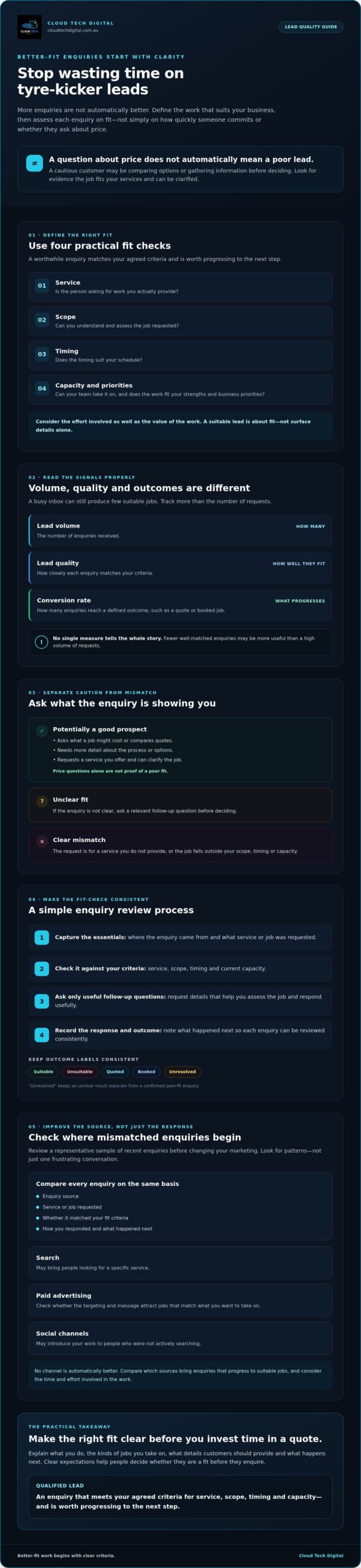
A useful enquiry matches your services, has a scope you can assess, fits your timing and is realistic for your current capacity. Keep price questions in perspective. Someone asking what a job might cost, or comparing quotes, may simply be gathering information before making a confident decision. Look for evidence of fit, not just certainty: does the person need work you actually do, and can you clarify what they’re asking for?
For example, a customer who needs more detail about the process may still be a strong prospect. An enquiry requesting a service you don’t provide is a clear mismatch. If it’s less obvious, ask a relevant follow-up question before deciding.
Why more leads can still mean fewer good jobs
Lead volume tells you how many enquiries came in. Lead quality shows how well those enquiries match your criteria. Conversion rate shows how many progress to a defined outcome, such as a quote or booked job. No single measure tells the whole story: a busy inbox can still produce few suitable jobs, while fewer well-matched enquiries may be more useful.
Broad advertising can attract people looking for work outside your services. Vague service pages can create the same problem if they don’t explain what you do, the kinds of jobs you take on or what information a customer should provide. Clear expectations help prospects decide whether they’re a fit before they enquire.
A qualified lead is an enquiry that meets your agreed criteria for service, scope, timing and capacity, and is worth progressing to the next step. Use that definition to assess enquiries consistently, rather than labelling someone a tyre kicker because they need information or haven’t committed yet.
Find where tyre kicker leads come from before changing your marketing
Once you’ve set your good-fit criteria, look for patterns in the enquiries you receive. Don’t make changes based on one frustrating conversation or a vague feeling that “the ads aren’t working”. Review a representative sample of recent enquiries instead. A simple audit can show whether the issue is a particular source, a mismatch between the message and the job, or follow-up that never reached a clear outcome.
Audit lead quality by source and job outcome
For each enquiry, record where it came from, what service or job the person requested, whether it matched your fit criteria, how you responded and what happened next. Keep outcome labels consistent, such as suitable, unsuitable, quoted, booked or unresolved. “Unresolved” is useful because it separates an unclear result from a confirmed poor-fit enquiry.
Compare enquiries from search, paid advertising and social channels on the same basis. Search may bring people looking for a specific service, while social advertising may introduce your work to people who weren’t actively searching. Neither channel is automatically better. The useful question is which source brings enquiries that progress to suitable jobs. For broader channel context, read this Australian tradie lead generation guide.
Where possible, compare the work that progresses with the time and effort it takes to deliver. Looking at profit per customer can help you consider more than enquiry volume. Some job types may fit your business better once you account for the work involved.
Spot the mismatch between the advert and the job
Check whether your keywords, audience targeting and ad copy describe the service you actually offer. If an advert promises broad help but your business wants a particular type of job, the wording may invite requests outside your scope. Compare the advert with its landing page: do they describe the same service, set consistent expectations and make the next step clear?
Pay attention to the questions prospects ask, too. Repeated queries about a service you don’t provide, what a quote includes or whether you take on a certain job may point to missing or unclear information. Update the message or page to answer those questions before the next enquiry arrives.
Assess lead quality by the source and the outcome, not by one interaction or a label attached to the person. That keeps decisions grounded in patterns and gives you a clearer basis for campaign adjustments. If you’d like support connecting marketing activity with suitable-job outcomes, explore lead generation for trade businesses.
Separate genuine price shoppers from poor-fit leads without losing good customers
A question about price isn’t proof that someone is wasting your time. Customers may be comparing quotes, working within a budget or trying to understand what a job involves before deciding. Treating every price-conscious person as a tyre kicker can mean turning away good work. Use your fit criteria, then ask a calm follow-up question if the details aren’t clear.
Price shopper or unsuitable enquiry: how to tell the difference
Look at the whole enquiry, not one comment about cost. These signs can guide your next step, but they’re prompts for a conversation, not guarantees about someone’s intent.
| Check | Potentially good fit | Possible mismatch |
|---|---|---|
| Service fit | They’re asking about work you provide. | They need a service you don’t offer. |
| Scope clarity | They can describe the job or provide details when asked. | The request remains outside your job scope after clarification. |
| Timing | Their preferred timing may fit your schedule. | The work needs to happen when you genuinely lack capacity. |
| Requirements | They’re willing to discuss the job so you can give a relevant response. | They won’t provide information needed to assess whether you can help. |
A customer comparing quotes may still be a strong fit if the service, scope and timing suit your business. Try: “Could you tell me a little more about the work you need done? That’ll help me confirm whether it’s a job we can take on and give you a useful response.” Their answer gives you context without pressuring them to commit.
Reduce friction without opening the door to every enquiry
Make your website do some of the explaining upfront. State the services you cover, the types of jobs you’re set up for and any clear exclusions. Be specific enough to help the right person recognise the fit, without making promises about timing or outcomes you can’t confirm.
Tell prospective customers what to include in an enquiry, such as the service they need, a brief description of the job and their preferred timing. That information helps you assess fit and respond with relevant next steps. A clear website doesn’t need aggressive screening questions or language that puts genuine customers on the defensive.
For ideas on making those details easier to find, explore this conversion-focused tradie website guide. Clear service information and a straightforward enquiry path can help suitable prospects approach you with better context, while reducing the chance that poor-fit enquiries misunderstand what you offer.
Use a practical qualification process to reduce low-fit trade enquiries
A consistent process helps you respond fairly, gather the details needed to assess a job and avoid spending time preparing a quote before you know whether the work is suitable. If you’re working out how to stop getting tyre kicker leads, make each step clear rather than putting prospects through an interrogation.
Use a simple workflow from first contact to final outcome:
- Log the enquiry: Note its source, the service requested and when it came in.
- Check the fit: Compare the request with your services, job scope, timing and current capacity.
- Ask for what’s missing: Request only the details you need to understand the work and give a relevant response.
- Agree on the next step: Explain whether you need more information, can prepare a quote or can’t take on the job.
- Record the result: Mark whether it was quoted, won, lost, unsuitable or still unresolved.
Keep your response process realistic. Decide who checks new enquiries and what response timeframe the business can maintain during busy periods. If you can’t give a full answer straight away, a brief acknowledgement can set expectations, provided you can follow through on the timeframe you communicate. Don’t promise a response window that doesn’t match the way you work.
Ask useful questions before preparing a quote
Make each question earn its place. Ask what work is needed, where it’s required and when the customer hopes to have it done. If the job’s scope is unclear, invite them to share photos or other relevant details. These questions help you determine whether the work is suitable and what information you need to respond accurately. They’re not a test of whether someone is a “serious” customer.
You can explain the reason simply: “Could you send through a few details about the work and your preferred timing? That’ll help me check whether it’s a job we can take on and work out the right next step.” If the information still isn’t available, record the enquiry as unresolved rather than making assumptions about the person’s intent.
Build a simple lead feedback loop
Track the enquiry source, fit, quote status and whether you won the work. Review the records regularly for patterns. If a campaign brings enquiries for a service you don’t offer, that’s useful feedback for whoever manages the marketing. If suitable enquiries stall before a quote, the next step or response process may need attention. Share outcomes with your marketing provider so targeting, ad messaging and landing-page content can be adjusted based on the jobs that actually fit.
For wider growth planning, read these marketing strategies for tradies. To connect campaign activity with enquiry outcomes, explore lead generation support for trade businesses.
Make marketing generate better-fit leads, not just more enquiries
You now have the basis for a useful feedback loop: define the work that suits your business, audit where enquiries come from, make expectations clear, qualify consistently and record what happens next. Use that sequence to judge marketing by the suitability of the jobs it attracts, not just the number of forms or calls coming in.
Assess each channel against the same fit criteria. SEO may bring people searching for a specific service, paid search can connect adverts with active searches, and social advertising can introduce your work to prospective customers. Landing pages give you space to explain the service and guide people towards an enquiry. None is automatically right for every trade business. Compare the enquiries and suitable jobs each generates, alongside quote and booking outcomes.
When to change targeting, messaging or the landing page
Look for repeated patterns before changing a campaign. If unsuitable enquiries keep coming from an identifiable source, review its targeting and the search terms or audiences it reaches. If prospects regularly misunderstand the service, scope or next step, tighten the advert and make sure the landing-page wording matches. If suitable prospects seem unsure about what happens after they enquire, add clearer process information to the page.
Where practical, make one considered adjustment at a time, then record what changes in the enquiries and job outcomes. That makes it easier to see whether the issue was targeting, unclear messaging or missing information, rather than guessing at a fix. It’s a measured way to approach how to stop getting tyre kicker leads without assuming every enquiry will convert.
Choose support based on the problem you have identified
If your records show that source quality or targeting needs ongoing attention, campaign management can help monitor performance and inform adjustments. If the barrier is unclear service information or a confusing enquiry pathway, web design or a focused landing page may be a better fit. These are different problems, so match the support to the evidence in your audit.
Cloud Tech Digital provides SEO, pay-per-click advertising, Facebook ad management, web design and landing pages for trade businesses. These services can help align campaign targeting and website content with the work you want to attract, but they can’t guarantee a particular lead outcome or replace your own assessment of enquiries.
Once you have a clear picture of what’s happening, review your trade business marketing with Cloud Tech Digital and consider which changes best fit your goals.
Build a lead system around the jobs you want
Better enquiries start with clear criteria. Define what makes a job a good fit, then use enquiry records to see which marketing sources attract suitable work and which messages may be setting the wrong expectations. A consistent, respectful qualification process helps you make that call without writing off customers who simply need more information.
That’s the practical answer to how to stop getting tyre kicker leads: focus less on chasing a bigger enquiry count and more on improving fit, clarity and follow-through. Review the outcomes regularly, then adjust your targeting, advertising or website content based on what the evidence shows.
Cloud Tech Digital supports trade businesses with SEO, paid advertising, social-media advertising and web design. Client testimonials describe measurable sales increases and rapid lead turnover, but these are individual experiences, not promised results. If you’re ready to discuss your own marketing performance, talk to Cloud Tech Digital about improving your trade business leads.
Start with a clearer picture of the work you want. Better-fit enquiries are a goal you can build towards, one informed improvement at a time.
Frequently Asked Questions
How do I stop getting tyre kicker leads?
Start by defining what makes an enquiry suitable for your services, job scope and current capacity. Record where enquiries come from and whether they lead to a quote or booked work. Then check whether your advertising and website clearly describe what you do, ask a few relevant questions before quoting and review outcomes regularly. Don’t dismiss every price-conscious customer. First find out whether the requested work is a genuine fit.
What is a tyre kicker lead?
A tyre kicker lead is an informal term for an enquiry that appears unlikely to become suitable paid work. The job might fall outside your services, the scope may not be viable, or the person may be gathering information without a clear need. But the label is subjective. Set consistent criteria for service, scope, timing and capacity rather than assuming someone lacks intent because they ask questions or haven’t committed.
Are price shoppers always tyre kickers?
No. A customer asking about price may be comparing options, working within a budget or trying to understand what the work involves. Explain how you assess a job and ask enough about the requested work to decide whether you can provide a relevant quote. Repeated questions about cost can be one signal to consider, but they don’t prove an enquiry is unsuitable. Assess the whole request against your business’s fit criteria.
How can I qualify a trade lead before quoting?
Ask concise questions that help you understand the job, where it’s required and the customer’s preferred timing. If the scope is unclear, invite them to share photos or other useful details. Explain that the information helps you assess the work and prepare a relevant response, then set out what happens next. Keep questions proportionate: you need enough context to respond accurately, not a lengthy questionnaire that creates unnecessary friction.
Can my website help reduce tyre kicker enquiries?
Yes. Clearly describe your services, suitable job types, exclusions and enquiry process so prospects can judge whether they’re in the right place. Make sure campaign landing pages match the advert that brought the visitor there. Explain what details to provide and what the next step involves. This clarity may help unsuitable prospects recognise a mismatch and help suitable customers send useful information, but it can’t guarantee every enquiry will be a good fit.
Should I stop advertising if most leads are low quality?
Not before checking the evidence. Compare enquiry fit and outcomes by source, campaign and requested service, then inspect the targeting, advert wording and landing page for mismatches. You may need to refine a campaign rather than stop it. Track changes consistently and review a representative set of enquiries; a small or unusual batch may not reflect the campaign’s typical results. Use recorded outcomes to guide your next decision instead of relying on frustration alone.
What should I track to improve lead quality?
Record each enquiry’s source, requested service, fit against your criteria, quote status and whether the work was booked. Use the same outcome categories over time so you can compare like with like. Keep records focused on information relevant to assessing the job, and avoid collecting unnecessary personal details. Reviewing enquiry outcomes alongside your marketing activity can reveal which sources and messages are associated with suitable work, though a pattern alone doesn’t prove what caused it.
