


Your landscaping work speaks for itself, but if potential customers can’t find you on Google, your best projects might as well be invisible. That’s the hard truth facing many landscaping businesses across Australia right now, and it’s costing them a steady stream of qualified leads every single day.
If you’ve ever wondered how your competitors keep landing jobs through their website while yours sits collecting digital dust, you’re not alone. Most landscapers are brilliant at what they do outdoors but find SEO for landscapers confusing, time-consuming, or just plain overwhelming. The good news? It doesn’t have to be.
This guide cuts through the noise and gives you a practical, no-fluff roadmap to improving your search rankings, attracting the right customers, and turning your website into a genuine lead-generation machine. You’ll walk away understanding the fundamentals of SEO, the strategies that actually move the needle for trade businesses, and how to implement them without blowing your marketing budget. Whether you’re starting from scratch or looking to sharpen what you’ve already got, everything you need is right here.
Key Takeaways
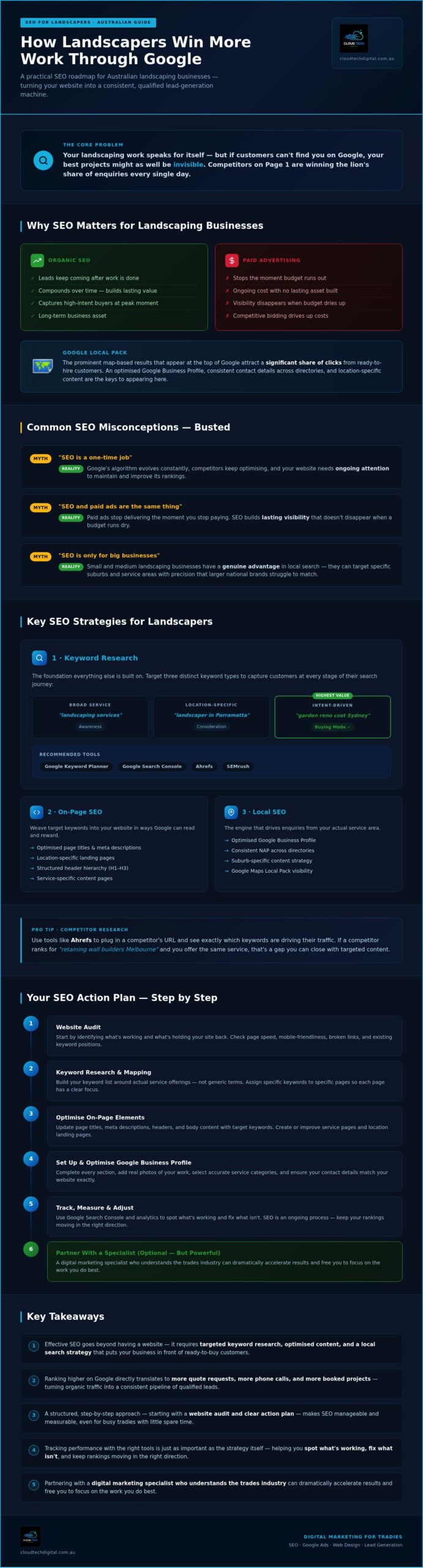
- Effective SEO for landscapers goes beyond having a website — it requires targeted keyword research, optimised content, and a local search strategy that puts your business in front of ready-to-buy customers.
- Ranking higher on Google gives landscaping businesses a genuine competitive edge, turning organic search traffic into a consistent pipeline of qualified leads without relying solely on word-of-mouth.
- A structured, step-by-step approach — starting with a website audit and building out a clear action plan — makes SEO manageable and measurable, even for busy tradies with little spare time.
- Tracking your SEO performance with the right tools is just as important as the strategy itself, allowing you to spot what’s working, fix what isn’t, and keep your rankings moving in the right direction.
- Partnering with a digital marketing specialist who understands the trades industry can dramatically accelerate your results and free you up to focus on the work you do best.
Why SEO Matters for Landscaping Businesses
Think about the last time you needed a tradie. Chances are, you opened Google and typed something like “landscaper near me” or “garden design [your suburb].” Your potential customers are doing exactly the same thing, right now, every single day. The question is whether your business shows up when they do, or whether a competitor takes that call instead.
SEO for landscapers isn’t a marketing luxury. It’s a fundamental business tool. When done right, it positions your business in front of people who are actively looking to hire, not just browsing. That’s a fundamentally different type of lead compared to someone who stumbles across a flyer or sees a Facebook ad. Search intent is powerful, and organic search captures it at its peak.
The competitive reality in Australian landscaping is stark. Most suburbs have dozens of operators competing for the same jobs, and the businesses ranking on page one of Google are consistently winning the lion’s share of enquiries. Ranking higher isn’t just about vanity; it directly translates to more quote requests, more phone calls, and more booked projects. The businesses sitting at the top didn’t get there by accident. They invested in a strategy that compounds over time.
That’s what makes SEO a genuinely smart long-term investment. Unlike paid advertising, where leads stop the moment your budget runs out, strong organic rankings keep delivering results month after month. The effort you put in today builds an asset that continues working for your business well into the future.
The Role of SEO in Attracting Local Clients
Local SEO is the engine that drives enquiries from your actual service area. When someone in your suburb searches for landscaping help, Google prioritises businesses with a strong local presence, which includes an optimised Google Business Profile, consistent contact details across directories, and location-specific content on your website. Getting these fundamentals right puts your business in the Local Pack, the prominent map-based results that appear at the top of Google searches and attract a significant share of clicks from ready-to-hire customers.
Common Misconceptions About SEO
Several myths hold landscaping businesses back from getting started. Here’s what you actually need to know:
- SEO is a one-time job. It’s not. Google’s algorithm evolves constantly, competitors keep optimising, and your website needs ongoing attention to maintain and improve its rankings.
- SEO and paid ads are the same thing. They’re not. Paid ads stop delivering the moment you stop paying. SEO builds lasting visibility that doesn’t disappear when a budget runs dry.
- SEO is only for big businesses. Small and medium landscaping businesses often have a genuine advantage in local search because they can target specific suburbs and service areas with precision that larger national brands struggle to match.
Key SEO Strategies for Landscapers
Knowing SEO matters is one thing. Actually implementing it is another. The landscapers who consistently win work through Google aren’t doing anything mystical; they’re executing a clear set of strategies with discipline and consistency. Here’s what that looks like in practice.
Conducting Keyword Research
Keyword research is the foundation everything else is built on. Get it wrong and you’ll spend months optimising for terms nobody actually searches. Get it right and your website starts attracting exactly the kind of visitors who are ready to book.
Start with free tools like Google Keyword Planner or Google Search Console, then layer in paid tools like Ahrefs or SEMrush if your budget allows. The goal is to identify three types of keywords: broad service terms (“landscaping services”), location-specific phrases (“landscaper in Parramatta”), and intent-driven searches (“garden renovation cost Sydney”). That third category is gold, because it captures people who are already in buying mode.
Don’t overlook competitor research. Tools like Ahrefs let you plug in a competitor’s URL and see exactly which keywords are driving their traffic. If a competitor is ranking for “retaining wall builders Melbourne” and you offer the same service, that’s a gap you can close with targeted content.
Build your keyword list around your actual service offerings, not generic landscaping terms. Specificity wins in local search.
On-Page SEO Techniques
Once you’ve identified your target keywords, the next step is weaving them into your website in ways Google can read and reward. On-page SEO for landscapers covers several key elements:
- Title tags and meta descriptions: Each page needs a unique title tag containing your primary keyword, ideally within the first 60 characters. Meta descriptions don’t directly influence rankings, but a well-written one improves click-through rates from search results.
- Header tags (H1, H2, H3): Structure your content with clear headers that include relevant keywords naturally. Your H1 should appear once per page and clearly describe what that page is about.
- Alt text on images: Every photo on your site should have descriptive alt text. This helps Google understand your images and improves accessibility. “Backyard-landscaping-project-Brisbane.jpg” tells Google far more than “IMG_4572.jpg”.
- Image compression: Large image files slow your site down, and page speed is a confirmed ranking factor. Compress images using tools like TinyPNG before uploading them, keeping file sizes under 150KB wherever possible.
- Internal linking: Link between related pages on your site to help Google understand your content structure and keep visitors exploring longer.
Content quality matters just as much as technical optimisation. Each service page should answer the questions your customers are actually asking: What’s included? Which suburbs do you service? What does the process look like? Thin, generic content won’t cut it in a competitive market.
If you’d rather focus on delivering great landscaping work while someone else handles the technical side, working with an SEO specialist who understands the trades industry can save you significant time and accelerate your results considerably.
Implementing Your SEO Strategy: Step-by-Step Guide
Strategy without execution is just wishful thinking. Knowing what SEO involves is useful; actually implementing it in a logical sequence is what separates landscaping businesses that climb the rankings from those that stay stuck on page three. Here’s a clear, step-by-step process that gives you a real starting point, not just a list of vague suggestions.
Website Audit Essentials
Before you optimise anything, you need an honest picture of where your website currently stands. A website audit does exactly that. It identifies what’s working, what’s broken, and where the biggest opportunities are hiding.
Start with these free and low-cost tools:
- Google Search Console: Shows which pages are indexed, which keywords you’re appearing for, and any crawl errors Google has flagged on your site.
- Google PageSpeed Insights: Measures how quickly your pages load on both desktop and mobile, with specific recommendations to fix performance issues.
- Screaming Frog SEO Spider (free up to 500 URLs): Crawls your entire site and surfaces technical problems like broken links, duplicate title tags, and missing meta descriptions.
- Ahrefs Webmaster Tools (free version): Gives you a backlink overview and highlights pages with weak or missing on-page optimisation.
During your audit, focus on four core areas: page load speed, mobile responsiveness, indexability, and on-page completeness. A slow, mobile-unfriendly site will undermine every other SEO effort you make, regardless of how good your content is.
Creating an Action Plan
Once your audit is done, you’ll likely have a list of issues ranging from urgent technical fixes to longer-term content opportunities. The key is prioritising by impact, not by what’s easiest to tick off.
A practical action plan for SEO for landscapers typically looks like this:
- Weeks 1 to 2: Fix critical technical issues identified in the audit. Broken links, missing title tags, and slow page speeds should be resolved before anything else.
- Weeks 3 to 6: Optimise existing service pages with targeted keywords, improve internal linking, and update any thin or outdated content.
- Months 2 to 3: Begin building location-specific pages if you service multiple suburbs, and start a consistent content publishing schedule.
- Ongoing: Monitor performance monthly and adjust based on what the data tells you.
Set KPIs that are specific and measurable. Useful ones for landscaping businesses include organic traffic volume, keyword ranking positions for your target service terms, and the number of enquiry form submissions or phone calls attributed to organic search. Vague goals like “rank better on Google” give you nothing to work with. Concrete targets like “rank in the top five for ‘landscaper in [suburb]’ within 90 days” give you something to chase.
Allocate time realistically. If you’re managing this yourself, block out two to three hours per week dedicated solely to SEO tasks. If that’s not feasible around running your business, it’s worth considering whether a specialist can deliver better results with your budget than a DIY approach stretched thin across too many priorities.
Monitoring and Adjusting Your SEO Efforts
Building a solid SEO foundation is just the beginning. What separates landscaping businesses that sustain strong rankings from those that plateau is a commitment to regular performance reviews and a willingness to adapt when the data says something isn’t working. Set-and-forget is not a strategy; it’s a slow slide backwards.
Google’s algorithm updates frequently, your competitors are constantly optimising, and customer search behaviour shifts over time. Without a structured monitoring routine, you won’t know whether your efforts are compounding or quietly unravelling.
SEO Tools and Analytics
You don’t need an expensive tech stack to track what matters. A handful of well-used tools will give you a clear, actionable picture of your SEO performance:
- Google Analytics 4 (GA4): Tracks where your website traffic is coming from, which pages visitors spend time on, and where they drop off. For landscapers, the most useful reports are organic traffic by landing page and goal completions tied to enquiry forms or phone call clicks.
- Google Search Console: Shows exactly which search queries are triggering your pages, your average ranking position for each keyword, and your click-through rate from search results. If a page is ranking on page two for a high-value term, that’s a clear signal to strengthen it.
- Ahrefs or SEMrush: Useful for tracking keyword ranking movements over time, monitoring your backlink profile, and keeping an eye on what competitors are doing differently. Even the entry-level paid tiers provide enough data to inform smart decisions.
Review these tools at least once a month. A quick monthly check-in takes less than an hour and gives you enough information to catch problems early before they cost you rankings.
Continuous Improvement Strategies
Effective SEO for landscapers is iterative, not linear. When the data reveals a page receiving solid impressions but few clicks, the fix is often a more compelling title tag or meta description. When traffic to a service page drops after a Google algorithm update, the response is usually improving content depth and relevance, not panicking and overhauling your entire site.
Stay informed about algorithm changes through credible sources like Google’s Search Central Blog and industry publications such as Search Engine Journal. You don’t need to act on every update, but understanding the direction Google is moving helps you make smarter decisions about your content and technical setup.
Build a simple quarterly review into your business routine. Assess which pages gained or lost rankings, identify any new keyword opportunities that have emerged in your service area, and update older content that’s become stale or thin. Small, consistent improvements compound into significant results over time.
If interpreting the data feels like a second job on top of running your landscaping business, partnering with a specialist who can turn your analytics into a clear action plan is often the most efficient path forward.
Why Choose Cloud Tech Digital for Your Landscaping SEO?
Most digital marketing agencies will take your money and send you a monthly report full of graphs that don’t translate into booked jobs. Cloud Tech Digital operates differently. We work specifically with trade businesses across Australia, which means we understand the rhythms of a landscaping operation, the seasonality, the suburb-by-suburb competition, and the type of customer who actually converts into a paying client. That industry-specific focus changes everything about how we approach SEO for landscapers.
Our work isn’t built on generic templates. Every strategy we develop starts with your specific service area, your current website performance, and the competitive landscape in your market. From there, we build a plan that targets the right keywords, fixes the technical issues holding your rankings back, and creates content that speaks directly to the customers you want to attract. Personalised, practical, and built around measurable outcomes.
Transparency sits at the centre of how we work. You’ll always know what’s being done, why it’s being done, and what result it’s driving. No black-box reporting, no vague promises about “improved visibility.” Just clear data tied to real business outcomes: enquiry volume, keyword ranking movement, and organic traffic growth.
Client Testimonials and Success Stories
The landscaping businesses we’ve worked with came to us facing a familiar problem: a website that wasn’t generating enquiries despite years of solid work and strong word-of-mouth. Through targeted local SEO strategies, optimised Google Business Profiles, and location-specific content, we’ve helped trade clients move from page three obscurity to consistent page one visibility in their core service suburbs. The downstream effect is predictable: more quote requests, more phone calls, and a pipeline that doesn’t depend entirely on referrals to stay full. Our reporting keeps clients across every step of that progress, so there’s never any guesswork about where results are coming from.
Get Started with Your SEO Journey
Getting started is straightforward. Reach out, and we’ll take a look at your current online presence, identify the biggest opportunities in your market, and walk you through exactly what a tailored SEO strategy would look like for your business. No jargon, no pressure, just a clear conversation about where you are and where you could be.
If you’re ready to turn your website into a genuine lead-generation asset, reach out to Cloud Tech Digital today and take the first step toward owning your local search rankings.
Build a Sustainable Pipeline for Your Landscaping Business
Dominating the local search results isn’t about luck; it’s about a disciplined strategy that puts your expertise in front of the right homeowners. You’ve seen how a structured audit and consistent on-page optimisation can transform your website from a static brochure into a lead-generating asset. SEO for landscapers is the most reliable way to secure your business’s future and reduce your reliance on expensive, short-term advertising.
Success in 2026 requires more than just being online. It demands a partner who understands the unique challenges of the Australian trades industry. At Cloud Tech Digital, we offer specialised expertise in trade businesses and have a proven track record of increasing online visibility through tailored strategies built for measurable success. We don’t just chase rankings; we chase the high-quality leads that help your business grow.
Don’t let your competitors take the best jobs in your suburb while your site stays hidden. Contact Cloud Tech Digital to boost your landscaping business with expert SEO strategies! It’s time to get your business the visibility it deserves and start filling your calendar with the projects you actually want to do.
Frequently Asked Questions
What is SEO and why is it important for landscapers?
Search Engine Optimisation (SEO) is the practice of improving your website so it ranks higher on Google for relevant searches. It’s essential for landscapers because organic search is a primary source of high-intent leads. When you rank well, you capture customers at the exact moment they’re looking for garden design or construction services, giving you a massive advantage over competitors who rely solely on word-of-mouth.
How long does it take to see results from SEO efforts?
Most landscaping businesses start seeing significant ranking improvements and traffic growth within three to six months of starting a campaign. SEO is a compounding investment rather than an instant switch. While technical fixes might provide a small initial bump, the real results come from building authority over time through consistent content updates and quality link building for competitive terms like SEO for landscapers.
What are the key components of an effective SEO strategy for landscaping businesses?
An effective strategy for landscaping businesses focuses on three pillars: technical performance, content relevance, and local authority. This means having a fast-loading website that works perfectly on mobile, creating detailed service pages that target specific keywords, and maintaining an active Google Business Profile. Combining these elements creates a site that both Google and your potential customers trust.
Should I do SEO myself or hire a professional?
While you can manage basic tasks like updating your Google Business Profile, hiring a professional is usually more efficient for long-term growth. SEO for landscapers requires technical knowledge and a significant time commitment that most business owners can’t spare. A specialist ensures your strategy stays on track while you focus on delivering high-quality projects for your clients.
How can local SEO benefit my landscaping business?
Local SEO puts your business in front of homeowners in your specific service suburbs. By optimising for local search terms and the Google Maps “Local Pack,” you attract enquiries from people who are physically close to your business. This reduces travel time for quotes and increases the likelihood of winning the job since you’re already a recognised local operator.
What common mistakes should landscapers avoid when implementing SEO?
Common mistakes include ignoring mobile optimisation, using generic content that doesn’t showcase your actual work, and failing to track your results. Many landscapers also make the mistake of “keyword stuffing,” which is forcing too many keywords into a page in a way that feels unnatural. Google penalises this behaviour, so it’s better to write for humans first and search engines second.
How do I track the success of my SEO campaigns?
You can track success by monitoring organic traffic, keyword rankings, and conversion rates through Google Analytics 4. Don’t just look at how many people visit your site; focus on how many of those visitors actually fill out a quote form or click your phone number. These “hard” conversions are the only metrics that truly reflect the impact of your SEO efforts on your bottom line.
